How Much Does It Cost to Build a Food Delivery App Like DoorDash?
A food delivery app like DoorDash typically costs $150,000 to $300,000+ in the USA for a full four-panel platform, though a lean MVP can start around $20,000 to $40,000.

LoudOwls
·8 min read
Key Takeaways
● A food delivery app like DoorDash typically costs $150,000 to $300,000+ in the USA for a full four-panel platform, though a lean MVP can start around $20,000 to $40,000.
● The number of user panels drives cost more than any single feature. A real DoorDash-style platform needs four synchronized apps: customer, restaurant, driver, and admin.
● Real-time logistics is the hardest and most expensive part to get right, not the ordering flow itself. Dispatch, live tracking, and payment settlement all have to happen in seconds.
● Choosing between a custom build and a white-label food delivery app development services provider is the single biggest early decision, and it can shift your budget by 5x or more.
● A meaningful share of the true cost only appears after launch, through driver payout infrastructure, mapping API fees, and compliance work.
"Can we actually build something like DoorDash?" It's a fair question, and the honest answer is yes, but the number depends on how much of DoorDash you're trying to replicate. A single-restaurant ordering app and a multi-vendor marketplace with live driver dispatch both get called "food delivery apps," and they belong in completely different budget conversations.
Revenue in the online food delivery market is projected to reach US$473.49bn by the end of 2026. Revenue is expected to show an annual growth rate (CAGR 2026-2031) of 6.83%, resulting in a projected market volume of US$658.83bn by 2031.
Here's what actually drives the cost of a food delivery app like DoorDash this year: what shapes a real quote, how the number shifts by platform and feature depth, what the development process looks like stage by stage, and where the expenses nobody mentions upfront tend to hide.
What Is the Average Cost to Build a Food Delivery App Like DoorDash?
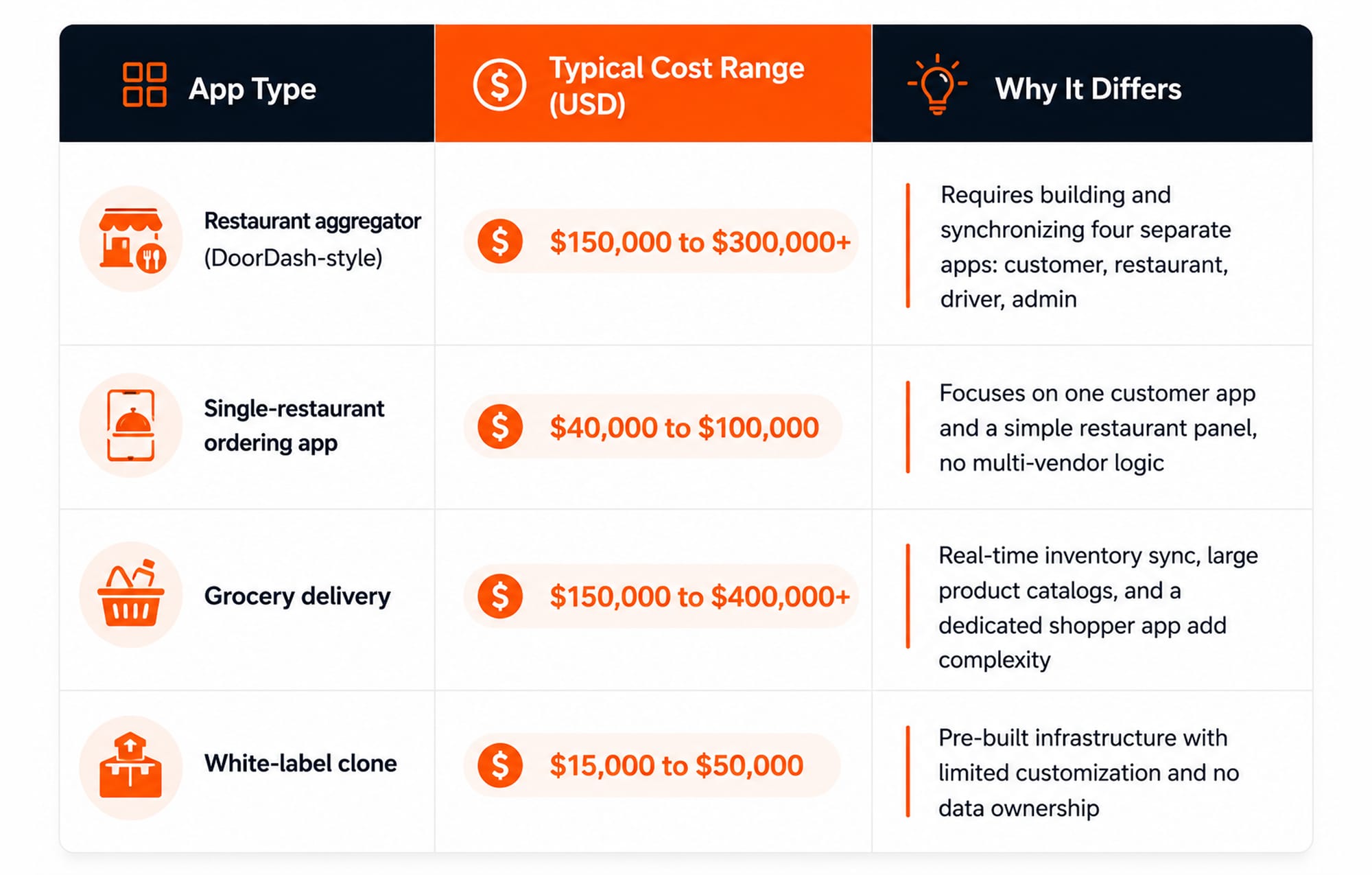
Most businesses aiming to build a food delivery app with real DoorDash-level functionality land somewhere between $150,000 and $300,000 in 2026. That range assumes a genuine three-sided marketplace: customers, restaurants, and delivery drivers, all coordinated through live dispatch.
A simpler ordering app for a single restaurant chain costs far less. The tiers below reflect what businesses are actually paying this year, sorted by scope.
● White-label MVP: $15,000 to $50,000, a pre-built platform customised with your branding, faster to launch but limited in customisation and data ownership
● Basic custom app: $20,000 to $60,000, single-city, core ordering and payment flow, minimal driver tooling
● Mid-range platform: $50,000 to $150,000, custom design, real-time tracking, multiple user roles, payment integrations
● DoorDash-equivalent platform: $150,000 to $300,000+, full four-panel architecture, live dispatch, AI-powered recommendations, multi-city support
● Enterprise-scale platform: $300,000 and up, multi-market operations, advanced analytics, and heavy compliance overhead
A food delivery app isn't one product. It's four connected applications working together, and each one adds its own scope to the total.

What Determines the Cost of Food Delivery App Development?
The cost of food delivery app development in the US market is almost never one variable doing all the work. It's the number of user panels, the depth of real-time logistics, and the platform's ability to handle three-sided coordination, all pulling in the same direction.
● Number of user panels: a true DoorDash-style build needs four synchronised apps. Each panel adds its own screens, its own testing cycle, and its own maintenance burden.
● Real-time dispatch and tracking: live driver location, order status updates, and route optimisation are demanding to build reliably at scale, and that's what separates a real platform from a simple ordering form.
● Payment infrastructure: in-app payments, driver payouts, restaurant settlements, and split transactions each carry their own setup time and compliance requirements.
● Third-party integrations: mapping APIs, SMS or push notification providers, payment gateways, and analytics platforms each add licensing costs and ongoing maintenance.
● AI-powered features: demand prediction, personalised restaurant recommendations, and multi-order batching are increasingly expected in 2026, not optional add-ons.
● Compliance requirements: PCI DSS for payments, ADA accessibility, and gig worker classification rules all add documentation and review time that a simple app skips entirely.
● Build approach: whether you go custom, white-label, or hybrid changes both the price and how much control you keep over your own data and roadmap.
● Team location: rates vary meaningfully depending on where your development team is based, and that's often the single biggest lever in the entire budget.
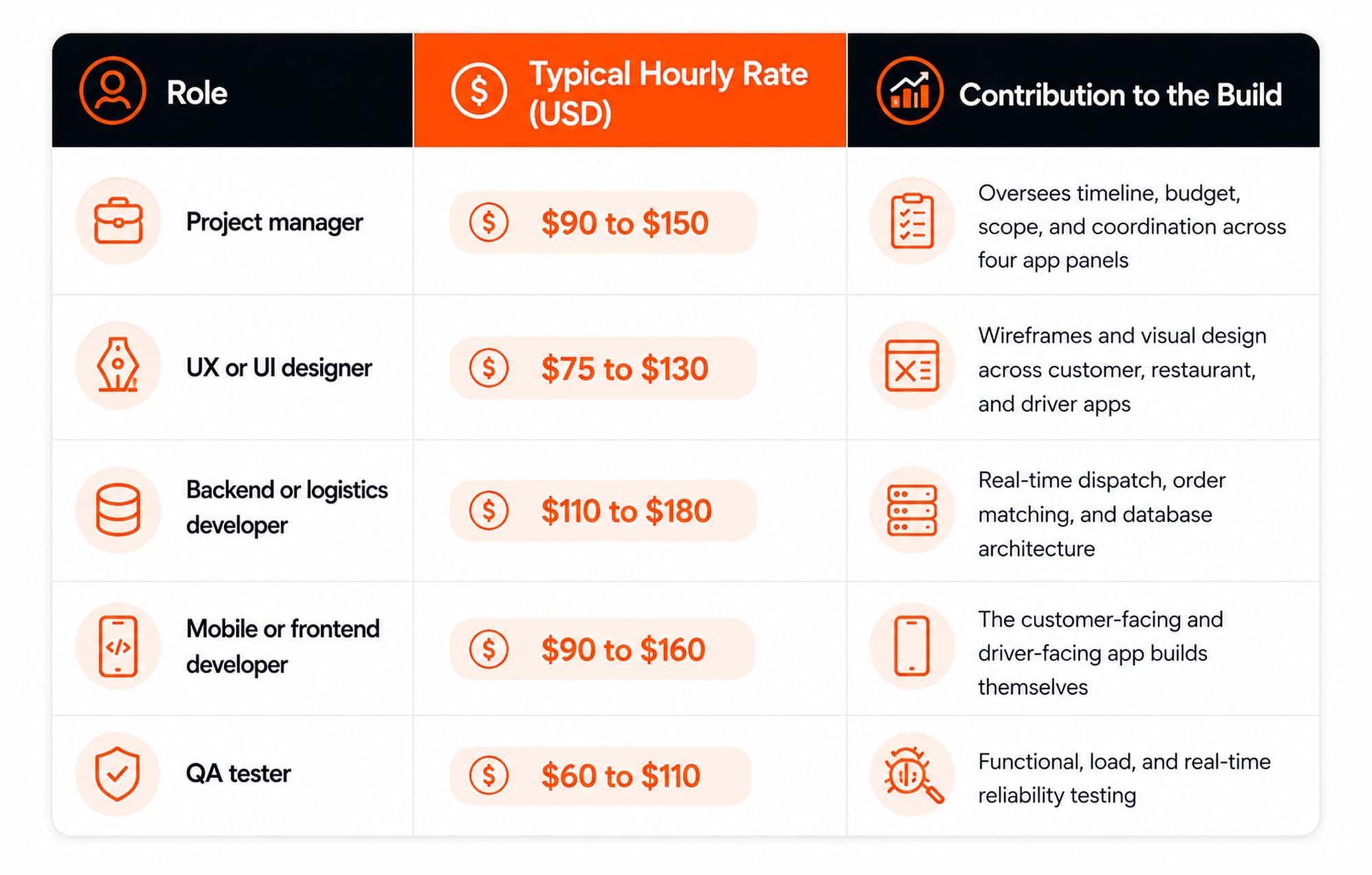
Team composition alone can shift a quote substantially. A lean team building a basic ordering flow and a full team building live dispatch logic produce very different invoices, even when both are called "food delivery apps."
Where the team sits matters almost as much as who is on it. Coastal tech hubs carry a premium, while other U.S. markets and hybrid offshore models offer comparable quality at a noticeably lower rate.
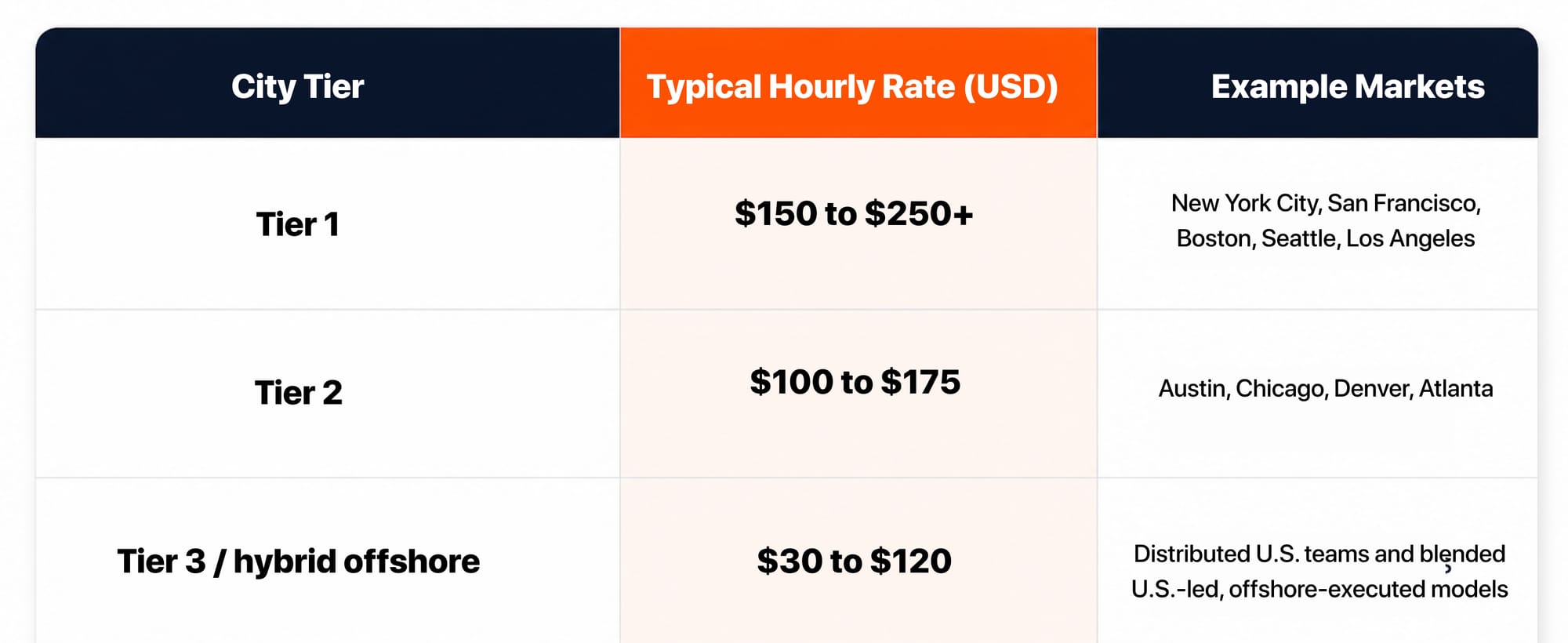
These are general U.S. software development rates, not food-delivery-specific figures. City-level rates don't typically change based on app category, so this should transfer reasonably well, though it wasn't independently verified for this vertical.

How Does Food Delivery App Development Cost Vary by Platform?
Platform choice affects food delivery app cost less than the feature set does, but it's still a real lever. Building native apps for iOS and Android separately roughly doubles the frontend engineering hours compared to a single cross-platform codebase. No reliable source was found breaking down food-delivery-specific cost by platform this year, so no invented numbers are presented here: the general rule holds that cross-platform frameworks like Flutter or React Native typically cut frontend cost compared to building two separate native apps, but the exact percentage varies too much by team and scope to state as a fixed figure.
Complexity moves the number just as much as the platform does. A single-city ordering app and a multi-city marketplace with AI dispatch are not remotely the same project, per timeline benchmarks from Space-O Technologies and Space-O's services page.
● Basic apps: 3 to 4 months of build time
● Mid-range platforms: 5 to 7 months of build time
● DoorDash-equivalent platforms: 8 to 12 months, often needing a phased rollout across panels to stay on schedule
Knowing where the budget goes, phase by phase, makes it easier to spot a quote that's missing something.
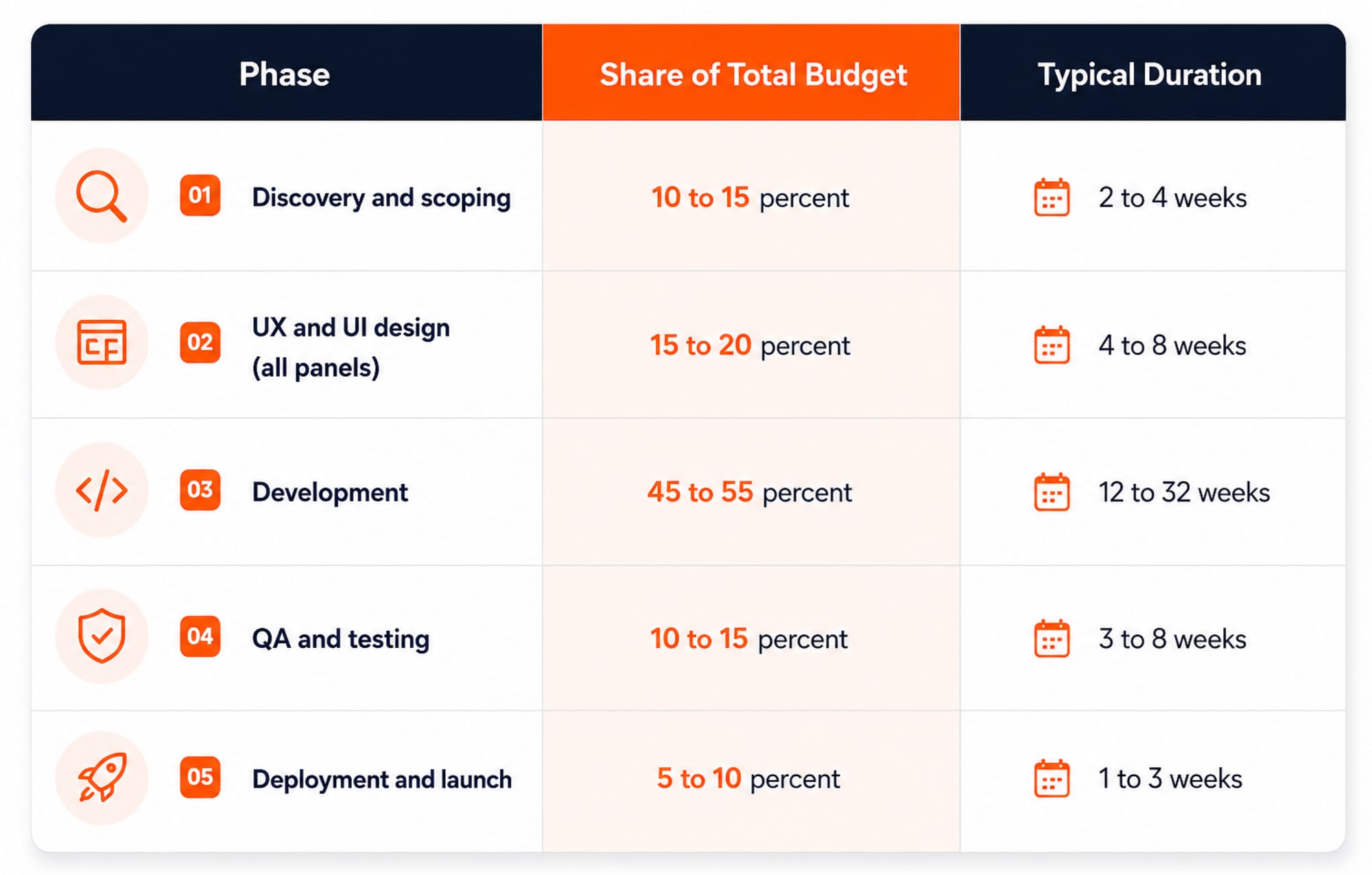
These percentages reflect a general software development lifecycle benchmark, not a figure found specifically for food-delivery platforms. Treat the split as a starting point for planning, not a verified statistic.
What Does Food Delivery App Development Look Like Step by Step?
A disciplined process is the difference between a platform that holds up at scale and one that falls apart the first time order volume spikes.
1. Discovery and scoping. The team maps business goals, defines which of the four panels are needed for launch, and locks down the commission and payout model before any design work starts.
2. UX and UI design. Wireframes and prototypes get built for the customer app first, then the restaurant panel and driver app, since each has a genuinely different user and a different job to do.
3. Backend and real-time infrastructure. This is where dispatch logic, order matching, live tracking, and payment settlement get built. It's the most technically demanding phase and the one most likely to eat extra budget if scoped loosely.
4. Development sprints. Frontend and backend work proceed in parallel, usually in two-week sprints with regular demos across all four panels.
5. QA and load testing. Functional testing matters, but so does load testing: simulating real order volume, driver availability, and peak-hour spikes before launch, not after.
6. Deployment and launch. App Store and Google Play submission for both customer and driver apps, restaurant onboarding tooling, and monitoring setup happen in the final weeks before go-live.
Working with an experienced food delivery app development services partner keeps this process from turning into a sequence of expensive surprises.
Hidden Costs That Affect Food Delivery App Development Cost
The quoted development cost rarely matches what you actually pay. A real share of any food delivery platform's budget gets eaten by expenses that only show up once the build is finished.
● Mapping and geolocation API fees, which scale with order volume and can become a significant recurring line item
● Payment processing fees on every transaction, plus driver payout infrastructure
● SMS and push notification costs for order updates, which add up fast at scale
● Ongoing dispatch algorithm tuning as order density and driver supply change city by city
● PCI DSS compliance, ADA accessibility review, and gig worker classification requirements
● Restaurant and driver onboarding tooling and support
● Customer support tooling once real users start reporting real problems
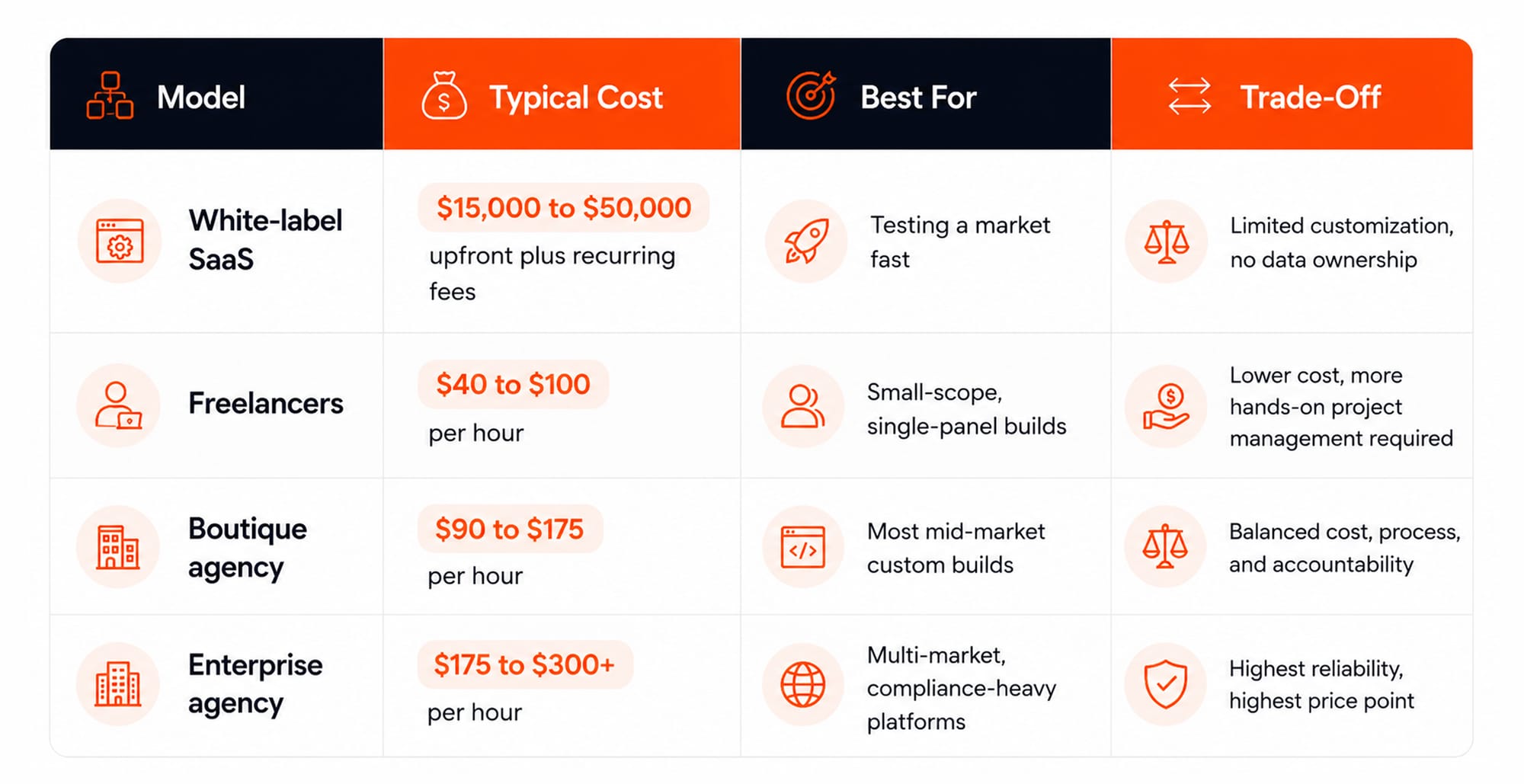
How a business staffs the build also shapes what it's exposed to down the line.

Conclusion
Building a food delivery app like DoorDash in 2026 is as much a strategic call as a financial one. The businesses that actually get traction rarely chase the cheapest quote in the room. They scope the real architecture upfront, price the whole lifecycle instead of just the build, and pick a development partner who treats the dispatch logic with the same seriousness as the app's UI.
LoudOwls has spent years walking businesses across the USA through exactly this decision, serving clients building on-demand platforms across North America. We start every engagement with a real scope and an honest number, not a placeholder quote designed to win the deal and balloon later. If you're serious about entering the food delivery space and want a partner who treats your budget with the same care as your product, we'd be glad to talk it through.
FAQs
1. What is the average cost to build a food delivery app like DoorDash?
A full four-panel platform with live dispatch typically costs $150,000 to $300,000+ in the USA. A leaner single-city MVP can start around $20,000 to $40,000, though it won't have DoorDash's full marketplace functionality.
2. How much does it cost to build an app with all four panels: customer, restaurant, driver, and admin?
Expect $85,000 to $205,000 for a mid-range build across all four panels, and $150,000 to $300,000+ for a full-featured version with AI recommendations and multi-city support. This figure is corroborated by three independent agency sources, not just one.
3. Should I build a custom app or use food delivery app development services with a white-label option?
White-label makes sense if you need to validate a market fast on a $15,000 to $50,000 budget. Custom development makes sense once you need proprietary dispatch logic, full data ownership, or a business model that doesn't fit an off-the-shelf platform.
4. What features increase food delivery app development cost the most?
Real-time GPS tracking, multi-vendor support, AI-powered recommendations, and a fully built driver app are the four biggest cost drivers beyond basic ordering functionality.
5. How long does it take to build a food delivery app like DoorDash?
A basic app takes 3 to 4 months. A mid-range platform takes 5 to 7 months. A full DoorDash-equivalent platform with all four panels typically takes 8 to 12 months.