How to Choose the Right Mobile App Development Company in Dubai
Dubai has plenty of app companies; finding a good one is the real challenge. The market is flooded with agencies, studios, and repackaged freelancers, all with portfolios and five-star reviews.

LoudOwls
·9 min read
QUICK SUMMARY-
1. Dubai has plenty of app companies; finding a good one is the real challenge. The market is flooded with agencies, studios, and repackaged freelancers, all with portfolios and five-star reviews. Most businesses still end up with products that underdeliver because they're evaluating the wrong things from the start.
2. The mistakes that sink projects happen before the contract is signed. Chasing the lowest quote, taking portfolios at face value, skipping the post-launch conversation, these aren't rookie errors; they're just what happens when the evaluation is built around comfort rather than honesty.
3. The right questions separate real partners from good salespeople. Who actually builds the work? Can they explain a technical decision without jargon? Is the proposal specific to your product or copied and pasted with your name on it? The answers tell you more than any pitch deck will.
4. There's a baseline every serious agency should meet, no exceptions. A single accountable project owner, design rooted in real user behaviour, security baked in from day one, independent QA, and post-launch terms that are actually written down. If any of these are fuzzy before you sign, they won't get clearer after.
Dubai Has No Shortage of App Companies. Good Ones Are Another Story.
If you've spent any time searching for a mobile app development company in Dubai, you already know the paradox. There are hundreds of options – agencies, studios, offshore teams operating through a local front, freelancers packaging themselves as companies. Everyone has a portfolio. Everyone has five-star reviews somewhere.
And yet businesses keep ending up with products that don't work, partnerships that fall apart mid-project, and apps that look decent in a demo but can't handle a thousand real users.
The problem isn't the market. Dubai's tech scene is genuinely strong. The problem is that the selection process most businesses use was never built to find quality; it was built to find whoever responds fastest and quotes lowest.
This blog is for businesses that want to make better decisions than that.
The Biggest Mistakes Businesses Make When Choosing App Developers in Dubai
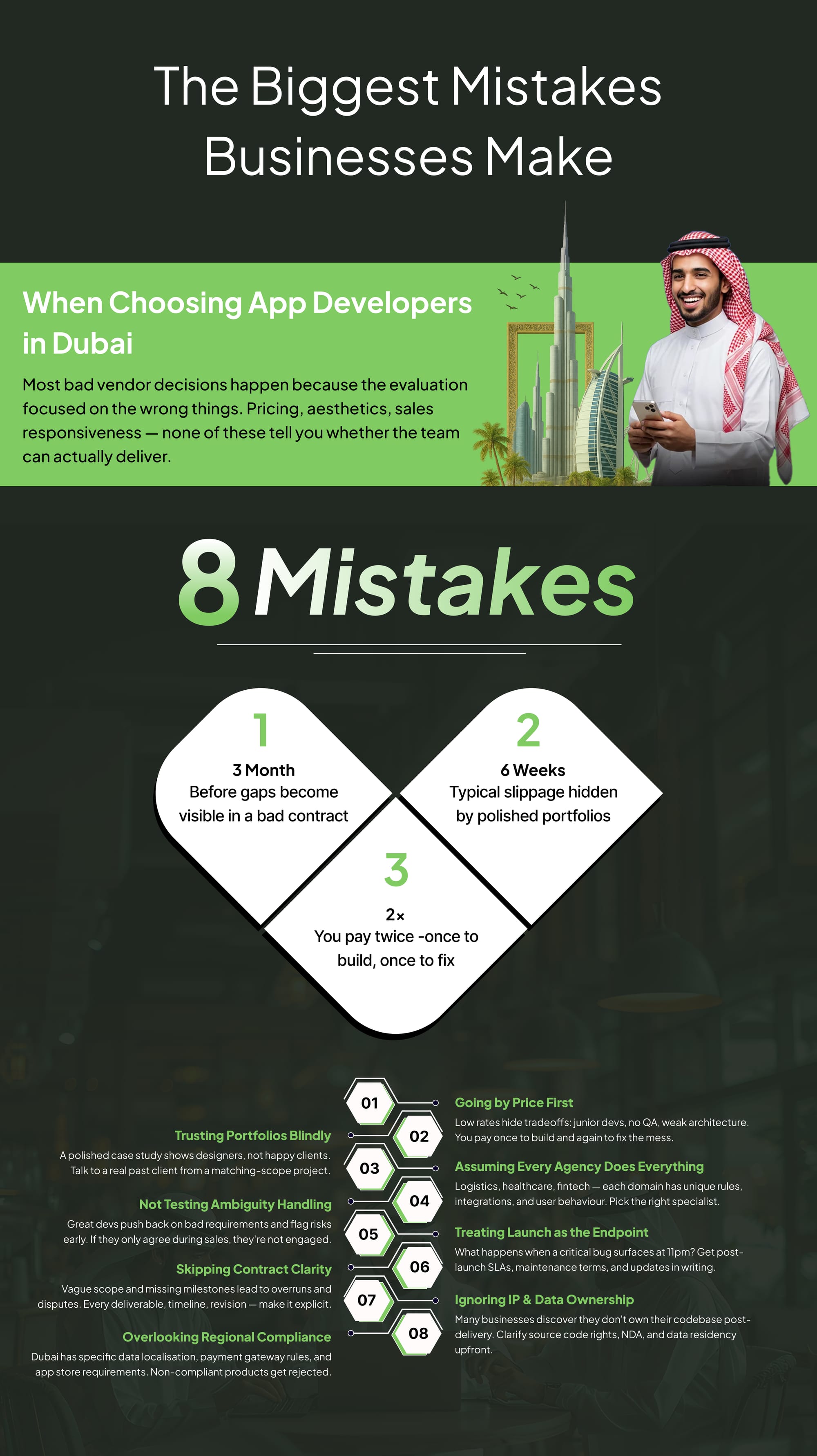
Most bad vendor decisions do not happen because businesses were careless. They happen because the evaluation was focused on the wrong things entirely. Pricing, aesthetics, and responsiveness during the sales process: none of these tells you whether a team can actually deliver. By the time the gaps become visible, you are already three months into a contract. These are the patterns that show up most often, and understanding them before you start shortlisting will save you considerably more than time.
Going by price first
The average app developers Dubai has to offer will still cost you more in the end. Not because affordable development is impossible, it's not, but because low rates usually come with tradeoffs that only become visible once you're three months deep. Junior developers without senior oversight. No real QA process. Architecture that works for version one but becomes a problem when you try to scale. You end up paying twice: once to build it, once to fix it.
Trusting portfolios without asking the harder questions
A polished case study tells you a company has good designers. It doesn't tell you whether the client was happy, whether the app actually performed under load, or whether delivery ran six weeks over schedule. Before you shortlist any mobile app development company in Dubai, ask to speak directly with a past client, not a reference they've prepped, but a real contact from a project that matches your scope. What you hear in that conversation will be more useful than anything on their website.
Assuming every agency does everything equally well
An app company in Dubai that's built five logistics platforms is different from one that's spent three years in healthcare or fintech. The regulatory requirements are different. The integration complexity is different. The way users behave in those products is different. Hiring a team that's great at consumer apps to build an enterprise B2B product, or vice versa, creates friction that no amount of good project management fully absorbs.
Not testing how they handle ambiguity.
Good mobile app developers, Dubai businesses rely on, don't just execute a spec. They push back on requirements that don't make sense, ask questions that reveal gaps you hadn't spotted, and tell you when a decision you're about to make is going to create a problem later. If a company only ever agrees with you in the sales process, that's not a sign of alignment. It's a sign they're not engaging seriously.
Treating launch as the endpoint
What happens the day after the app goes live? What happens when a critical bug surfaces at 11 p.m. on a Thursday? Many businesses only think about this after it becomes a problem. Before you hire app developers in Dubai, get the post-launch support terms in writing, response SLAs, what's included in maintenance, and how updates are handled. A company that can't answer these questions clearly before you sign probably doesn't have good answers after.
5 Criteria to Evaluate a Mobile Application Development Company in Dubai
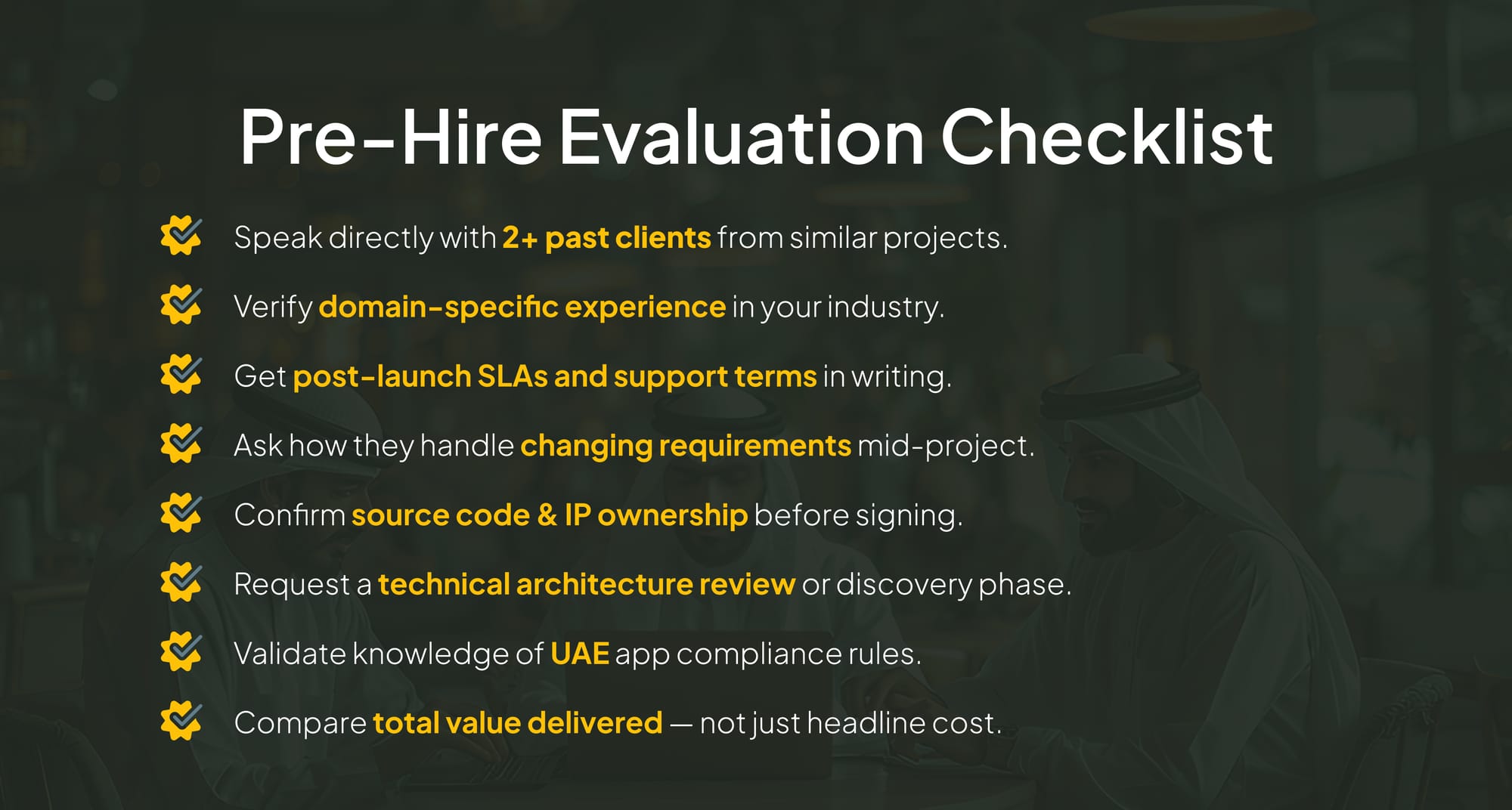
Shortlisting is the part most businesses rush. You have seen the pitch, reviewed the portfolio, and had a call that went well. It feels like enough. It rarely is. The criteria that actually predict how a project will go are not the ones that show up in a first meeting. They emerge when you press deeper, ask specific questions, and pay attention to how a team responds when the conversation gets less comfortable. These five areas are where the real evaluation happens.
Do they explain their technical decisions?
You shouldn't need an engineering background to understand why a team is recommending React Native over Flutter, or native over cross-platform. A strong app development company in Dubai can explain that reasoning in business terms, what it means for performance, cost, timeline, and what you give up either way. Teams that can't do this usually don't fully understand the decision themselves.
Who is actually doing the work?
This matters more than it gets asked. Some agencies have a strong leadership team and offshore or subcontracted developers handling the actual build. That's not necessarily a dealbreaker, but you deserve to know. Ask directly. Where are the developers based? Are they employees or contractors? Who owns quality control? You want accountability to live somewhere specific, not be distributed across a chain of handoffs.
What do the references say when you go off-script?
Ask a past client: "What would you have wanted to know before you started working with them?" That question tends to get honest answers. Any mobile app developer Dubai team worth hiring should be able to give you references who'll give you an unfiltered account, timeline slippage, how they handled a difficult moment, and whether they'd do it again.
Is the proposal specific to your project?
Generic proposals are a red flag. If a mobile app development company in Dubai sends you a scope document that could have been written for anyone, they haven't thought carefully about your product. A thoughtful proposal shows they listened, identifies the genuine risks in your project, and makes decisions, rather than leaving everything open as a hedge.
Do they think about what comes after launch?
The best teams are already thinking about your roadmap while building version one. They make architectural choices that don't box you in, and they ask about where you want to be in eighteen months. That kind of forward thinking doesn't happen by accident; it comes from teams that have seen what happens when it's ignored.

Essential Features Every Professional Mobile App Development Company Should Offer
There is a baseline of capability that any serious mobile application development company in Dubai should be able to demonstrate without being prompted. These are not differentiators. They are on the floor. If a company you are evaluating cannot clearly show how they handle any of the following, that is useful information to have before you sign anything.
One person owns your project
Not a department. One person who knows your timeline, flags problems before they compound, and answers your calls. This sounds obvious. It isn't always how agencies operate. If the onboarding process doesn't make clear who your single point of contact is and what authority that person actually has, ask before you sign.
Design grounded in how real users think
The mobile apps Dubai markets reward are not the ones with the most features or the most visual flair. They're the ones that are easier to use than the alternative. That comes from actual user research, understanding what people need, where they get stuck, and what makes them come back. If a company's design process starts at Figma without passing through user understanding first, the product will show it.
Security that's built in, not bolted on
UAE data regulations are tightening. Any credible app company in Dubai should be building with security in mind from the first sprint, including authentication standards, encrypted data handling, secure APIs, and penetration testing before go-live. Not as a premium tier. As a baseline.
QA that's independent from the development team
Developers testing their own code is not a QA process. A professional team maintains dedicated QA, runs structured test cases across real devices and OS versions, and has sign-off criteria that determine when, and only when, something is ready to ship. This is one of the areas most visible in the final product when it's done poorly.
Integration capability at the enterprise level
Most business apps don't stand alone. They need to connect with payment systems, CRMs, internal platforms, and third-party APIs. Doing this cleanly, with proper error handling, security at every connection point, and data that flows predictably, requires experience that not every team has. Ask for specific examples of integration work similar to what your project requires.
Communication that doesn't require chasing
Progress updates, sprint reviews, and release notes, these should arrive without you having to ask for them. If a company's communication structure puts the burden of follow-up on the client, that dynamic doesn't improve once the project is underway. It gets worse.
Post-launch terms that are actually documented
What's covered after launch, for how long, at what response time, and at what cost? These questions have specific answers when a team takes post-launch seriously. Vague assurances are not the same thing.
Ready to Hire a Mobile Application Development Company in Dubai? Book a Call with LoudOwls
Finding the right development partner takes longer than most businesses expect. You have conversations that go well in the pitch and badly in the project. You see portfolios that impress until you find out the team that built those projects isn't the one you'd be working with. You get proposals that look thorough until you realise they're the same proposal with your company name swapped in.
LoudOwls works differently, not as a positioning statement, but as something clients notice in the first conversation. The team asks questions before they make recommendations. They tell you what your budget realistically builds rather than promising everything and adjusting later. And they're still reachable six months after launch, which turns out to matter more than most businesses expect when they start.
As a mobile application development company, Dubai clients have often come back to LoudOwls with their second and third products. LoudOwls has built across fintech, retail, logistics, and enterprise SaaS. The work ranges from early-stage MVPs to complex platforms with integrations that took months to architect properly. What stays consistent across all of it is how the team works: transparently, methodically, and with a clear sense of what a successful outcome actually means for the client.
If you're serious about finding the right team to hire app developers in Dubai, the next step is a conversation. Come with a rough brief or come with just your questions. Either way, you'll leave with a clearer picture of what your project actually requires.
FAQs
- What budget should I expect for mobile app development in Dubai?
It depends heavily on scope, but the cheapest quote is rarely the cheapest outcome. Low rates usually mean shortcuts somewhere in QA, architecture, or senior oversight, which cost more to fix later. Get clarity on what's actually included before you compare numbers.
- Does it matter if the development team is local or offshore?
It matters more than most businesses expect. Local teams understand UAE regulations, communicate in your timezone, and are easier to hold accountable. If an agency has a Dubai office but builds offshore, ask who owns quality control and get a real answer, not a reassurance.
- How long does building an app in Dubai realistically take?
A focused MVP usually takes three to six months. Anyone giving you a firm timeline before they understand your project in detail is guessing or telling you what you want to hear.
- What should a good proposal from an app development company actually look like?
It should reflect your conversations, name the actual risks in your project, and make real decisions rather than leaving everything open. If it reads like it could have been sent to anyone, it probably was.
- What should I know about post-launch support before signing anything?
Get it in writing- response times, what maintenance covers, how bugs are handled, and what costs come after go-live. Teams that take this seriously have clear answers ready. Vague promises at this stage don't improve once the project starts.