social commerce app
How to Build a Social Commerce App: Features, Costs and Development
Quick Summary * A social commerce app blends product discovery, social interac

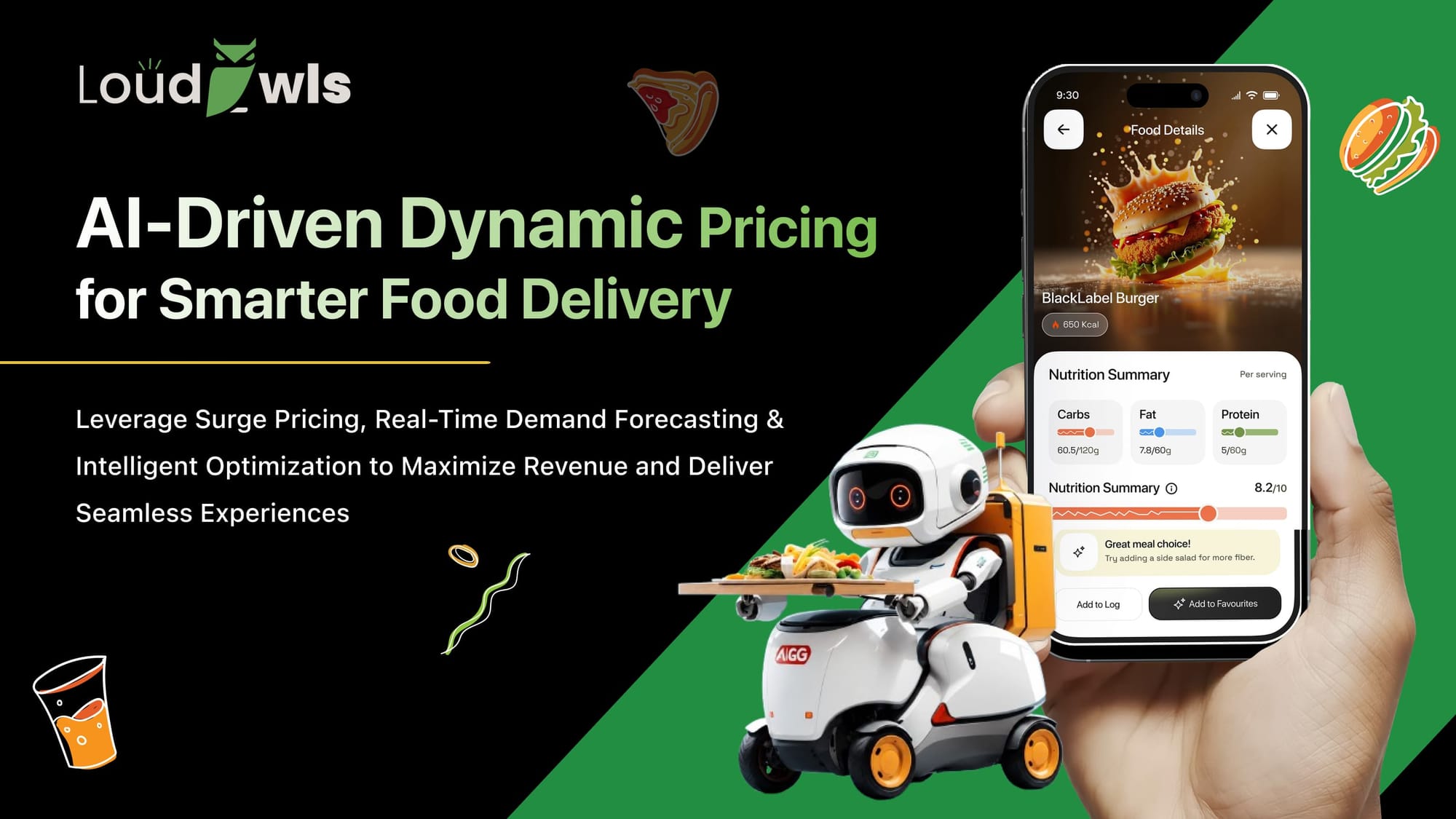

Food delivery platforms have evolved far beyond simple ordering systems. Today, dynamic pricing has become a core component of modern delivery ecosystems, allowing businesses to respond instantly to changing market conditions.
The environments in which platforms operate today have the potential to cause demand to skyrocket in just a few minutes an hour lunchtime rush, late-night snack, change in weather, or a major event can all create a situation with surging demand in a few minutes. Such volatility cannot possibly be accommodated using static pricing. This is the place where dynamic pricing in AI in food delivery is very important.
Dynamic pricing enables platforms to:
It is no longer an option, it is a competitive need.
dynamic pricing

Dynamic pricing is a pricing concept where prices are changed dynamically in real time based on a wide range of internal and external elements. In contrast to the traditional models of pricing, the latter is constant, dynamic pricing is fluid and data-driven.
In its simplest form, dynamic pricing tries to identify the best possible price-point, one that will maximize the revenue earned by the company, and one that will not drive users away by making the cost too high.
Dynamic pricing models take into account several variables at a time:
These inputs are combined to create AI systems that identify the most efficient price in real time.
One of the most apparent types of dynamic pricing is surge pricing. It is a situation that arises when prices rise as a result of an abrupt surge in demand or a decline in supply.
Surge pricing normally occurs when:
In cases where demand is greater than supply, the system may raise the costs of delivery or add surge multipliers. This helps to:
Suppose that on a Friday night, there are thousands of users placing their orders at the same time. In case of the insufficient delivery riders, the delays would rise to a considerable extent. Surge pricing assists to balance this imbalance through a slight upsurge in prices and a more smooth operation.
The change in price in AI in food delivery applications tends to leave users puzzled, yet is not accidental. These developments are influenced by advanced, AI-enhanced dynamic pricing systems that are capable of balancing demand, supply and operational efficiency in real time.
This is the most sensitive aspect that determines price variations. When many users make orders at once and there are not so many delivery partners or restaurants, then the prices naturally rise. On the contrary, when the demand is low, platforms can lower their fees to attract more orders.
The lunch and dinner times are always characterized by high number of orders. During these peak windows, the delivery platforms will adjust their prices to manage the increased load, to ensure timely deliveries, and to encourage more delivery partners to work.
Unfavourable weather conditions like rain, excessive heat or cold are very detrimental to the operations of delivery. There are less delivery partners who would be happy to work under such conditions, which decreases supply. To offset, platforms reduce delivery charges or implement surge pricing.
There were some such destinations as the business districts, densely populated residential areas or even popular urban hotspots, which were more likely to generate a consistently high demand. The order volume and complexity of delivery usually occur more often in these zones because of the dynamic pricing.
The food delivery apps of today are becoming more and more personal in terms of pricing. Depending on the user behavior, like how often they place orders, what cuisines and what they prefer, how responsive they are to discounts, etc., apps can offer varying delivery prices, offers, or promotions to various users.
Dynamic pricing can be enabled by the state-of-the-art artificial intelligence tools that can process large volumes of data in real time. These systems provide that the pricing is competitive and that the operational efficiency and profitability are maintained.
Predictive models are based on past patterns, seasonal patterns and user patterns to predict future demand. This enables platforms to predict order spikes and proactively adjust pricing instead of being reactive.
The models of machine learning (regression analysis, gradient boosting, neural networks) handle numerous variables at once. These are time of the day, weather conditions, traffic patterns, overflow at restaurants and the availability of delivery partners to establish optimal pricing.
Reinforcement learning allows the pricing systems to constantly develop. The algorithm takes into account previous results, including the rate of completing orders, customer turnover, and long-term income, and adjusts its pricing policies to achieve maximum efficiency, customer retention and profitability over time.
The AI-based pricing systems work based on a highly structured real-time pipeline that is constantly analyzing, predicting demand and adjusting prices within a few seconds. The aim is quite straightforward: to balance the demand and supply as well as to optimize efficiency and user satisfaction.
Constant data ingestion is at the heart of dynamic pricing. The real-time inputs of AI systems consist of multiple sources, such as:
It is this live data that is the basis of all pricing decisions.
Based on both historical trends and real-time indicators, AI models forecast short-term demand changes. They are very granular (sometimes down to individual restaurants) and enable platforms to predict surges in advance.
After the prediction of demand, the pricing algorithms determine the most efficient price point, based on:
The system will be designed to create a balance such that it is high enough to handle demand and incentivize supply, but not so high that it would cause conversions to fall.
Dynamic pricing systems do not remain in the same manner- they change. AI is continually improving its decisions through analyses of:
This feedback allows the system to get smarter and more on point over time.
The classical pricing theories are based on constant prices irrespective of the external factors. Although they are easy to implement and easy to understand by the users, they are not adaptive to changes in demand and supply, and tend to create inefficiencies during peak periods.
Dynamic pricing, however, is real time and data-driven pricing. It guarantees the efficient use of resources, an increase in the efficiency of delivery, and the full utilization of revenue. This model has become the industry standard in fast-paced ecosystem of delivery in the modern world.
Dynamic pricing is quickly becoming hyper-personalized pricing where each user can be shown slightly different prices on the basis of his or her behavior and preferences.
AI analyzes multiple user-specific factors, such as:
On the basis of these insights, platforms can customize the experience with:
This degree of self-personalization increases the engagement, loyalty and user satisfaction significantly.
Dynamic pricing helps in improving the profitability since the prices are adjusted to the actual demand in real-time. It is also effective in enhancing the efficiency of its operations and in ensuring that there is a better allocation of delivery resources.
Peak hour surge pricing would translate into increased earning opportunities. It also persuades more partners to remain active when there is high demand.
Although prices can vary, customers enjoy the advantages of faster delivery, high level of service reliability, and availability during peak seasons.

Unless communicated in an open manner, the changing prices may be perceived as unjust or arbitrary by the users, which may affect the trust.
Some areas are restricting the use of surge pricing and companies must develop pricing models to comply with the restrictions.
To develop a strong AI-driven pricing system, it will need to be supported by advanced infrastructure, scalable computing power and sophisticated algorithms.
The validity of pricing decisions will be wholly dependent on the quality and timeliness of information. Inaccurate pricing and missed revenue are some of the effects of poor data.
Designing a scalable and efficient pricing engine is a mix of strategy, data engineering, and AI expertise:
Make clear whether you are interested in revenue maximization, increasing the number of users, retention, or a combination of the above.
Create systems that can collect, process and store real-time information that is received by a variety of sources.
Demand patterns Can be predicted with high accuracy using machine learning models.
Develop algorithms capable of dynamically changing the pricing in response to demand, supply and user behavior.
Take advantage of cloud-based architecture to provide instant decision making and scaling.
Test and test pricing (A/B testing) and optimize models based on performance.
An effective dynamic pricing system must consist of:
Explain the reason behind price changes in a clear and understandable manner to gain trust and eliminate frustration of users.
Prevent drastic surges by setting limits of upper and lower limits to ensure that user experience is not compromised.
Implement hand controls when there are extraordinary conditions or delicate circumstances.
Strike a balance between profitability and fairness in order to retain customers in the long term.
With the further development of AI, the pricing systems will become further intelligent and user-centric.
On-demand prices would be provided in a unique manner that would correspond to the actions and preferences of the particular user.
IoT data (such as wearables or smart home assistants) may have an effect on demand forecasting and ordering patterns.
Not only will AI optimize the pricing, but also delivery routes, timing, and resource allocation at the same time.
It will be more concerned with fairness, transparency and absence of discriminatory pricing approaches.
Prices are continuously changed according to the real-time demand, the availability of supplies, location, time of the day, and user behavior, which are analyzed by AI systems.
Surge pricing is a short term rise in prices at times of high demand so as to balance the supply and ensure timely deliveries.
AI also involves real-time data, predictive analytics as well as machine learning algorithms to calculate the most optimal price at any given point.
Dynamic pricing has made the food delivery business a data-driven, AI-powered ecosystem. It enables platforms to be efficient, respond to real-time changes, and maximize revenue without compromising the quality of services.
Nevertheless, the key to success is to strike a balance between automation and transparency. The best services are those which exercise AI responsibly, that is, making sure that they are fairly priced and that the user experiences are exceptional.
Dynamic pricing is not a choice anymore; it is one of the very essentials of any successful food delivery platform.
LoudOwls assists startups and enterprises with building intelligent food delivery applications with advanced AI pricing engines, personalisation features, and scalable architecture.
Need to start or upgrade your delivery platform? Collaborate with LoudOwls and create smarter, faster, and more profitable apps.

Quick Summary * A social commerce app blends product discovery, social interac
LoudOwls
Quick Summary * Food delivery app development in 2026 ranges from roughly $20,
LoudOwls

Quick Summary * Building an AI app can cost anywhere from $15,000 to over $500
LoudOwls