How Much Does It Cost to Build an AI App in 2026? A Complete Guide
Building an AI app can cost anywhere from $15,000 to over $500,000, and the gap almost always comes down to one early decision founders get wrong. Your industry changes the price more than you'd think.

Pardip Bhatti
·9 min read
Quick Summary
- Building an AI app can cost anywhere from $15,000 to over $500,000, and the gap almost always comes down to one early decision founders get wrong.
- Your industry changes the price more than you'd think. Real estate chatbots and healthcare AI tools sit on opposite ends of the cost spectrum, and the reasons why matter for your budget.
- Hiring the wrong team can cost you thrice as much for the same build. See how US, offshore, and freelance rates actually stack up before you sign anything.
- The sticker price at launch is not the real number. There's a recurring cost most founders forget to plan for, and it can quietly eat into your budget every single month.
- Not every AI feature is worth building. Here's how to tell if your idea is one of the ones actually worth the investment.
AI has become a practical business tool for companies of every size. Whether you're launching a chatbot, an internal assistant, or an AI-powered product, the first question is usually the same: What will it cost?
The answer depends less on the technology and more on the scope. A simple chatbot and an enterprise AI platform both fall under "AI app," yet their budgets can differ by hundreds of thousands of dollars. This guide explains where those costs come from and how to budget with confidence.
What Counts as an AI App?
An AI app is software that uses machine learning, natural language processing, computer vision, or generative AI to do work that used to require a human judgment call. That includes chatbots, recommendation engines, document summarizers, fraud detection tools, and image generation features.
A traditional app runs on fixed logic: the same input always produces the same output. An AI app learns from data and improves as it processes more of it, which is exactly why its cost behaves differently than standard mobile or web development. Unlike traditional software, AI projects include data pipelines, model management, and ongoing inference costs alongside application development.
How Much Does AI App Development Cost in 2026?
AI app development projects generally range from $15,000 to $300,000 to build, with enterprise-grade platforms running past $500,000. The final number depends on app complexity, the AI model you use, data readiness, and where your development team is based.
Independent 2026 market research puts the full range at $12,000 to over $500,000 depending on complexity and team location (SoftwareSuggest, 2026). That figure lines up with broader AI development cost research across the industry, though the exact number for your project depends on the tier below. Based on the projects we scope regularly, here is how that range breaks down by build tier:
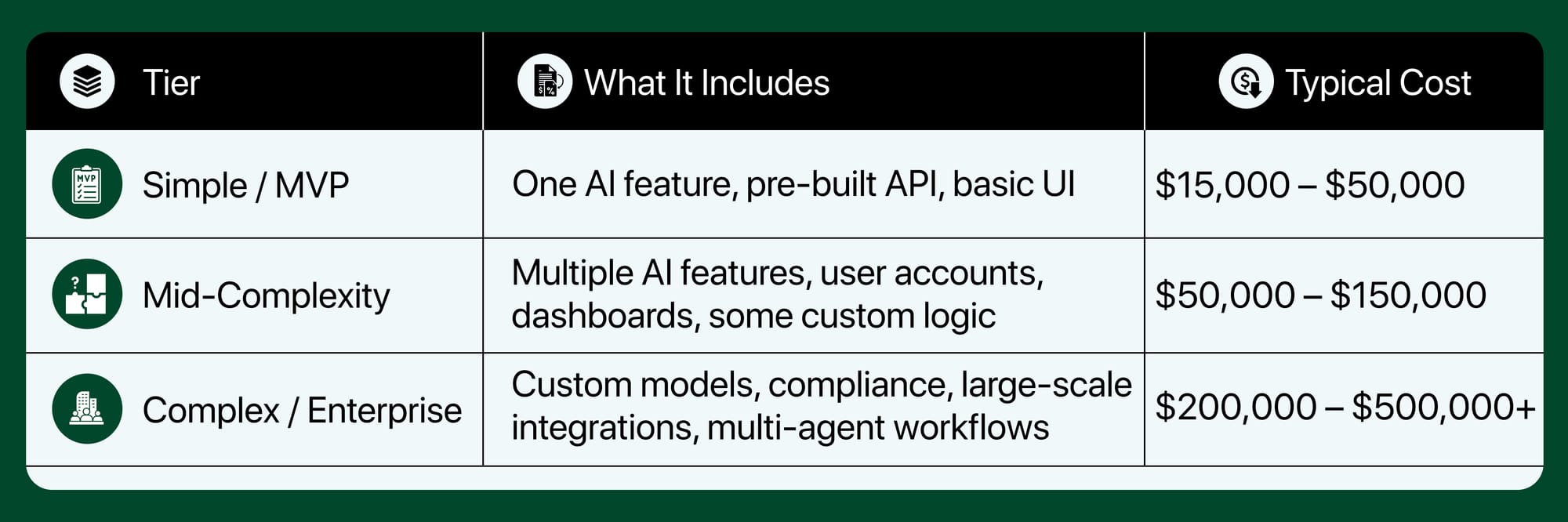
These are build-phase numbers only. They don't include the ongoing AI usage and infrastructure costs covered later in this guide.
Consider two common projects. A retail chain adding a product recommendation widget sits at the low end, likely under $50,000, since it runs on a hosted API with minimal custom logic. A logistics company building a route optimisation tool that pulls live fleet and traffic data lands much higher, both because of the integration work involved and the accuracy requirements around real-time decisions.
What Drives AI App Development Cost Up or Down
Four decisions have the biggest impact on your final budget: the AI model you choose, how ready your data is, how many systems you need to connect, and who builds it.
Pre-Built APIs vs. Custom Model Training
The first major budget decision is whether to build on an existing model or develop a custom one; an off-the-shelf API from OpenAI, Anthropic, or Google is faster, cheaper, and usually enough for a first version.
Custom training only pays off at scale. Fine-tuning costs notably more than API integration, and training from scratch is a different league, often the gap between a five-figure and seven-figure project. Unless you need a proprietary model, that spend rarely makes sense before the product is proven.
Data Readiness and Infrastructure
Clean, well-structured data lays the foundation for reliable AI results. Scattered or legacy-locked data means a real chunk of budget goes to cleaning and structuring before model work begins. Data prep often costs more than the model itself, so it deserves its own line item.
RAG (retrieval-augmented generation) is usually the cheaper path: it lets an app answer from your own documents without retraining, keeping build and maintenance costs lower.
Integrations and Compliance
AI products rarely work in isolation. Connections to CRMs, payment platforms, EHRs, or internal systems add development time and testing. Regulated industries add another layer. Healthcare-adjacent builds that require HIPAA-style safeguards, or fintech apps with strict audit requirements, carry compliance and documentation overhead on top of the base build.
Development Team Location
Your development team's location can significantly influence the overall budget. The same project can cost $125 to $175 an hour with a US team or $27 to $82 an hour offshore, a gap that geography alone accounts for.
How Long Does It Take to Build an AI App?
Development timelines vary with complexity. A simple AI app usually takes 6 to 10 weeks to build, while an enterprise-grade platform can take 6 to 12 months. Here's how build phases break down by tier:
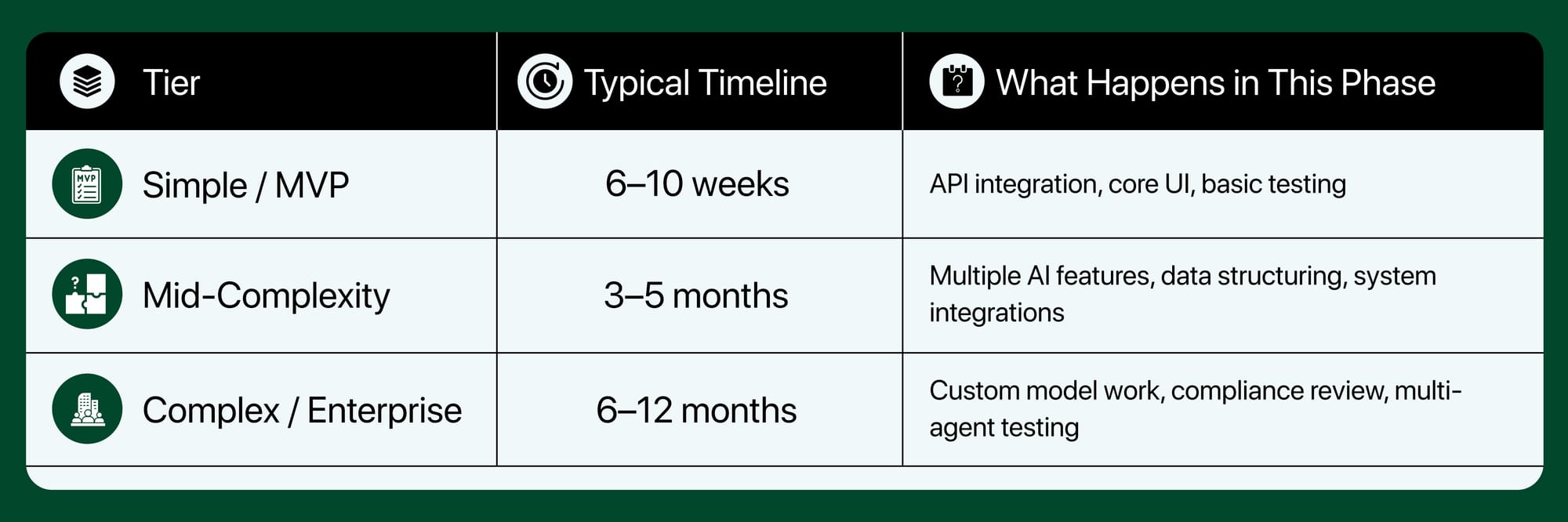
Clean, organised data keeps projects moving. Poor data quality shifts time away from development and into preparation. A buffer for data cleanup early on tends to save weeks in QA later.
How Much Does a Generative AI App Cost to Build?
A generative AI app, one that writes, summarises, or creates content on the fly, typically costs $15,000 to $60,000 for an API-based MVP and $150,000 to $500,000-plus for a fully custom platform with proprietary models and enterprise security.
A customer-support assistant and an enterprise document intelligence platform both use generative AI, but they require very different investments. The pricing spread is wide because a generative AI app can mean a simple ChatGPT-style assistant or a multi-modal enterprise platform, and those are very different builds.
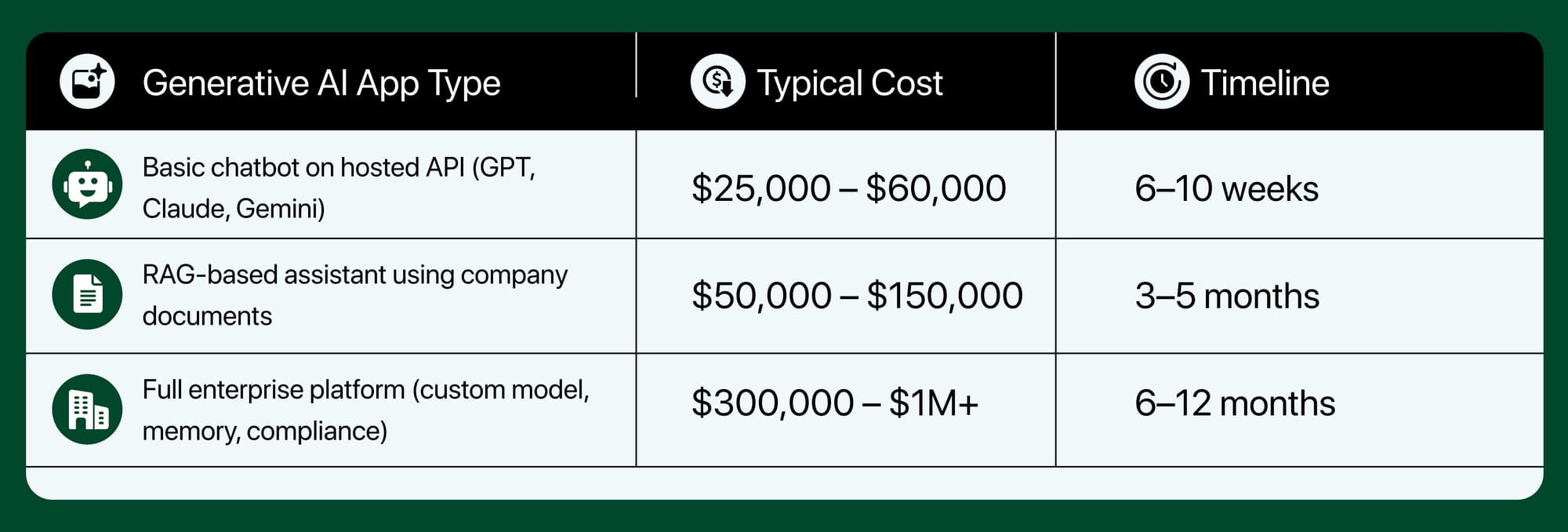
Layering generative AI onto an existing mobile app carries its own premium on top of these figures. Most of that added cost comes from LLM integration, vector databases, and retrieval architecture, not from the core app itself, which is why two apps that look similar on the surface can carry very different price tags depending on what sits underneath the chat window.
AI App Development Cost by Industry
AI app development cost shifts depending on the industry, mostly because of data sensitivity, compliance load, and how many existing systems the app needs to talk to.
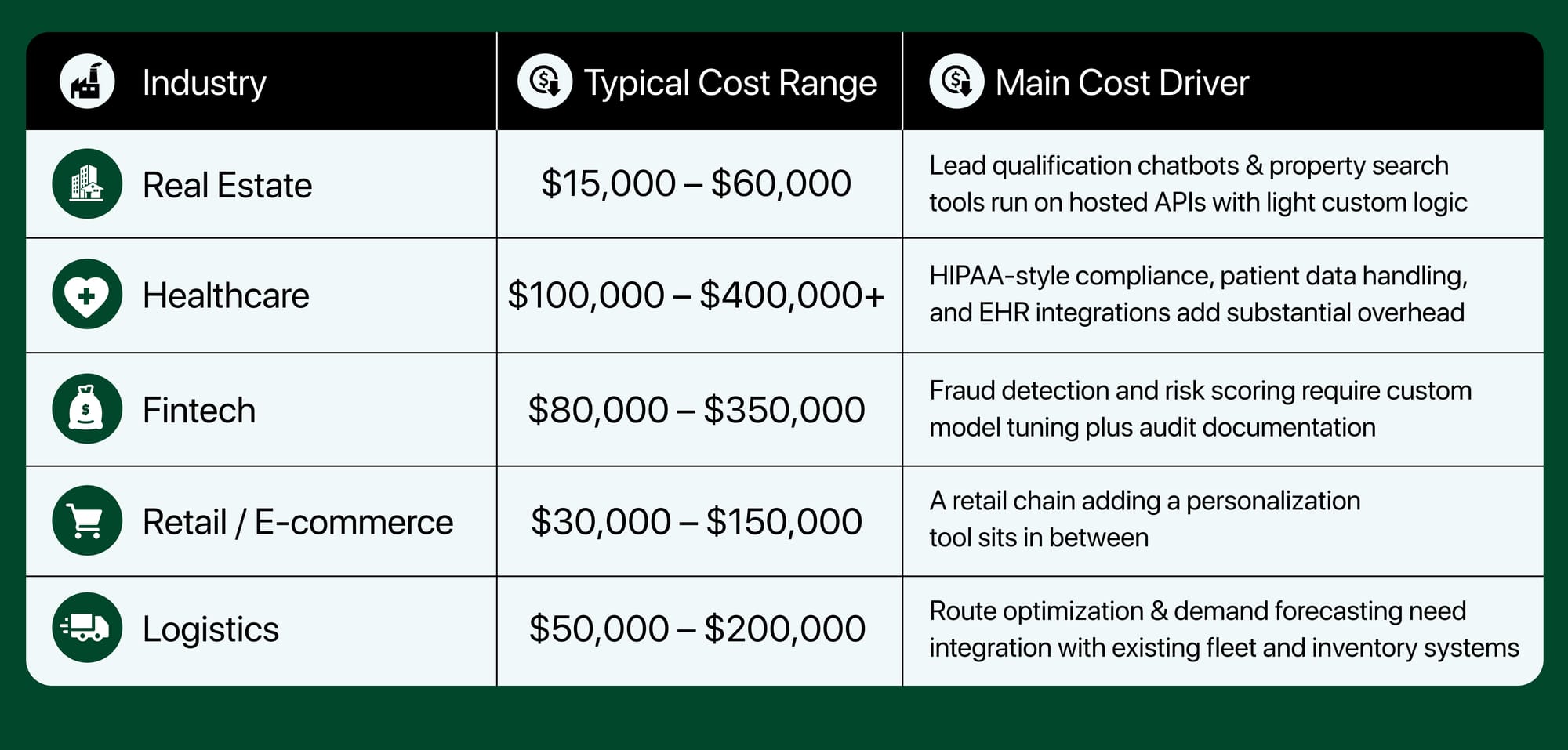
A real estate brokerage adding a lead-qualification chatbot can launch on a hosted API in under 10 weeks. A fintech company building that same fraud detection layer also carries audit-trail and explainability requirements that stretch the QA phase further. A retail chain adding a recommendation engine sits in between, with cost tied closely to how much product and customer data already exists in a usable format.
In-House, Agency, or Freelance: How to Hire AI Developers
When planning an AI project, businesses generally choose between three paths: an in-house hire, a dedicated AI app development company, or an independent freelancer, each with its own cost and risk profile.
Choosing an AI App Development Company vs. In-House
Geography is the clearest cost variable. Traditional US consultancies charge $125 to $175 an hour, compared to $27 to $82 an hour for equally skilled nearshore and offshore agencies, and freelance rates swing the widest of all, from $50 to over $200 an hour depending on specialisation (Debutinfotech, 2026).
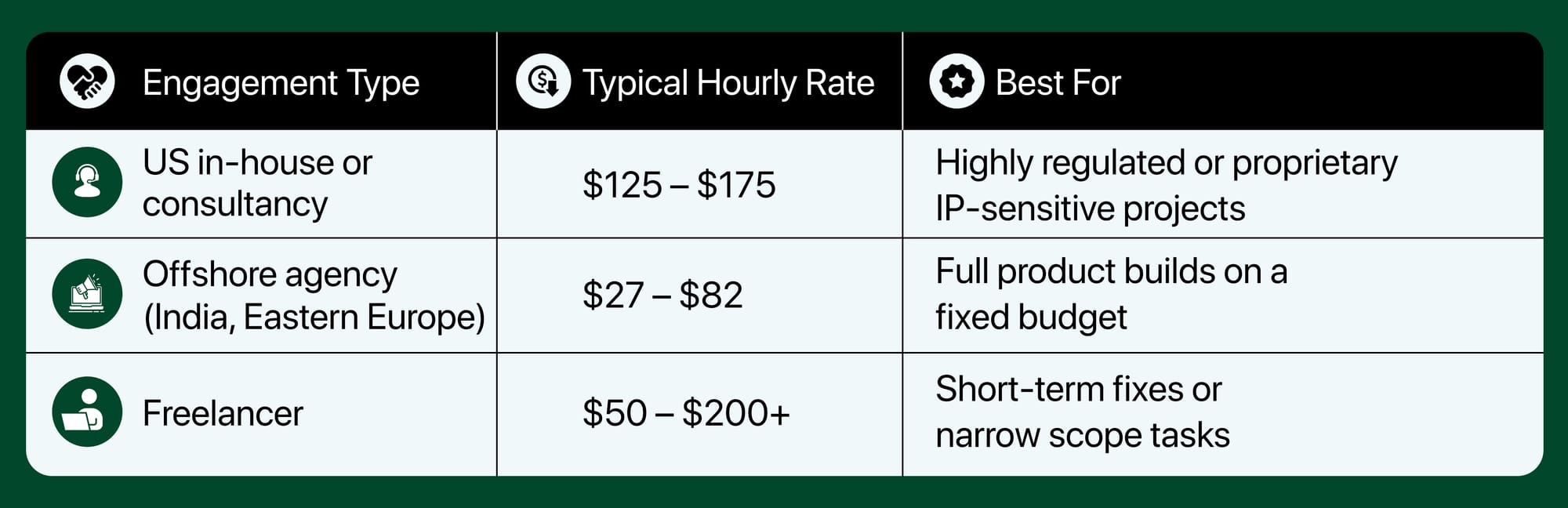
That gap is not just the cost of living at work. AI and ML engineering involves managing non-deterministic outputs, tuning prompts, and controlling token spend, a different skill set than standard app development, so vetting matters more if you hire AI developers directly rather than through an established agency.
Hidden Costs to Budget For After Launch
The initial build is only one part of the total investment. AI usage, hosting, and monitoring continue every month after the app ships, and skipping this line item is the most common budgeting mistake founders make.
The number to watch isn't the build invoice; it's the monthly one. Every AI call your app makes carries a token cost, and that scales directly with usage. Industry estimates put the annual total, covering hosting, monitoring, and updates, at 15–25% of the original build cost (Codiant, 2026). One way to estimate your own number: monthly AI cost scales with active users, sessions per user, AI calls per session, and average tokens per call, multiplied by your model's price per token.
Build this into the budget from day one instead of treating it as an afterthought. Founders who only price the build phase are often surprised three months post-launch when the AI usage bill lands alongside hosting and support costs. Planning for both numbers up front- the one-time build and the recurring monthly spend- paints a far more accurate picture of what the product costs over its first year.
How to Reduce AI App Development Cost Without Cutting Corners
A larger budget does not guarantee a better AI product. Prioritising the right work does.
- Start with a pre-built API instead of custom training. Most apps do not need a proprietary model. Prove the concept of an existing API first.
- Build a RAG pipeline before fine-tuning. RAG is cheaper, faster to iterate, and covers most business use cases without retraining anything.
- Scope a true MVP. Ship one core AI workflow well instead of five AI features half-built.
- Consider offshore or nearshore talent for the build phase. A vetted offshore team can cut hourly pricing significantly compared to a US-based agency without sacrificing quality, as long as the vendor is properly screened.
- Buy before you build. Off-the-shelf AI tools and APIs already solve most common use cases without a custom engineering effort behind them.

Is Building an AI App Worth the Investment?
For most businesses, yes. Companies report an average return of $3.70 for every $1 invested in generative AI, and 74% report a positive ROI overall (Deloitte, via Uvik, 2026).
That does not mean every AI feature is worth building. AI adoption is accelerating across nearly every industry, and the businesses seeing the clearest payoff are the ones solving a specific, measurable problem for their users rather than adding AI for its own sake. The AI app development cost conversation should always start with the problem the app solves, not the technology behind it.
Frequently Asked Questions
How much does it cost to build a simple AI app?
A simple AI app built on a pre-built API, such as a basic chatbot or content assistant, generally costs $15,000 to $50,000, depending on UI complexity and the number of integrations.
Is generative AI more expensive than traditional AI development?
Generally, yes, over time. Generative AI apps carry ongoing token and API usage fees that traditional rule-based AI systems do not, so total cost of ownership tends to run higher even when initial build costs are similar.
Should I hire an AI app development company or build in-house?
Choose an AI app development company when you need design, engineering, and QA coordinated together, or when your team lacks in-house AI expertise. Build in-house only if you already have engineers experienced with LLM integration and data pipelines.
How much do offshore AI developers cost compared to US-based teams? Offshore AI developers typically bill $27 to $82 an hour, compared to $125 to $175 an hour for US-based consultancies, a substantial savings before accounting for project management overhead.
What ongoing costs should I expect after my AI app launches?
Budget roughly 15–25% of your initial build cost per year for hosting, API usage, monitoring, and periodic model updates. These costs scale with your active user count and how often the app calls the AI model.