AI App Development in Saudi Arabia: 5 Features to Add in 2027
Saudi Arabia's digital economy is creating new opportunities for businesses to build smarter mobile products. From digital payments and e-commerce to healthcare and logistics, customers increasingly expect applications that are convenient, responsive, and personalised.

Niti Aggarwal
·10 min read
Saudi Arabia's digital economy is creating new opportunities for businesses to build smarter mobile products. From digital payments and e-commerce to healthcare and logistics, customers increasingly expect applications that are convenient, responsive, and personalised.
For businesses planning a new product, this raises an important question: should your next mobile application simply offer digital services, or should it actively help customers make decisions, solve problems, and complete tasks?
This is where AI app development adds real value.
AI-powered applications can automate customer support, understand Arabic conversations, detect suspicious transactions, recommend relevant products, and predict business demand. Instead of adding technology for the sake of innovation, businesses can use AI to improve specific customer experiences and operational processes.
Saudi Arabia is also developing its Arabic AI ecosystem, creating opportunities for businesses to build applications that better understand local language preferences and customer expectations.
In this guide, we explore five practical AI features worth considering in 2027, their business applications, and what to look for when choosing an AI app development company in Saudi Arabia.
Why AI Mobile Apps Matter in Saudi Arabia
Businesses investing in mobile app development in Saudi Arabia need to consider more than attractive interfaces and basic functionality. Customers expect convenient digital experiences, while businesses need applications that can support growing demand without increasing manual work.
Three developments make AI particularly relevant to the Saudi market.
1. Digital payments are expanding
According to the Saudi Central Bank (SAMA), electronic payments accounted for 85% of total retail payments in 2025, compared with 79% in 2024. The number of electronic transactions also reached 14.6 billion.
For fintech companies, e-commerce platforms and digital service providers, this creates opportunities to improve transaction monitoring, payment experiences and fraud prevention.
2. Arabic AI is gaining momentum
Saudi Arabia is investing in AI models and applications designed around Arabic-speaking users.
A notable example is HUMAIN Chat, launched in August 2025 and powered by ALLaM 34B. It supports Arabic speech input across multiple dialects and switching between Arabic and English within conversations.
For businesses, this highlights an important opportunity: Arabic support should go beyond translating an English interface. Applications should consider local expressions, language preferences, and conversational context.
3. Data protection is a development priority
Saudi Arabia's Personal Data Protection Law (PDPL) has moved beyond its compliance grace period, which ended on September 14, 2024.
AI applications that process personal information must appropriately address data collection, processing purposes, security, retention, and international data transfers.
Businesses should consider these requirements during application architecture and development, rather than treating privacy as a last-minute addition.
These developments create opportunities for businesses to introduce practical AI solutions into their digital products.
Here are five features worth considering.
1. Arabic AI Chatbots and Conversational Assistants
Customer support is one of the most practical starting points for AI app development.
An Arabic AI chatbot can help customers find information, check orders, book appointments, and resolve common questions without waiting for a support representative.
However, a useful chatbot needs more than a language model connected to a chat interface. It should understand customer intent and interact with the actual business systems behind the application.
Features worth building:
- Saudi dialect understanding: Support Modern Standard Arabic and relevant Saudi and Gulf expressions.
- Arabic-English conversations: Allow customers to switch languages naturally.
- Right-to-left interface: Design a proper Arabic experience rather than simply mirroring English screens.
- Business system integration: Connect the chatbot with CRM, booking, payment, and order management systems.
- Human support handover: Transfer complex queries to support representatives with conversation history.
- Response controls: Reduce inaccurate responses through relevant data, guardrails, and escalation rules.
Business example:
Imagine an e-commerce application where a customer asks in Arabic, "Where is my order?"
The chatbot checks the order management system, retrieves the delivery status, and provides an estimated arrival time. If the customer wants to initiate a return, it can guide them through the process.
This reduces unnecessary navigation and makes customer support more convenient.
Businesses planning such functionality should look for an experienced AI chatbot development company that can connect conversational AI with real business processes.
2. Voice-Enabled AI with Arabic Dialect Support
Typing is not always the easiest way to interact with a mobile application.
Voice-enabled AI allows customers to search, navigate, and perform actions using natural speech. It can make applications more accessible while reducing the steps required to complete everyday tasks.
Why it matters in Saudi Arabia
Arabic voice experiences need to account for differences in pronunciation, accents, and everyday expressions.
HUMAIN Chat's Arabic speech input and dialect support demonstrate how voice-based conversational experiences are developing in the region.
Businesses can introduce similar capabilities into their own products based on their customers' requirements.
Features worth building:
- Arabic speech recognition: Understand spoken Arabic and relevant regional accents.
- Voice search: Search products, services, menus, and content using speech.
- Voice commands: Perform actions such as checking an order or booking an appointment.
- Text-to-speech: Convert written responses into natural speech.
- Multilingual interaction: Support Arabic and English conversations.
- Accessibility support: Make essential app functions easier to use for customers who find typing difficult.
Business example:
A food delivery application allows customers to say, "Order my usual meal from last Friday."
The application checks previous orders, displays matching items, and asks the customer to confirm before checkout.
This is a practical example of how AI mobile app development can improve convenience without introducing unnecessary complexity.
3. AI-Powered Fraud Detection and Smart Security
As more business transactions move to mobile platforms, protecting customer accounts and financial information becomes increasingly important.
AI-powered fraud detection helps applications identify suspicious behaviour by analysing transaction patterns, devices, and user activity.
Instead of relying entirely on predefined rules, machine learning models can identify unusual patterns and help businesses respond to potential risks.
Why it matters in Saudi Arabia
The growth of digital payments creates opportunities for businesses, but it also makes transaction security an important consideration.
Fintech platforms, digital wallets, banking applications, and online marketplaces need to identify suspicious activity without creating unnecessary friction for genuine customers.
Features worth building:
- Real-time transaction monitoring: Identify unusual payment amounts, frequency, or locations.
- Behavioural analysis: Detect unexpected changes in login and application usage patterns.
- Device recognition: Flag access from unfamiliar devices.
- Identity verification: Integrate suitable identity checks and liveness detection.
- Risk-based authentication: Request additional verification for higher-risk activities.
- Security monitoring: Provide relevant alerts to security teams.
Business example:
A customer normally accesses a financial application from Riyadh using a recognised device.
The system detects an unusual login attempt from an unfamiliar device, followed by a large transfer request.
It flags the activity and requests additional verification before the transaction proceeds.
This allows the business to investigate potentially fraudulent activity.
AI software can support security across banking, e-commerce, subscription platforms, and digital marketplaces. However, these systems require reliable data, continuous monitoring, and human oversight for high-impact decisions.
4. Hyper-Personalisation with Machine Learning
Customers do not want to see the same recommendations, notifications, and offers every time they open an application.
Hyper-personalisation uses machine learning to adapt the app experience according to customer preferences, browsing behaviour, and previous interactions.
Rather than treating every customer identically, AI applications can deliver more relevant experiences using appropriate, permission-based data.
Why it matters in Saudi Arabia
Customer preferences can change around Ramadan, Eid, White Friday, school holidays and other seasonal events.
A personalised application can respond to these changes instead of displaying the same generic content throughout the year.
Features worth building:
- Personalised recommendations: Suggest products, services and content based on user interests.
- Behaviour-based experiences: Adapt relevant application content according to browsing patterns.
- Seasonal personalisation: Highlight suitable products around Ramadan, Eid and shopping periods.
- Smart notifications: Deliver relevant updates based on customer preferences.
- Language preferences: Present content in the customer's preferred language.
- Privacy controls: Give customers transparency and control over how their information is used.
Business example:
A shopping application identifies that a customer frequently purchases groceries and household essentials.
During Ramadan, it highlights relevant food products, suhoor essentials, and iftar shopping categories. Before Eid, it can prioritise gifting and seasonal offers.
The experience becomes more relevant without requiring customers to search through hundreds of products.
For businesses, personalisation can support customer engagement, repeat purchases and retention. The objective should always be relevance, not simply collecting more data or sending more notifications.
5. Predictive Analytics and Smart Automation
Not every AI feature needs to be visible to customers.
Some of the most valuable applications of AI work in the background, helping businesses understand patterns, anticipate demand, and automate repetitive activities.
Predictive analytics uses historical and real-time data to estimate future outcomes. Automation can then help teams act on those insights.
Why it matters in Saudi Arabia
As businesses expand across cities, manage larger customer bases and handle increasingly complex operations, manual decision-making becomes harder to scale.
Predictive models can help organisations make informed decisions instead of relying entirely on assumptions.
Features worth building:
- Demand forecasting: Estimate future demand for inventory, deliveries or appointments.
- Customer churn prediction: Identify customers who may stop using a service.
- Predictive maintenance: Identify potential equipment or system issues before they become major problems.
- Smart scheduling: Recommend suitable schedules based on demand and availability.
- Workflow automation: Automate repetitive approvals, reminders, reporting and follow-ups.
- Business intelligence dashboards: Present predictions and performance indicators in an understandable format.
Business example:
A healthcare booking application analyses appointment patterns and identifies days when clinics are likely to experience higher demand.
The system helps administrators plan appointment availability and sends reminders to patients who may miss scheduled visits.
This reduces manual coordination and helps the organisation use its resources more efficiently.
For growing businesses, predictive analytics can turn ordinary operational data into useful insights.
How to Choose an AI App Development Company in Saudi Arabia
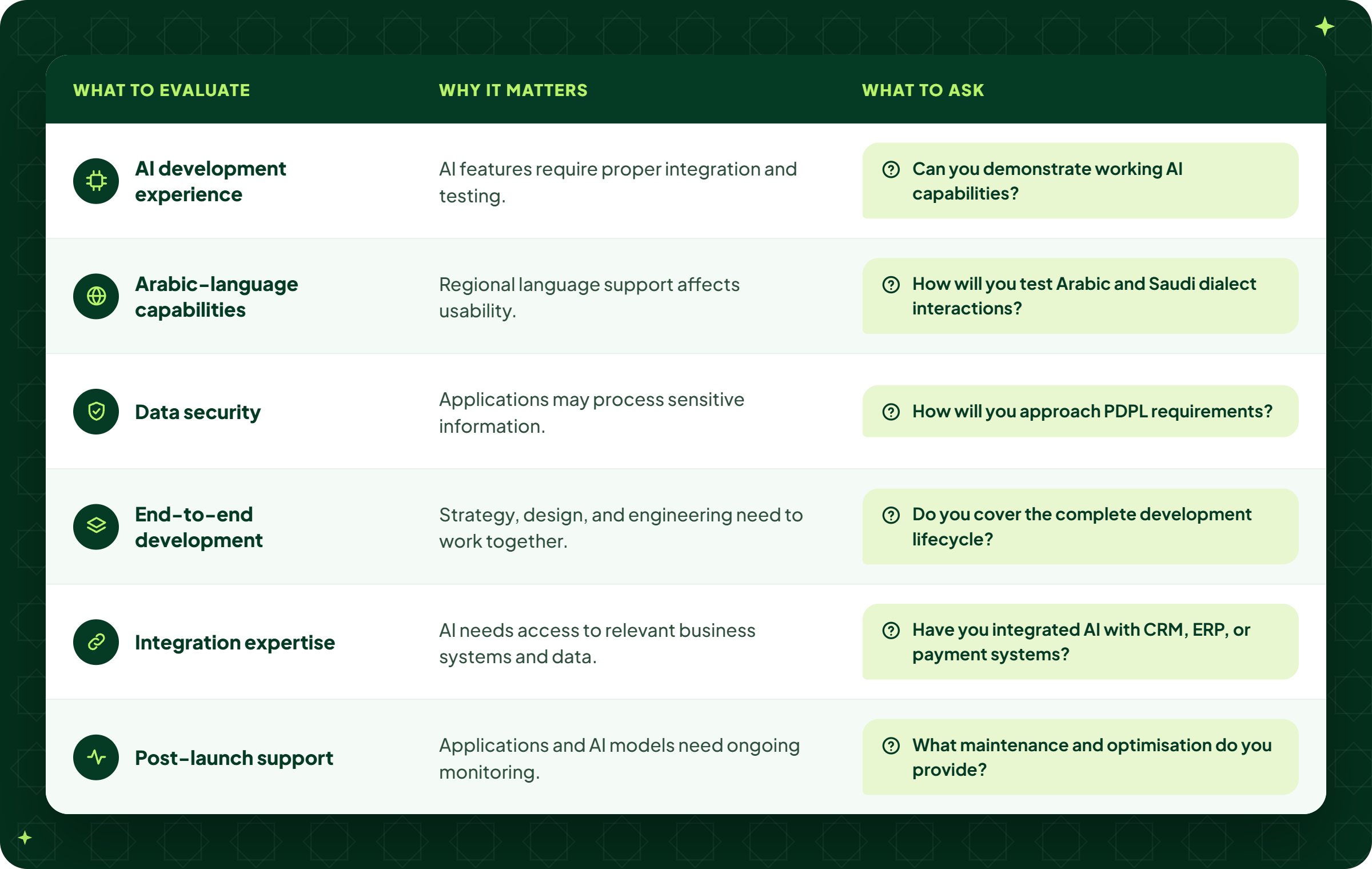
Choosing the right development partner is an important decision. AI features involve more than selecting a model or integrating an API. They require product planning, software engineering, data architecture, security, and ongoing improvement.
When researching the top mobile app development companies, look beyond rankings and marketing claims. Focus on whether a company can understand your requirements and build a reliable application.
Here are six things to evaluate before deciding.
Why Your Development Partner Matters
A reliable AI mobile app development company should understand both the technology and the business problem behind your application.
For example, a retail business may need personalised recommendations, while a fintech company may prioritise transaction monitoring and fraud detection.
The development approach should be different for each.
Look for a development team that can:
- Identify the most valuable AI features for your business.
- Recommend suitable AI models, APIs, and technologies.
- Build secure and scalable application architecture.
- Integrate AI with existing business systems.
- Test performance against real-world scenarios.
- Monitor and improve the application after launch.
A good development partner will not recommend every available feature. They will help you prioritise what makes sense for your budget, customers, and long-term business objectives.
How LoudOwls Can Help with AI App Development
Building an AI-powered application requires the right combination of product strategy, software engineering, and technology expertise.
At LoudOwls, we help businesses turn application ideas into scalable digital products. Our AI app development services can support intelligent application experiences, machine learning integration, natural language processing, computer vision, and predictive analytics.
Whether you are launching a new product or adding AI capabilities to an existing application, our approach starts with understanding what your business needs to achieve.
Our development capabilities include:
- AI integration: Connecting intelligent models and services with mobile applications.
- Machine learning: Building data-driven experiences and recommendation capabilities.
- Natural language processing: Supporting conversational interfaces, chatbots, and language-based features.
- Computer vision: Integrating image recognition and visual processing capabilities.
- Predictive analytics: Using business data to support forecasting and smarter decisions.
- Mobile engineering: Developing applications for iOS, Android, and cross-platform environments.
We also bring experience across fintech, healthcare, fitness, education, and other digital product categories.
For example, our Motus case study demonstrates our mobile engineering capabilities through camera-based movement tracking, automatic repetition counting, and an interactive fitness experience.
Explore our mobile app development services and project portfolio to understand how we approach digital product development.
With a business presence in Ottawa, Canada, and teams in India and the UAE, LoudOwls works with businesses across markets to plan, develop, and support digital products.
Build AI Applications Around Real Business Needs
The next generation of mobile applications will be shaped by how effectively businesses use AI to solve customer and operational problems.
For companies in Saudi Arabia, five opportunities stand out:
- Arabic AI chatbots and conversational assistants.
- Voice-enabled AI with Arabic dialect support.
- AI-powered fraud detection and smart security.
- Hyper-personalisation with machine learning.
- Predictive analytics and smart automation.
However, successful AI app development does not mean adding every available feature to your product.
Start by identifying a problem that affects your customers or business operations. Choose the AI capability that addresses it, build a focused first version, and measure its performance.
As your application grows, you can introduce additional capabilities based on customer feedback and real usage data.
At LoudOwls, we help businesses plan and develop intelligent mobile applications using modern AI technology and scalable software engineering.
Whether you need a new AI-powered product or want to introduce intelligent features into an existing application, the right starting point is a clear development roadmap.
Frequently Asked Questions
1. How much does AI app development cost in Saudi Arabia?
The cost depends on the application's complexity, required AI features, integrations and development scope.
For example, adding a focused Arabic AI chatbot to an existing application generally requires less development effort than building a complete AI-powered platform from scratch.
The best approach is to define your essential features first and request an estimate based on your actual requirements.
2. How long does it take to develop an AI mobile app?
The development timeline depends on functionality, AI integrations, design requirements, and testing needs.
A focused first version with one or two AI features may take a few months. More complex applications involving multiple AI models, third-party integrations, and advanced security requirements will need additional time.
3. Can an Arabic AI chatbot understand Saudi dialects?
Yes. Arabic conversational systems can be designed to understand Modern Standard Arabic and relevant regional dialects.
However, the quality depends on the selected language model, configuration, conversation design, and testing with actual users.
Businesses should test common expressions, regional language variations and Arabic-English conversations before launching.
4. Do AI applications in Saudi Arabia need to comply with PDPL?
Applications processing personal data covered by Saudi Arabia's Personal Data Protection Law must consider its applicable requirements.
Businesses should assess data collection, processing purposes, user rights, security, retention, and international data transfers.
PDPL considerations should be included in application architecture and development. Businesses should consult qualified legal professionals about their specific obligations.
5. Can I add AI features to my existing mobile application?
Yes. In many cases, adding AI capabilities to an existing application is a practical alternative to rebuilding the entire product.
The development team should first assess your existing architecture, APIs, data quality, security, and performance.
Based on this assessment, you can introduce features such as chatbots, recommendations, voice search, or predictive analytics without necessarily replacing your current application.
6. How do I choose the right AI app development company?
Look for a company with experience in mobile application engineering, AI integration, security, and scalable architecture.
Ask about previous projects, technology choices, testing processes, integration capabilities, and post-launch support.
Most importantly, choose a development partner that understands your business objectives and can recommend a realistic roadmap instead of simply promising a long list of AI features.