AI App Development Cost in 2026: Pricing, Factors & Hidden Fees
An AI app can cost $10,000 to build, or more than $150,000. It all comes down to what you're actually building.

Pardip Bhatti
·10 min read
An AI app can cost $10,000 to build, or more than $150,000. It all comes down to what you're actually building. You could be building a simple chatbot on top of an existing AI model, or a bespoke platform that uses your own data, integrates with your business systems, and runs at scale.
According to Clutch's AI development pricing data, most projects fall in the 49,000–$ 99,000 range, with an average project cost of about $120,595. That spread is why a single price point rarely covers the full range of AI development costs.
Most budgets overlook AI model API usage, infrastructure, maintenance, monitoring, and future improvements. Annual maintenance alone can add significantly to the original AI software development cost.
This guide breaks down AI app development costs in 2026, from initial build and AI model training to ongoing running costs, so you can plan before you commit. If you're still exploring what an AI product could do for your business, start with our overview of AI app development
At LoudOwls, we build AI-powered mobile and web apps for startups and growing businesses from our offices in India and Canada. Our work spans fitness (Motus), finance (Klink), healthcare (Hoag Compass), and education (Virtual School). The ranges below reflect what we see when scoping real projects, not theoretical numbers.
How Much Does AI App Development Cost?
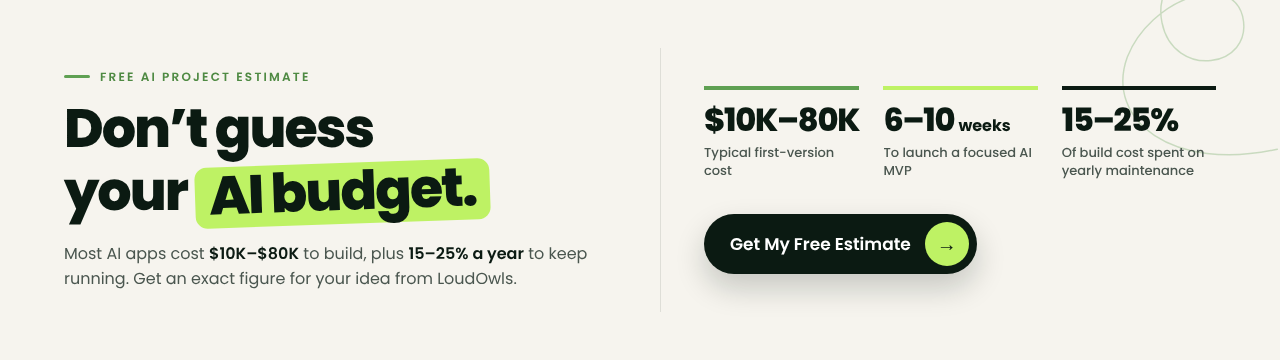
In 2026, a first version of an AI app typically costs $10,000-$80,000, depending heavily on scope. A focused MVP sits at the lower end. An app connected to your business data and systems costs more, and enterprise platforms can easily exceed $150,000.
On top of the build, budget for ongoing running costs (roughly 15–25% of the build cost per year) plus usage-based AI fees. Treat the table below as a planning guide, not a fixed quote.
These ranges assume an experienced team, data that's ready to use, and stable requirements. Actual quotes vary with your features, integrations, and who builds it.
AI Development Cost by App Type
The easiest way to estimate your budget is to find the app type closest to your idea. AI development cost is driven mainly by how much data the app processes, how costly a wrong answer would be, and how many systems it connects to. A chatbot is far quicker and cheaper to build than an app that analyses camera footage or handles medical records.
These are first-version ranges. Your quote will depend on features, integrations, and design.
Key Factors That Affect AI Software Development Cost
Two apps that look similar can carry very different price tags. These eight factors move AI software development cost the most.
Scope is the single biggest driver. One contained feature, such as a support chatbot, is a predictable piece of work; every additional workflow multiplies testing and edge cases.
Data readiness is the most underestimated. Clean, structured, accessible data keeps the build moving. Messy data can consume a large share of the budget before any AI work begins.
AI Model Training Cost: Do You Actually Need It?
Many founders assume they need to train their own model. Most don't. Today's foundation models are capable enough that the majority of business apps can be built on top of them, which keeps AI model training cost low or close to zero.
These are planning ranges. Real costs depend on data volume, the quality of labelled examples and the compute required.
Our advice: start with prompting or RAG. Prove the app works and that people use it. Move to fine-tuning only when you hit a clear limit — by then you'll have real usage data to fine-tune with.
Hidden Fees: The Costs Most Budgets Miss
The build is only part of the bill. These ongoing costs catch teams out after launch.
Usage-based fees deserve special attention. AI pricing from model providers is usually charged per use, so an app that's cheap with 100 users can become expensive with 100,000 if nobody planned for it. Good architecture — caching common answers, routing simple tasks to smaller models, and limiting response lengths — can cut these costs significantly.
AI Pricing Models: How Development Partners Charge
When you request quotes, you'll usually see one of three engagement models.
Typical hourly rates by region
Rates are approximate and vary widely by experience and specialism.
A lower rate doesn't always mean a lower total. An experienced team at a higher rate that ships in eight weeks can cost less than a cheaper team that takes six months and needs rework.
How LoudOwls fits in: We run engineering from India with client-facing leadership in Canada. You get India and South Asia delivery rates with North American time-zone overlap and communication. Ask us for current rates on your project.
How to Reduce AI App Development Cost (Without Cutting Corners)
1. Start with a proof of concept. Spend a few thousand dollars confirming the AI can do the job before committing to a full build.
- Launch one core AI feature first. Add the rest once you know what users value.
- Use existing models before custom ones. Fine-tune or train only when there's a proven need.
- Get your data ready early. Clean, organised data saves weeks of development.
- Use cross-platform frameworks. One codebase for iOS and Android can lower costs considerably — see our cross-platform app development work.
- Design for API efficiency from day one. Caching, smaller models for simple tasks, and usage limits keep running costs predictable.
- Put maintenance in the budget. Unplanned post-launch fixes always cost more than planned ones.
Custom AI Solutions vs Off-the-Shelf Tools
Not every business needs a custom build. Before you commit, check whether an existing tool could do the job.
Many businesses end up with a mix: off-the-shelf tools for internal tasks and custom AI solutions where it matters most.
In-House Team vs Freelancers vs an AI App Development Company
If you've decided to build, the next question is who builds it.
If you plan to hire AI developers in-house, remember that a working AI product needs more than an AI engineer. You'll also need backend and frontend developers, a designer, QA, and someone managing infrastructure. An AI app development company gives you that whole team without the hiring time.
Why Build Your AI App with LoudOwls
LoudOwls is an AI app development company that takes products from idea to launch with one team: strategy, UI/UX, AI integration, mobile and web development, QA, and post-launch support.
How to Choose the Right AI App Development Company
When comparing partners, look for:
- Relevant case studies: proof they’ve shipped AI products in your industry or at a similar level of complexity.
- A clear discovery phase: good teams ask about your data, users, and goals before they give you a quote.
- An itemised estimate: you should see what each part of the budget covers, including ongoing costs.
- Honest advice on AI approach: be cautious of anyone who pushes custom model training without a clear reason.
- Security and compliance experience: essential if you handle personal, health, or financial data.
- Post-launch support: know what maintenance, monitoring, and updates look like after go-live.
- Clear ownership: you should own the code, the data, and any trained models.
Frequently Asked Questions
- How much does it cost to build an AI app in 2026?
Most AI apps cost between $10,000 and $80,000 for a first version. A simple proof of concept can start around $3,000, while enterprise platforms often go beyond $150,000.
- How much does a generative AI app cost?
A generative AI app built on an existing model typically costs 15,000–40,000, depending on output quality, user volume, and integrations.
- What is the cost of training an AI model?
Most business apps don't need a model trained from scratch. Fine-tuning an existing model usually costs 10,000–50,000+, while training a custom model can run from $100,000 into the millions.
- How long does it take to build an AI app?
A proof of concept takes 2–4 weeks, a focused MVP 6–10 weeks, and an integrated business app 3–5 months. Enterprise platforms can take 6–12 months or more.
- What are the ongoing costs of an AI app?
Plan for maintenance at roughly 15–25% of the build cost per year, plus cloud hosting and usage-based AI fees that grow with your user base.
- Is it cheaper to hire AI developers or work with an agency?
For a first version, an agency is usually faster and more cost-effective because you get a complete team immediately. In-house hiring makes more sense once AI is the core of a long-term product.
Why choose LoudOwls for AI app development?
LoudOwls gives you a complete product team — AI, mobile, web, design and QA — with India-based delivery and Canada-based leadership. We've shipped apps in fitness, finance, healthcare and education, and every project starts with a free, itemised estimate covering both build and ongoing costs.
Conclusion
AI app development cost in 2026 depends far more on what you build than on the technology itself. A focused MVP built on an existing model can launch on a modest budget, while an integrated or enterprise platform needs more investment, plus a plan for usage fees, maintenance and future improvements.
The smartest approach is to start small, prove value with real users, and scale from there. With LoudOwls as your AI app development company, you'll know your full costs — build and ongoing — before you commit.