Thousands of ring combinations, priced in real
time
A configurator-first storefront for a UK diamond manufacturer — build a ring from stone or setting, watch the price recalculate live, across 22 localised markets.



Selling a product that has no fixed SKU?
Diamonds Factory sells direct from the workshop, which means a single ring design isn't one product — it's thousands of valid combinations of stone type, shape, carat, clarity, colour, metal and setting, each with its own price and lead time. A conventional catalogue can't hold that. So we inverted the model: products live at /design/<slug>-<sku> with "From £X" pricing, and the real price is computed from the customer's configuration on the fly.
Around that engine we built the full commerce surface — faceted browse across eight categories, wishlist, search, education guides, instalments and 0% APR finance, showroom booking, certificate handling — and the admin system that keeps designs, stone inventory and the pricing matrix in sync. All of it on OpenCart, deployed to 22 country storefronts.
- Price computed from configuration, not stored per SKU
- Diamond builder: start from a stone or start from a setting
- 22 localised storefronts, one platform
- Klarna, V12 0% APR, PayPal, Amazon Pay, Apple Pay, card
- GIA/IGI certificates, UK hallmarking, Assay Assured
- Showroom booking across six UK cities, plus click & collect
Where a configurable-price catalogue gets difficult
The interesting problems weren't visual. They were in the combinatorics, the consistency of the attribute matrix, and the accumulated debt of a large multi-market template.
A matrix, not a product list
Style, stone, shape, metal and price facets across eight top-level categories all have to agree with inventory and pricing rules — or a customer configures a ring that can't be made.
22 storefronts, one codebase
UK, US, DE, FR, CA, AU, AE and more share a platform but not currency, pricing or content. Every configurator change has to hold in all of them.
Trust has to be visible at £2,000
Nobody commits to a bespoke ring on faith. Certification, hallmarking, price-match and lifetime guarantee needed to be first-class surfaces, not footer links.
Inherited front-end debt
A viewport locked with maximum-scale=1 breaks pinch-zoom (WCAG 1.4.4), an unresolved /trustpilot_url1 placeholder ships in the header, and a malformed ?instock=1?price_min= facet silently drops the price filter.
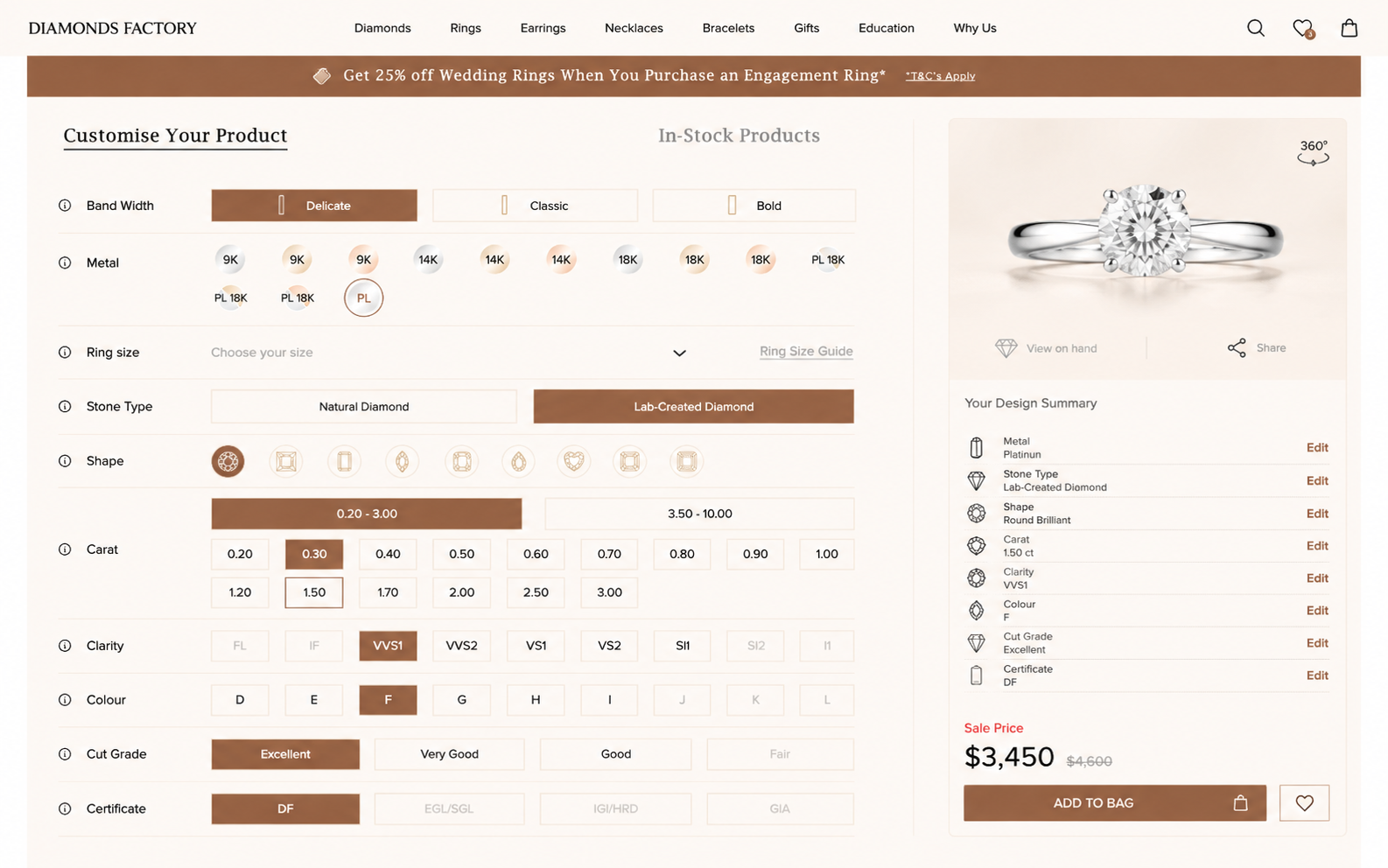
Diamond builder with live pricing
Configure every attribute and see price recalculate as you go, with a preview of the finished piece before it goes in the bag.
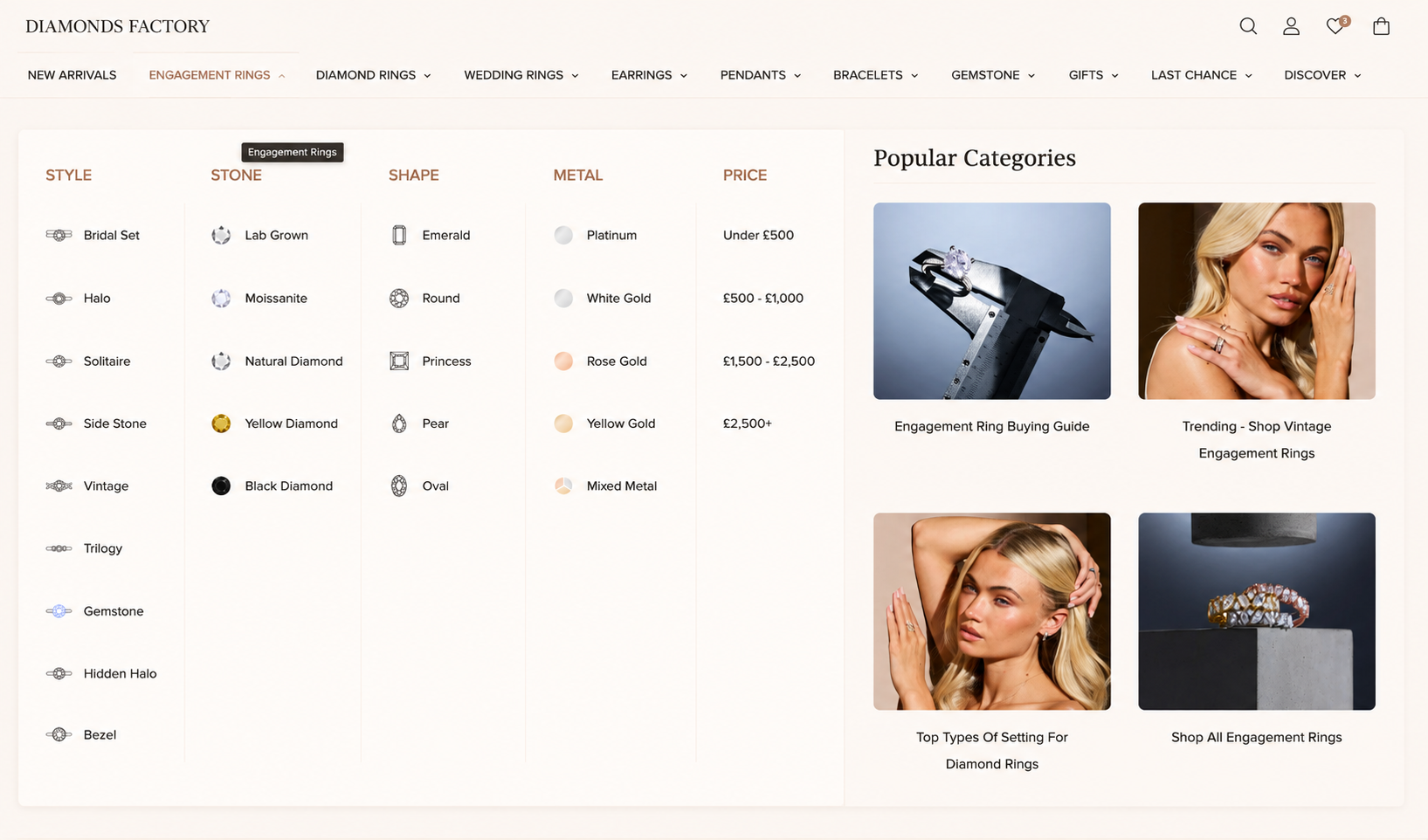
Faceted browse across eight categories
Style, stone, shape, metal and price filters resolve against the live attribute matrix, so results are always buildable.
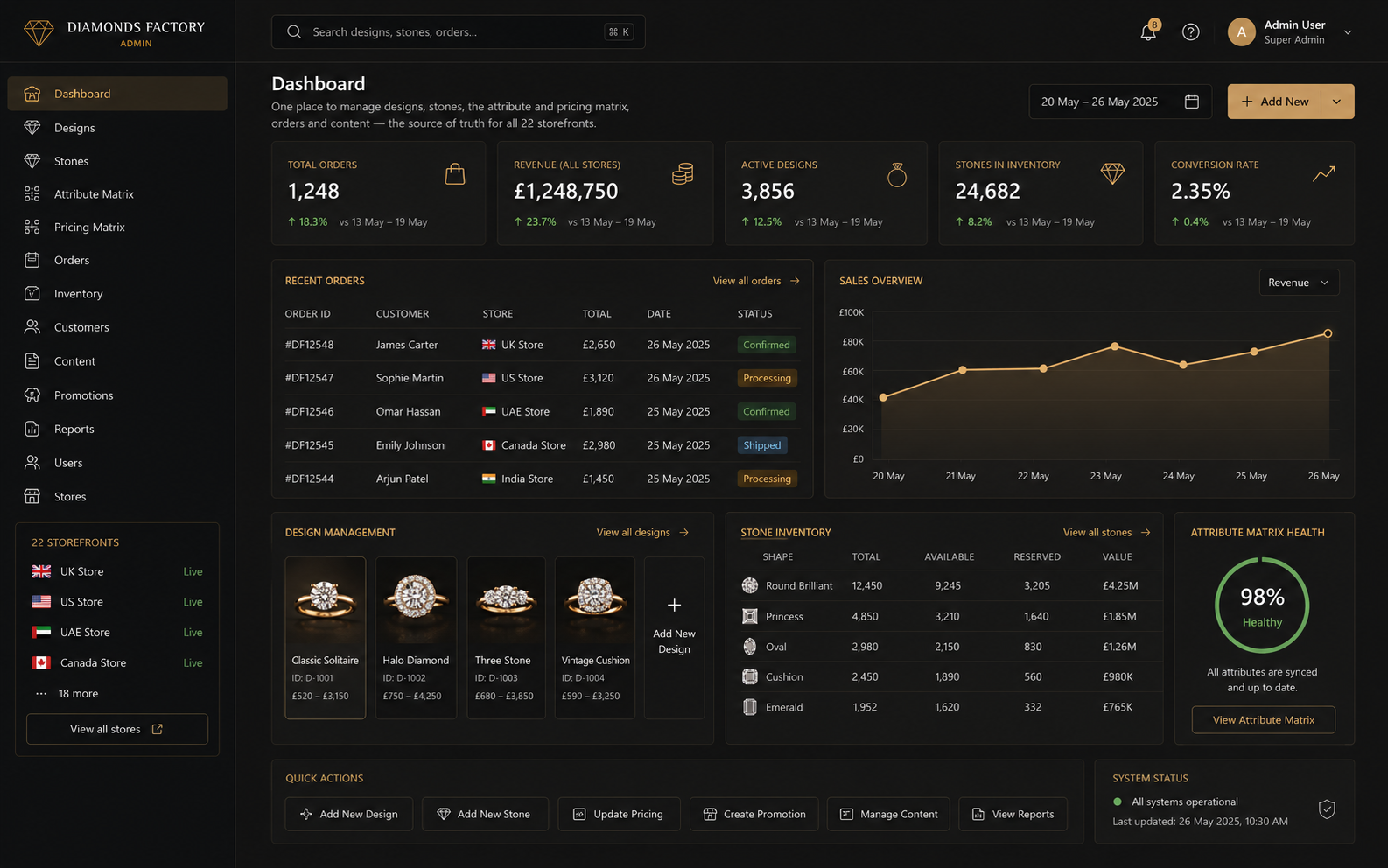
Admin for designs and stone inventory
One place to manage designs, stones, the attribute and pricing matrix, orders and content — the source of truth for all 22 storefronts.
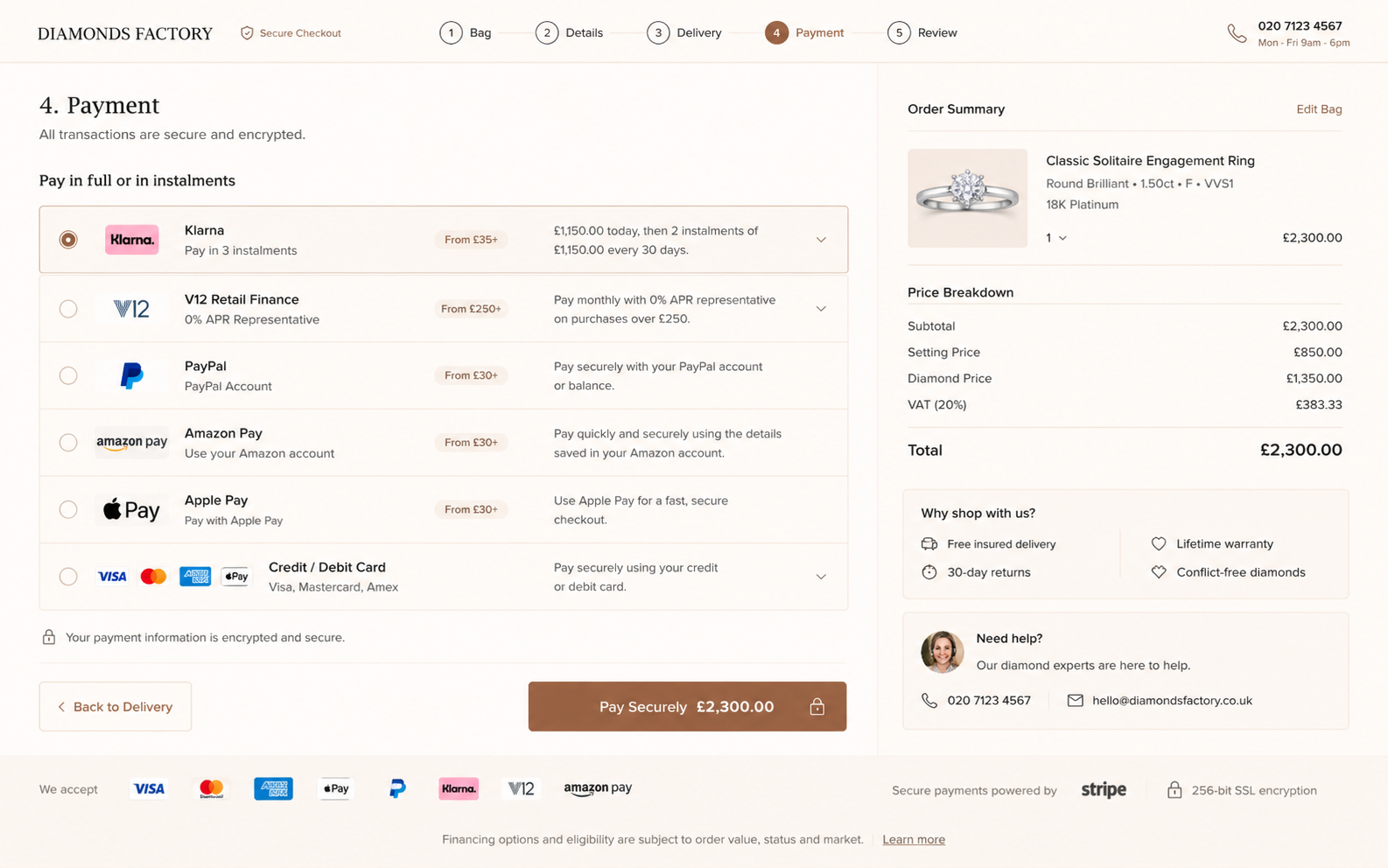
Finance and payments at checkout
Klarna instalments, V12 0% APR, PayPal, Amazon Pay, Apple Pay and card, with eligibility rules applied per order value and market.
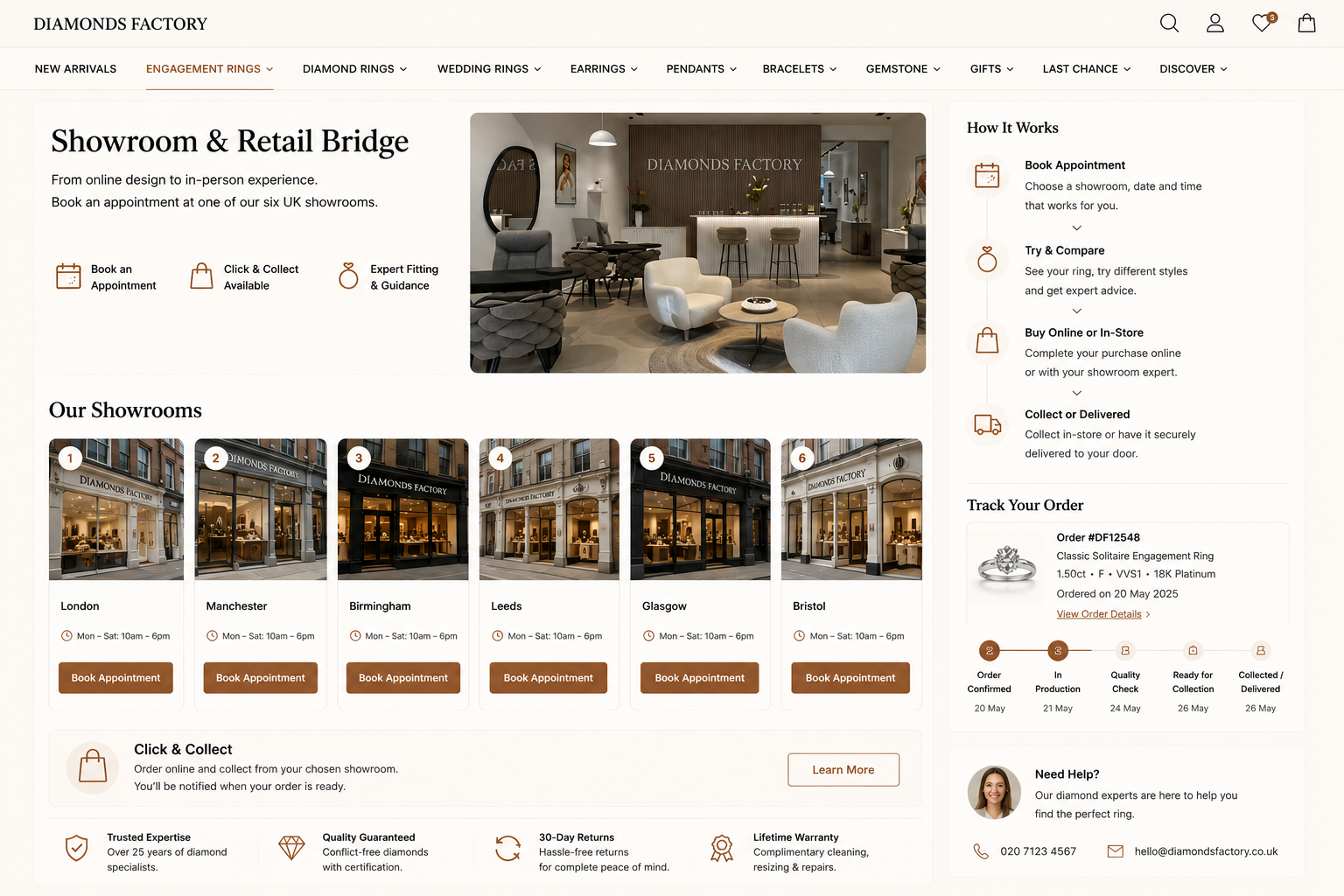
Showroom and retail bridge
Appointment booking across six UK showrooms, click & collect and order tracking connect the online build to a real fitting.
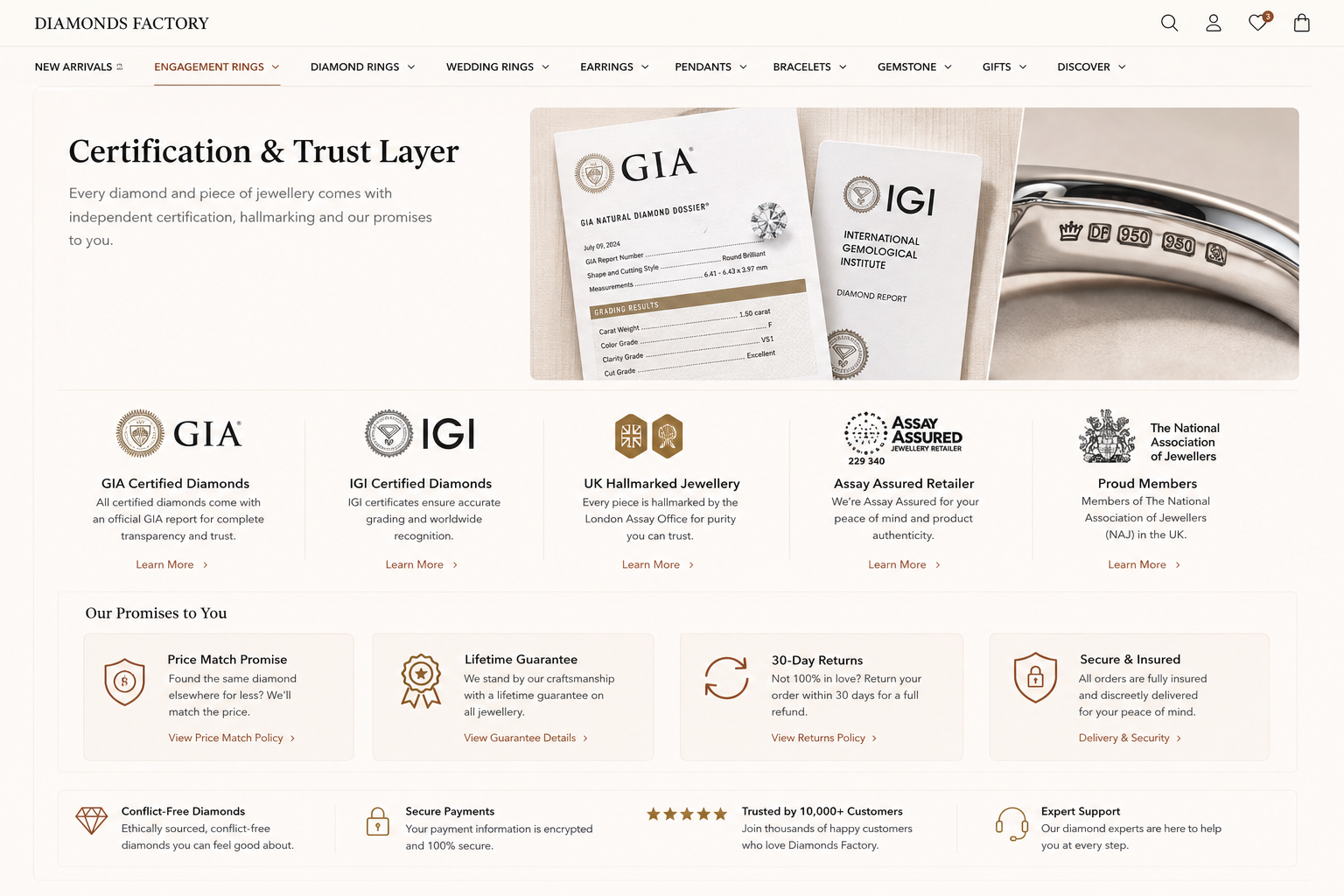
Certification and trust layer
GIA/IGI certificate handling, UK hallmarking, Assay Assured, price-match and lifetime guarantee flows surfaced through the journey.
Build the pricing engine first, then the storefront around it.
We treated configuration as the core domain and everything else as a view onto it. That kept pricing, inventory and merchandising from drifting apart as the catalogue and market count grew.
We defined the attribute space — stone type, shape, carat, clarity, colour, metal, setting — and made price a function of a valid combination. "From £X" became a computed floor rather than a hardcoded field.
Customers arrive with different intent: some love a setting, some are hunting a stone. The builder supports both directions and reconciles them into one configuration, with live price and a preview of the finished piece before add-to-bag.
Eight categories, filterable by style, stone, shape, metal and price, all reading from the same matrix. Wishlist, search and buying guides sit on top so browsing feeds the builder instead of competing with it.
One deployment pipeline pushes 22 storefronts with region-specific currency, pricing and content. Finance and payment options — including Klarna's £100–£499 eligibility band — are gated per market at checkout.
A configurator that feels like a jeweller's bench.
Desktop-first: attribute controls on one side, the piece rendering on the other, price updating in place. Restrained typography and metal-tone neutrals keep attention on the stone.
Let's ship
the next one.
Tell us about your project. We'll come back within a business day with a scoped plan and a straight answer.