social commerce app
How to Build a Social Commerce App: Features, Costs and Development
Quick Summary * A social commerce app blends product discovery, social interac

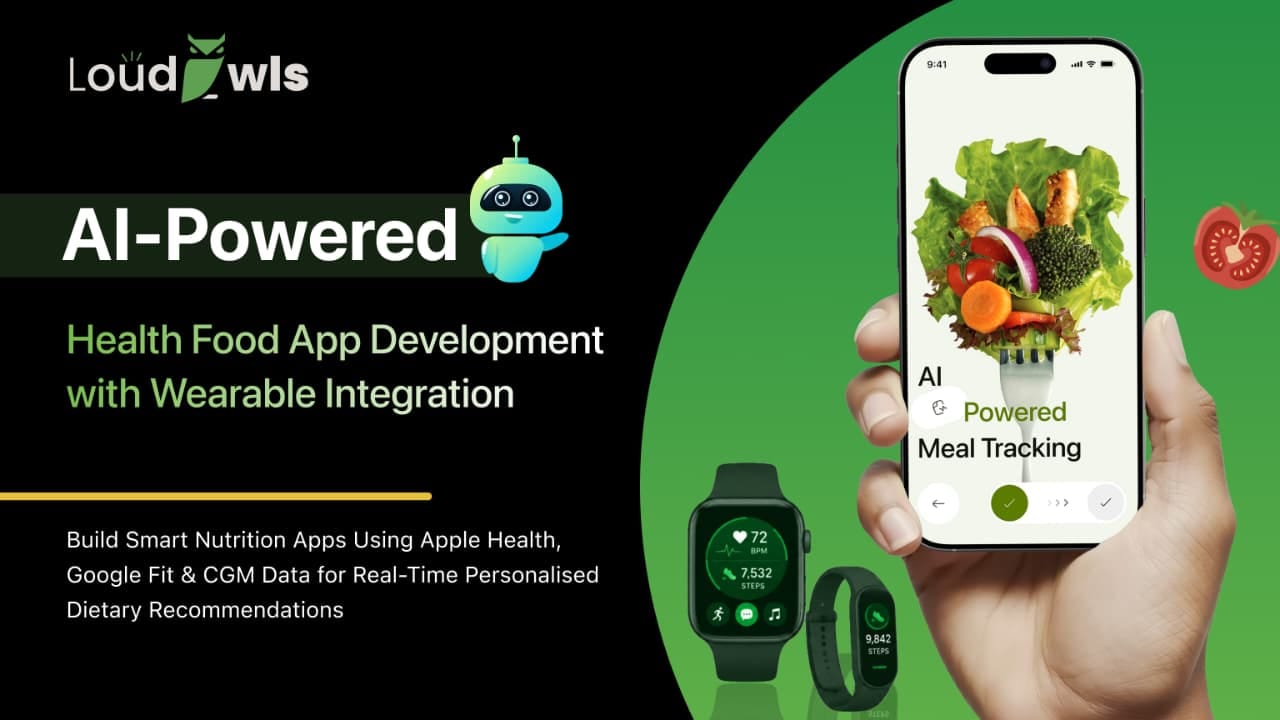

Most food apps just let you record what you ate. Some might tell you if you had too many carbs, but that’s usually as far as it goes. The gap between that and a genuinely useful health tool is large. A person's daily calorie needs change based on how well they slept, how hard they trained, and what their glucose levels did after their last meal. A static food tracker has none of that information. It is a guess.
The health food app development with wearables closes that gap. When a food app is connected to an Apple Watch, a Garmin, or a user's continuous glucose monitor, it no longer makes guesses. It takes the real data, adjusts the nutritional advice as needed, and provides advice that fits the individual using the app and not a generic portrait.
That is what makes the next generation of Health Food Apps different than the already existing ones. And it is the core question for any health-tech business deciding where to build in 2026.
The calorie-counting apps have been around for over 15 years. The basic formula has not changed much. You track food, the application calculates nutrients, and you compare it with a daily goal. The issue is that the daily target is never precise in the case of a particular individual on a particular day. In a study published in the NIH journal PMC (2025), personalized AI-based dietary recommendations were found to outperform standard dietary guidelines in enhancing health markers in multiple user groups. It narrowed down to real-time data entry and not fixed targets.
It is these gaps that generic apps always seem to fail to cover:
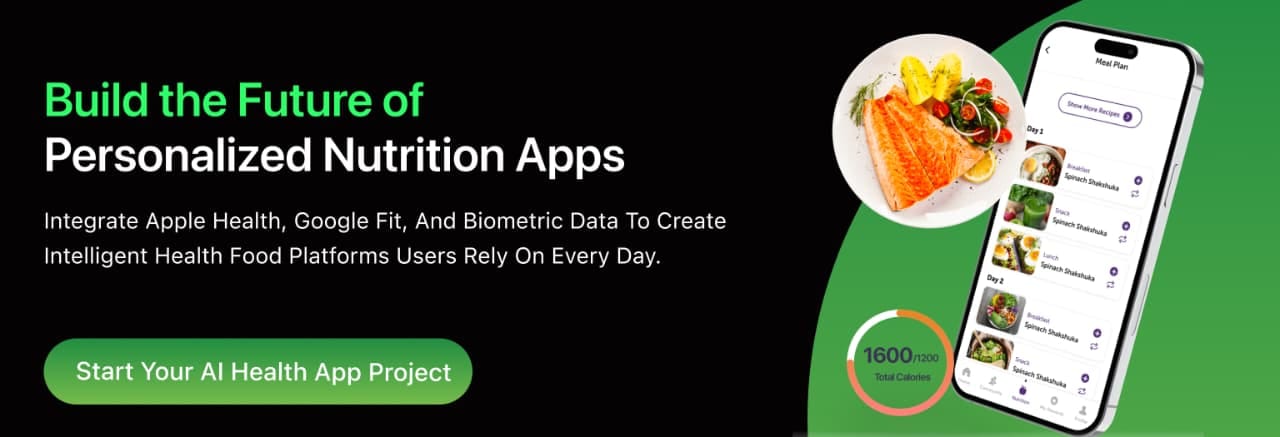
The technical layer that enables a Health Food Apps to access the data in the health devices of a user in real time is the wearable API integration food app . In 2026, the most popular integrations are:
Retrieves steps, heart rate, active calories, sleep levels, and workouts information in iPhone and Apple Watch.
The Android version, which includes activity, sleep, heart rate, and nutrition data provided by Google Fit-compatible devices.
This provides detailed activity, sleep score, resting heart rate, and daily preparedness scores.
It is powerful and enduring, and incorporates VO2 max and training load as well as recovery time.
Fetches continuous glucose data every five minutes so that the app can match particular meals with the glucose reaction.
The app creates a running profile of the user when these streams of data are active. It knows when they worked out, how long they slept, the resting heart rate is trending at, and, in the case of CGM users, how precisely their body reacted to their last meal. The AI recommendation engine is fed on that profile.
An AI dietary recommendation app development project is built around a recommendation engine that sits between the raw data and the user-facing output. The engine does not just read numbers. It identifies trends in various data streams and renders them into certain and practical food advice.
The process in practice works in the following way:
The most successful Health Food Apps combine wearable integrations, dynamic nutrition planning, and personalized health insights.
The app will update daily calorie and macro targets, which are not based on a specific formula but rather updated every day based on the wearable data of that day.
Users are able to take pictures of a meal, and the application can identify the types of food and can estimate nutritional content with the help of computer vision. Together with wearable data, it eliminates the annoyance of manually recording, which is the most frequent cause of users giving up on food tracking apps.
The app records the foods that have generated a high or stable glucose response in users with CGM devices and makes future recommendations that favour foods that have a high or steady glucose response. This is a feature that is becoming popular outside the diabetes field as users of general wellness increasingly become interested in metabolic health.
The app uses wearable data to detect poor sleep, which it uses to adjust the food recommendations on the next day to prioritize recovery. Foods with high amounts of magnesium, foods that aid in the production of serotonin, and lower-sugar foods are all on the list of top recommendations.
The users are able to see how their dietary practices have been correlated with energy, sleep quality, and output of activity over time. This renders the app as a decision-support tool as opposed to a logging requirement.
An application of feature-complete health food, wearable integration, artificial intelligence (AI) recommendations and tailored dietary plans are usually priced between $60,000 and $150,000, depending on complexity. This is how that breaks down on the key build elements.
LoudOwls is a Dubai-based mobile app development company that builds AI-powered health food apps for health-tech businesses across the UAE, Canada, and the US. We handle the full build stack for Apple Health Google Fit food app sync projects, from the wearable API integration layer through to the AI recommendation engine, meal logging interface, and user analytics dashboard. For clients who need CGM integration or custom dietary plan logic, we build that into the core architecture rather than as an afterthought.
Our process begins with a data architecture workshop where we map the target user profile of the client, the wearable data sources that are of most interest to the target user, and the AI logic that will drive the output of the recommendation. That base defines all the downstream: the data model, the API sequence to integrate with it, and the machine learning strategy of the recommendation engine.
Most health food apps lose users in the first 30 days because the recommendations stop being relevant. Reach out to LoudOwls for an affordable project scoping call.
The health food app market is not short of options. What it is short of is apps that actually use the data users are already generating. Every person with a smartwatch is producing activity, sleep, and heart rate data every day. Most food apps ignore all of it.
The development of Health Food Apps with wearables and a proper AI dietary recommendation engine turns that unused data into a product that drives daily use. The market is moving in this direction. The AI personalized nutrition sector is on track to grow from $1.12 billion in 2024 to $4.26 billion by 2032.
The businesses that build the right product now will hold the user base when the market is four times larger. LoudOwls builds these products for health-tech businesses that want to do it properly the first time. If you have a concept or a brief, the right starting point is a conversation about your data, your users, and what the AI layer needs to do.
We support Apple HealthKit, Google Health Connect, Fitbit API, Garmin connect, and CGM streams data such as Dexcom. The specific integrations depend on the target user profile and device mix of your audience.
The AI engine considers user biometrics, activity information, sleep information, dietary history, and health goal to make real-time adjustments to meal suggestions. It is conditioned on the data of each user over time and with the profile rising the better the suggestions are.
An app with wearable and AI dietary recommendation features, and custom diets, usually costs between $40,000 and $120,000. The due date is 14-24 weeks. Final cost depends on the number of wearable APIs, the complexity of the AI layer, and the platform scope.
Yes, users can receive tailored meal suggestions and progress tracking aligned with their specific weight objectives.
Healthcare providers, wellness startups, nutrition companies, fitness brands, and digital health businesses benefit significantly today.
Development timelines usually range between fourteen and twenty-four weeks depending on integrations, features, and complexity levels.
Quick Summary * A social commerce app blends product discovery, social interac
LoudOwls
Quick Summary * Food delivery app development in 2026 ranges from roughly $20,
LoudOwls
Quick Summary * Building an AI app can cost anywhere from $15,000 to over $500
LoudOwls