How to Develop a Hotel Booking App? Features, Types, and Cost
A hotel booking app is a mobile app that lets travellers search for rooms, compare prices, and complete a booking without leaving it. It replaces the browser tab and the front-desk phone call with a few taps.

LoudOwls
·9 min read
bg green: Quick Summary
- A hotel booking app lets travellers search, compare, and book rooms right from their phone, no browser or phone call needed.
- This guide covers the four app types you can build, the development process, must-have features, tech stack choices, and how to pick a development partner.
- The US hospitality market is worth $247.81 billion in 2026 and growing, with online hotel booking alone worth $55.8 billion.
- A realistic budget starts around $15,000 for a simple version and can pass $150,000 for a full platform with hotel-system integration and loyalty features.
- You'll also find a cost and timeline breakdown, region-specific considerations for the US market, five common mistakes to avoid, and answers to the most-asked questions about building one.
[CTA Green: Book a Free Consultation](https://www.loudowls.com/contact-us)
What Is a Hotel Booking App?
A hotel booking app is a mobile app that lets travellers search for rooms, compare prices, and complete a booking without leaving it. It replaces the browser tab and the front-desk phone call with a few taps.
Most travellers expect this now. The online hotel booking application industry in the US reached $55.8 billion in 2025, growing at nearly 19.5% a year over the past five years, and mobile keeps taking a bigger share of that growth.
Why the US Hotel Booking Market Rewards a Direct App
The US hospitality market is worth $247.81 billion in 2026 and is expected to reach $305.53 billion by 2031, according to Mordor Intelligence. That growth includes chain hotels, independent properties, and a growing number of direct digital bookings.
Online travel agencies still handle a large share of US digital hotel bookings. Every booking made through an OTA comes with a fee, usually between 15% and 30%, according to Skift Research reporting.
That fee is one of the strongest reasons to build a direct hotel booking mobile app. A property or hospitality startup that moves even a small share of bookings away from OTAs keeps that money instead of handing it over on every booking.
What Types of Hotel Booking Apps Can You Build?
There are four main app types, and the right choice depends on what you want the app to actually do.
- OTA-style marketplace apps list rooms from many properties at once, like Booking.com, Expedia, or TripAdvisor. These are the hardest to build: they need to sync inventory across many properties, handle booking fees, and keep listings updated constantly.
- Single-property or hotel-chain apps handle one brand's rooms directly. Marriott Bonvoy and Hilton Honours are good examples: no need to manage multiple properties, just search, availability, checkout, and loyalty points for rooms the brand already owns.
- Price-comparison apps show prices from other booking platforms without handling the actual booking, similar to Google Hotels. They earn money through referral fees instead of booking commissions.
- B2B tools for hotel operators connect a property's own booking system with several OTAs at once. These are built for hotel staff, not travellers, and need deep integration with the hotel's existing systems.
You also need to decide how the app will make money, separately from picking a type. Most apps in this space earn through one of four models: taking a cut (the app collects payment and keeps a share), charging properties a fee (properties pay to be listed or booked), selling ad space (revenue comes from featured listings), or charging no commission (a single property pays for the app instead of an ongoing fee). Single-property apps usually skip commissions entirely, since there's no second party in the transaction to charge one to.
For an independent hotel or a small chain, a single-property app with a no-commission model is often the fastest way to get a working product live without the complexity of a full marketplace.

What's the Step-by-Step Process to Build a Hotel Booking App?
The development process for a hotel booking app usually follows nine steps, from initial research through launch. Skipping or reordering them is where most timelines fall apart.
- Research your market and competitors. Find out who's already serving your target traveller and where their booking experience falls short.
- Choose how the app will make money. This decision shapes every technical choice that follows.
- Pick your app type. Marketplace, single-property, price-comparison, or B2B tool, based on the decision above.
- Define your first-version feature list. Cut everything except search, availability, payment, and confirmation for launch.
- Design the screens. Map out the full booking process, screen by screen, before any code gets written.
- Choose your tools and integrations. Decide whether to build native apps or one cross-platform app, and figure out which outside tools you actually need.
- Build and test. Testing should happen alongside development, not after it, so problems get caught before launch instead of in reviews.
- Launch on app stores. Apple and Google have different rules for approval, and both need extra time to review your app.
- Collect feedback and improve. Real usage turns up problems testing missed. Treat your first launch as a starting point, not the finish line.
What Features Does a Hotel Booking App Need?
A hotel booking app needs five things at minimum to launch: search, real-time availability, secure payment, user accounts, and booking confirmations. Everything else can wait.
Must-have features for launch:
- Search and filters by location, date, price, and amenities. This is the first thing people use, and if it's slow or confusing, they leave.
- Real-time availability and instant confirmation, so guests don't end up booking a room that's no longer available.
- Secure payment that works with major US cards and digital wallets, which builds trust and helps people finish checkout.
- User accounts with booking history, which turns a one-time booking into a repeat customer.
- Push notifications for confirmations and reminders, the simplest and cheapest way to bring people back.
Features to add after launch:
- Loyalty and rewards programs, which work better once you already have returning users.
- Personalised recommendations powered by AI, which need booking history to actually be useful.
- In-app chat with hotel staff or a chatbot, which cuts down on front-desk phone calls.
- Mobile check-in and digital room keys, now common at many branded hotels as guests come to expect a phone-first check-in.
- Smart room controls, like adjusting the temperature or lights from the app.
One common reason hotel booking apps fail to gain traction is launching with 40 features when 10 would have proven the concept.
Which Tech Stack Fits a Hotel Booking App?
Cross-platform tools like Flutter or React Native work well for most hotel app development projects, since one codebase can run on both iOS and Android.
This approach can save time on the front-end build compared to making two separate native apps. For most single-property or small-chain apps, that small tradeoff is worth the savings in cost and time.
Large marketplace apps with heavy real-time inventory updates sometimes need native development for certain screens, but that's more the exception than the rule.
How Much Does Hotel Booking App Development Cost?
Hotel booking app development usually costs between $15,000 for a basic version and $400,000 or more for a full platform with deep integrations. Where a project lands in that range depends mostly on the team's location, how deep the hotel-system integration goes, and how many platforms you're building for.
Connecting the app to the property's existing booking system shows up as the biggest cost driver across most sources reviewed for this guide. This step covers linking the app to the hotel's reservation system, keeping room availability updated in both directions, and making sure rate changes stay consistent across every channel the property sells through.
A single-property app that skips this step stays noticeably cheaper than one that needs live, two-way updates.
How Long Does Hotel Booking App Development Take?
Hotel booking app development timelines usually move with project complexity: a basic version with core booking features launches in six to ten weeks, covering search, availability, and secure checkout, nothing more.
Add a full admin panel and basic system integration, and the timeline stretches to three to five months.
AI recommendations, loyalty programs, and support for multiple properties push that even further, five to eight months, sometimes longer if you're connecting to several outside booking systems.
Regional Factors That Affect a US Hotel Booking App
Building for a US audience isn't one-size-fits-all. A few regional details change what a hotel booking app actually needs to handle.
- State privacy laws vary. California's CCPA and CPRA set a high bar, and a growing list of other states now have their own rules. If your guest base touches multiple states, build to the strictest applicable standard rather than patching state by state later.
- Booking behaviour shifts by market. Leisure-heavy markets favour fast, mobile-first checkout. Business-travel hubs see more booking through corporate tools. A single-property app in a leisure destination benefits more from a fast checkout than a heavy loyalty program.
- Accessibility compliance applies everywhere, not just in litigation-heavy states. ADA Title III applies nationwide, and it's covered in more detail in the mistakes section below.
How Do You Choose a Development Partner?
The right development partner should be able to show you three things: hospitality experience, a clear process, and transparent pricing.
- Hospitality experience matters more than general app experience. Hotel system integrations and booking logic have their own tricky problems. A team that's dealt with these before catches issues early, instead of finding out about them after launch.
- A clear process beats a vague timeline. Ask any potential partner to walk you through their actual steps: discovery, design, development, testing, launch, not just give you a quote. Vague answers usually mean a vague delivery.
- Honest pricing beats a suspiciously low quote. A price far below every other quote you've received usually means something is missing from the scope, not that the team is more efficient. Compare what's actually included, not just the total price.
What Mistakes Sink Hotel Booking Apps?
Five mistakes come up repeatedly when teams build hotel booking apps.
- Trying to copy Booking.com from day one. Trying to match a major OTA's full feature set right away delays launch without proving your app actually fits your market.
- Waiting to plan system integration. Adding this connection after launch, instead of planning for it from the start, usually costs more to fix than it would have cost to build in from day one.
- Ignoring accessibility. Federal website accessibility lawsuits under the ADA jumped 27% in 2025 to 3,117 filings, and hospitality is one of the industries seeing rising claims. Whether Title III technically covers a given app is still contested in some courts, but the litigation risk itself is real and growing. Building with accessibility in mind from the start avoids an expensive fight either way.
- Skipping a monetisation plan. How you'll charge, whether through commissions, subscriptions, or ads, shapes how the app is built. Deciding this after launch usually means rebuilding part of the backend.
- Forgetting about costs after launch. App store fees, hosting costs, tool renewals, and ongoing bug fixes don't stop once the app is live. Budgeting only for the build, not the upkeep, is a common way projects run out of money in year two.
Hotel Booking App vs Booking Website vs OTA Listing: What's the Difference?
Founders often think these three options are basically the same. They're not. A direct app and a booking website both keep the guest relationship with you, while an OTA listing hands that relationship, and a share of every sale, to someone else.
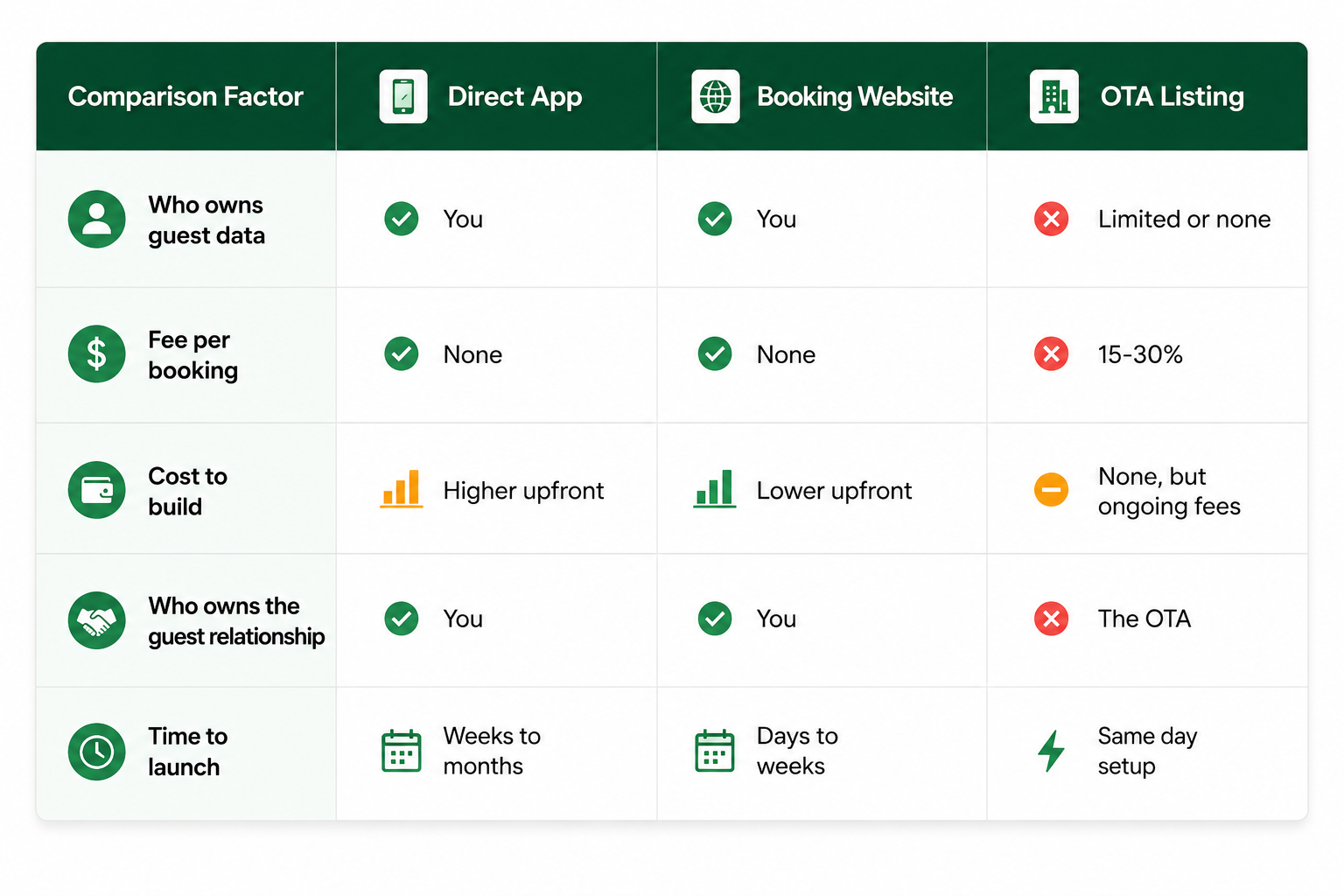
A direct app costs more upfront than a booking website, but it removes the recurring fee an OTA listing charges on every booking, which adds up fast over time.
Frequently Asked Questions
- How much does it cost to build a hotel booking app?
Hotel booking app development costs between $15,000 for a basic version and $400,000+ for a full-featured platform with system integration and AI features. Most single-property apps fall in the $50,000 to $120,000 range, though this varies by scope.
- How long does it take to build a hotel booking mobile app?
A basic version launches in 6 to 10 weeks. A mid-tier app with admin panels and system sync takes 3 to 5 months, and a full-featured platform can take 5 to 8 months.
- Should I build a native app or a cross-platform hotel booking app?
Cross-platform tools like Flutter or React Native work well for most hotel booking applications and cost less than building separate native apps, unless you need large-scale, real-time inventory updates across many properties.
- Do I need system integration for a hotel booking app?
Only if you're managing live room availability through an existing hotel system. A single-property app can launch without it, though most operators add it later once they're booking across multiple channels.
- Can a hotel booking app really compete with Booking.com or Expedia?
Not by copying their feature list. A direct hotel app development project competes by cutting OTA fees out of the equation entirely and keeping the guest relationship with you.
Build Your Hotel Booking App With LoudOwls
LoudOwls has spent 8 years building mobile apps across regulated, detail-heavy industries. A hotel booking app touches payments, guest data, and real-time inventory all at once, and getting any one of those wrong costs more to fix later than to build right the first time.
Our team works across Flutter and React Native, so whether you're building a lean single-property app or scoping something closer to a full booking platform, we can match the tech stack to your actual budget and timeline. We also work across hourly, dedicated team, and fixed-scope engagement models, so the structure fits your project from the start.