Mobile App Development Trends
Top 10 Mobile App Development Trends to Watch in 2026
Quick Summary * This blog explores the latest mobile app development trends re



Quick Summary
A package is shipped out of a warehouse in Dubai. It goes through three carrier handoffs, a customs clearance point and a last-mile network of riders before the delivery can be made to the recipient in Sharjah. At every step, data is generated. Order timestamps, vehicle GPS data, weight sensor data, and scan events. And at every step, that data disappears into a silo. The carrier has its data. The warehouse has its data. The e-commerce platform has its data. None of them talks to each other.
In 2026, most mid-market e-commerce businesses are still in the same situation as logistics digital twin development tech. Not a lack of AI ambition. A lack of connected infrastructure to make AI work.
The global AI in logistics market size was valued at USD 24.72 billion in 2025 and is projected to grow from USD 36.08 billion in 2026 to USD 742.03 billion by 2034 at a CAGR of 45.93% The companies that understand this gap are building real value right now. Because 2026 is not a transformation year. It is a foundation year.
The quality of AI models depends on the quality of the data they are based on. It's not a new concept, but a concept that's lost under the sensors, autonomous AI warehouse management system development and self-driving forklift hype. But before all that happens a single, unified, real-time data stream must flow throughout the logistics system.
Most mid-market logistics operations do not have that. They have warehouse management systems that export CSV files nightly, order management platforms that do not connect to carrier APIs, and spreadsheets that someone manually updates twice a week. That is not a data pipeline. It is a data graveyard.
The barriers are specific and well-documented. Legacy WMS and OMS platforms without open APIs make integration extremely difficult. This is where AI logistics software development 2026 actually starts, not with the model, but with the infrastructure the model will depend on.
Despite the infrastructure challenges, there are specific AI use cases in e-commerce logistics that are producing measurable, auditable returns right now. These are worth paying close attention to because they reveal where investment makes sense at this stage.
Currently, the application with the highest ROI for AI logistics software development 2026 is in this category. According to 2025 industry analysis that has referenced McKinsey research, a few examples of the benefits of relying on AI for forecasting include forecast error reduction of 20- to 50-percent, product unavailability reduction of up to 65 percent, and inventory cost reduction of 10-15 percent.

The mechanism is straightforward. AI demand models do not use rolling averages from past sales but instead respond to real-time data or signals such as promotions, weather, regional events, competitor prices, etc. that influence the demand for the products and adjust stock positioning accordingly. This results in fewer stockouts, less dead inventory, and much reduced carrying costs.
Fuel savings are being achieved consistently and in predictable ways, with AI route planning being the driver. AI systems can dynamically replan routes based on traffic conditions, new order entry, delivery window requirements and driver availability, unlike static route planning tools.
According to Fleet Rabbit's 2025 analysis, AI systems reduce delivery times by 25 percent and fuel consumption by 20 percent compared to traditional route planning. DHL's Greenplan dynamic routing algorithm achieved a 20 percent reduction in delivery costs.
Automated quality control using computer vision is reducing damage rates and mispick errors at fulfilment centres. A camera inspection system is used to flag any damaged or incorrect items and weight discrepancies, prior to leaving the packing stations for the warehouse. It's not just cheaper to catch a packing error at the warehouse; it's also preferable to dealing with a return, a replacement shipment, or a customer service interaction.
A significant share of logistics costs is not in the standard order flow. It is in the exceptions that are delayed shipments, failed deliveries, missing inventory, and carrier disputes. The predictive logistics software detection of exception patterns using AI models can help identify these events at an earlier stage and initiate automated exception resolution processes minimizing manual intervention at each stage.

The UAE's role in the AI logistics software development 2026 debate stems from proactive policies, geographical benefits, and infrastructure development that have benefited the country over the past few years.
According to Microsoft's AI Adoption Report for Q1 2026 the UAE reached a 70.1 percent AI adoption rate among its working-age population, making it the first country in the world to cross the 70 percent threshold. The global average sits at 17.8 percent.
For software development companies, the UAE is not just an addressable market. It is a reference market. The clients building AI logistics software development 2026 platforms here are building for scale, cross-border trade complexity, and regulatory environments that will look familiar to clients in Canada and the EU.
Generic WMS companies have built solid products for the operational core of logistics. They handle receiving, put-away, pick and pack, and shipping. What they have not built is a machine learning layer that adapts to your specific operational patterns over time. Their forecasting models are rule-based and batch-processed, neither real-time nor adaptive.
Enterprise platforms like SAP and Oracle offer AI capabilities, but their deployment model does not fit most mid-market operations. An enterprise SCM implementation takes 18 to 24 months and requires dedicated internal IT resources. For a business that needs to move this quarter, that timeline is not viable.
The gap is consistent. AI logistics software development 2026 platforms can be implemented within weeks, connect with current carrier and warehouse systems, and grow in stages with the increase in data quality are required for businesses.
Building for AI readiness in logistics is not the same as building a generic software platform and adding a machine learning module later. It requires specific architectural decisions made at the foundation level.
Every component of the platform must expose clean APIs. Every aspect of a AI warehouse management system development, order management, carrier integration and analytics must be able to be integrated with external systems and other aspects of the warehouse. If this doesn't happen, data remains isolated and AI models have no data to work with.
There are reasons for industry standards such as GS1 and EDI. Using standardised data schemas, a platform can be implemented with the possibility of connection to carrier networks, customs systems, and third-party analytics tools, without the need to custom develop each of those connections. The distinction between one that can grow and one that will add to maintenance efforts.
Logistics decisions are time-sensitive. A demand spike, a carrier delay, or a AI warehouse management system development capacity issue requires a response in minutes. Real-time event streaming infrastructure enables the platform to react to operational events as they happen rather than at the next batch processing cycle.
AI models in logistics need to be swappable. The demand forecasting model currently in use will need retraining as data volume grows. Modular inference pipelines allow individual models to be updated and replaced without disrupting the rest of the system.
All of this data, from AI warehouse management system development sensors and vehicle GPS to temperature readings and RFID data helps to enhance the performance of the AI model. Without an IoT integration layer, a logistics platform misses out on significant signal value.
The UAE is not alone in facing a data infrastructure challenge. The e-commerce logistics industry in Canada is expanding rapidly due to domestic e-commerce growth and the U.S. cross-border trade. The challenges of the legacy system and lack of in-house expertise and capacity to modernise the tech stack are the same in Canadian mid-market operations as in other markets.

The EU brings GDPR restrictions on data handling including for customer location data and delivery tracking. A logistics platform for the EU market should have privacy architecture built in, and not as an afterthought. What connects these three markets is that businesses in all of them need development partners who understand the operational reality of logistics, not just the technical capability to write software.
LoudOwls builds AI-powered software for complex operational problems. In logistics and supply chain, that means starting with the data infrastructure question before the model question.
LoudOwls builds e-commerce systems in the UAE, Canada, and the EU that are API-first, data-schema standard, event streaming in real time and modular ML inference pipelines. Whatever that requirement is, it's a forecasting module, last-mile delivery optimisation platform, 3PL management system or even a complete AI warehouse management system development, it all starts with the right foundation, gradual deployment and gradually increasing AI capability as the data quality improves.
Most ecommerce AI logistics software development 2026 functions are still struggling with a lack of clean and unified data. AI models need a good data pipeline to generate meaningful outputs. The top challenges in 2026 include data cleanup, API integration, sensor deployment, and system connectivity.
Demand forecasting can reduce forecast error by 20-50% and inventory savings of 10-15%. Route optimisation reduces fuel consumption by up to 20 percent and last-mile costs by 15 to 30 percent in the first year of deployment. and reduce last-mile costs by 15-30 percent during the first year of deployment. Then there are the consistent, auditable savings that can be realized through computer vision quality control and automated exception handling.
Through the UAE AI Strategy 2031, DP World's Jebel Ali and Jafza logistics technology investments, and a current AI adoption rate of 58 percent in supply chain AI enablement operations, the UAE leads the world in AI adoption, becoming the first country to cross the 70 percent in 2026.
Enterprise platforms like SAP and Oracle do offer AI capabilities, but they require 18–24 months to deploy and demand dedicated internal IT resources throughout. A custom AI logistics platform built on modular architecture can go live within weeks, integrate with your existing carrier and warehouse systems from day one, and scale gradually as your data quality improves. For mid-market operations that need to move this quarter, the enterprise timeline simply is not viable.
IoT devices are data source that makes AI models significantly more accurate. Warehouse sensors, vehicle GPS, temperature readers, and RFID tags all generate real-time signals that an AI model can act on. Without an IoT integration layer built into the platform from the start, a logistics operation misses out on the signal volume that separates a good AI model from a genuinely useful one.
GDPR imposes specific restrictions on how customer location data and delivery tracking information can be stored and processed. For logistics platforms operating in the EU, privacy architecture cannot be an afterthought added before launch. It must be designed into the data schema, API layer, and event streaming infrastructure from the beginning. Platforms that skip this step face expensive rebuilds when they try to enter or expand within EU markets.
Real-time event streaming is infrastructure that allows a platform to react to operational events as they happen, rather than waiting for the next scheduled data batch. In logistics, this matters because a demand spike, a carrier delay, or a warehouse capacity issue can develop within minutes. A platform processing data in nightly CSV exports cannot respond fast enough. Event streaming closes that gap and is one of the foundational requirements for any AI-ready logistics system.

Quick Summary * This blog explores the latest mobile app development trends re
LoudOwls
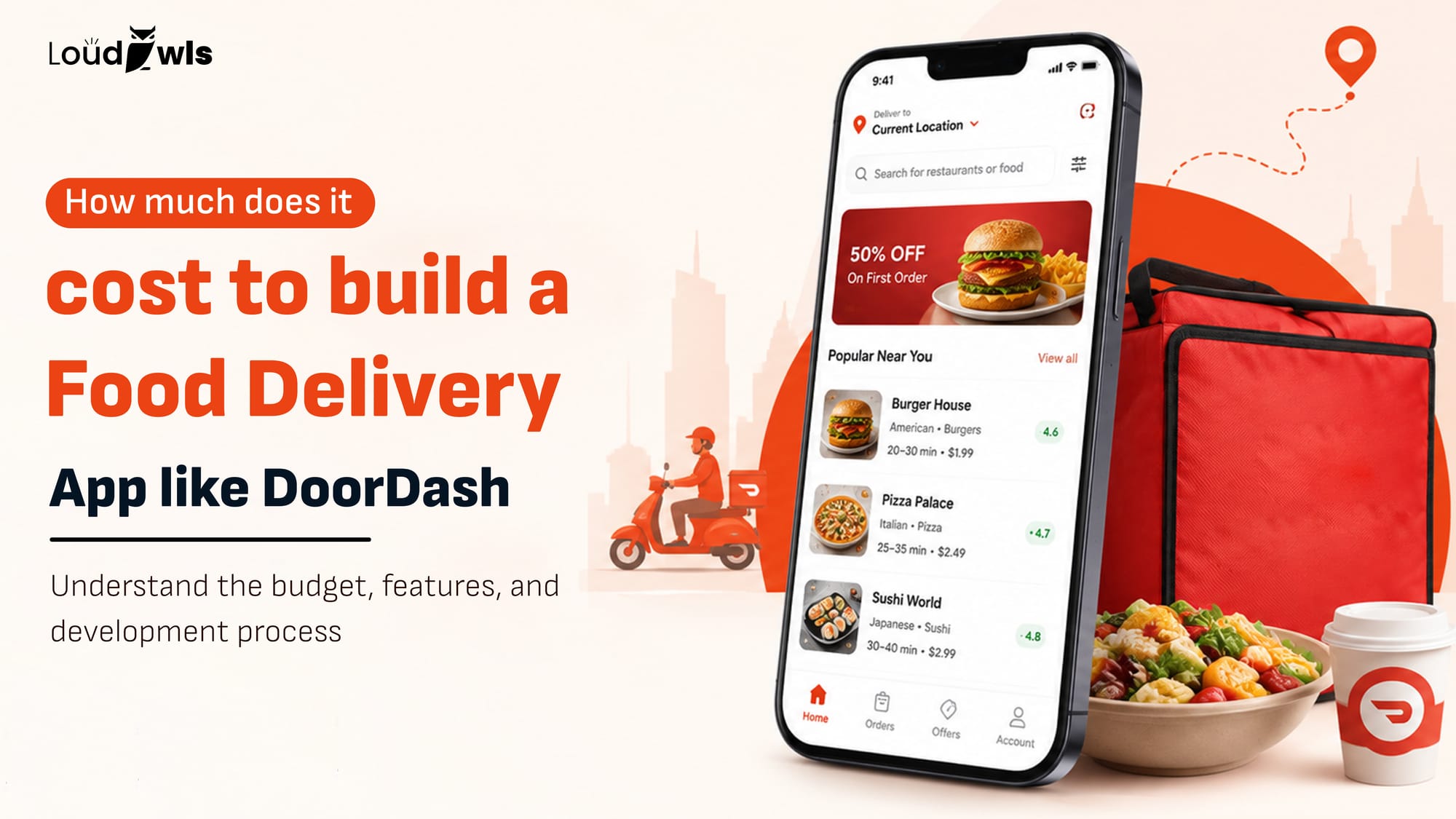
Key Takeaways ● A food delivery app like DoorDash typically costs $150,000
LoudOwls

QUICK SUMMARY- * A great mobile app development company in Canada combines pro
LoudOwls