Top 10 Mobile App Development Trends to Watch in 2026
This blog explores the latest mobile app development trends redefining how businesses build and scale digital products in 2026. It covers emerging technologies like AI, low-code development, Flutter, React Native, and 5G that are accelerating app development.

LoudOwls
·10 min read
Quick Summary
- This blog explores the latest mobile app development trends redefining how businesses build and scale digital products in 2026.
- It covers emerging technologies like AI, low-code development, Flutter, React Native, and 5G that are accelerating app development.
- It also highlights the growing importance of privacy compliance, wearables, AR, foldable devices, and adaptive app experiences.
- Discover the key considerations for choosing the right technology strategy to build competitive, future-ready mobile applications.
Every year brings a fresh batch of mobile app trends to watch, and most quietly disappear before the next budget cycle. 2026 is different: these mobile app development trends are already visible in framework adoption numbers, network data, and where development budgets are actually going. The US remains the largest single market for app revenue globally, an estimated $317.39 billion in 2026 alone (Statista), so decisions made here carry outsized weight for the whole industry.
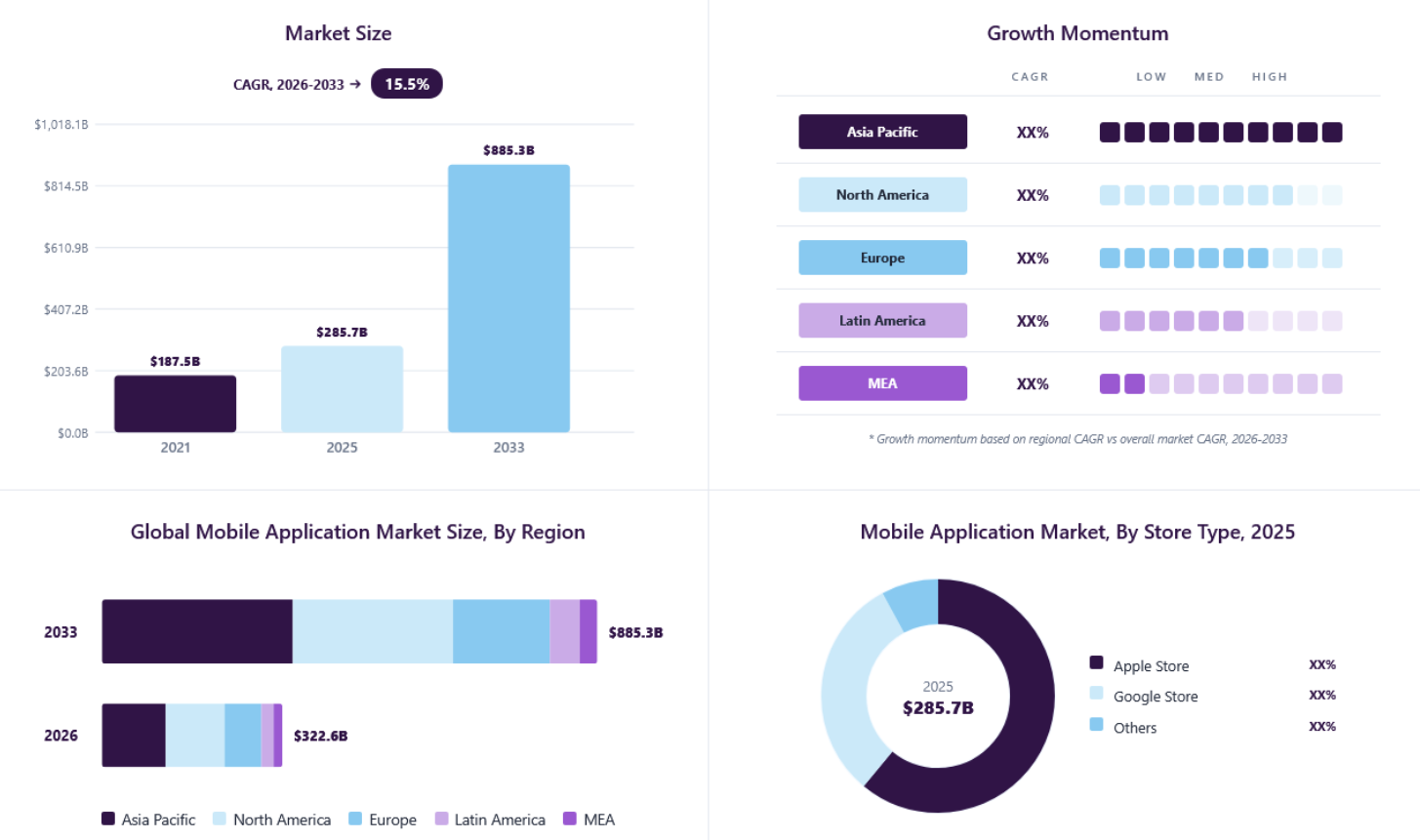
SOURCE- https://www.grandviewresearch.com/industry-analysis/mobile-application-market
If you're planning a build this year, whether that's a consumer app, an internal tool, or a project with a full mobile app development company behind it, these are the shifts worth understanding before a single line of code gets written.
Top mobile app development trends to Watch Out For in 2026
Some of these mobile app development trends are architectural decisions that shape your entire build. Others are smaller shifts worth knowing about before you scope a project. Either way, these are the mobile app trends actually moving the market right now, starting with the one changing how apps get designed from the ground up.
1. Mobile App Development in 2026: Why AI Is Now Built Into the Core
For years, "AI in mobile apps" meant a chatbot widget dropped into an otherwise ordinary product. That's changing. Development teams now design apps around on-device machine learning from day one, using frameworks like Apple's Core ML and Google's ML Kit to run inference directly on the phone instead of routing every request through a server. This is now a standard part of iOS app development specifically, where Core ML runs natively without any third-party dependency.
The payoff is speed. An app that predicts or personalises in real time, without waiting on a server, feels fundamentally different to use. For a business, that means AI stops being a feature line item and becomes an architectural decision made before the first wireframe exists.
If you're evaluating a mobile app development company for your next build, ask how they think about on-device intelligence from the start, not how they'd add it later.
2. Flutter vs. React Native: The Framework Choice for iOS and Android App Development
The native-versus-cross-platform debate has mostly settled for iOS and Android app development. According to Statista's developer survey, 46% of mobile developers now use Flutter, ahead of React Native, making these two frameworks the default starting point for most cross-platform projects.
The appeal is simple: one codebase, two platforms, lower long-term maintenance. Teams that once needed separate iOS and Android teams can now ship both experiences from a shared foundation.
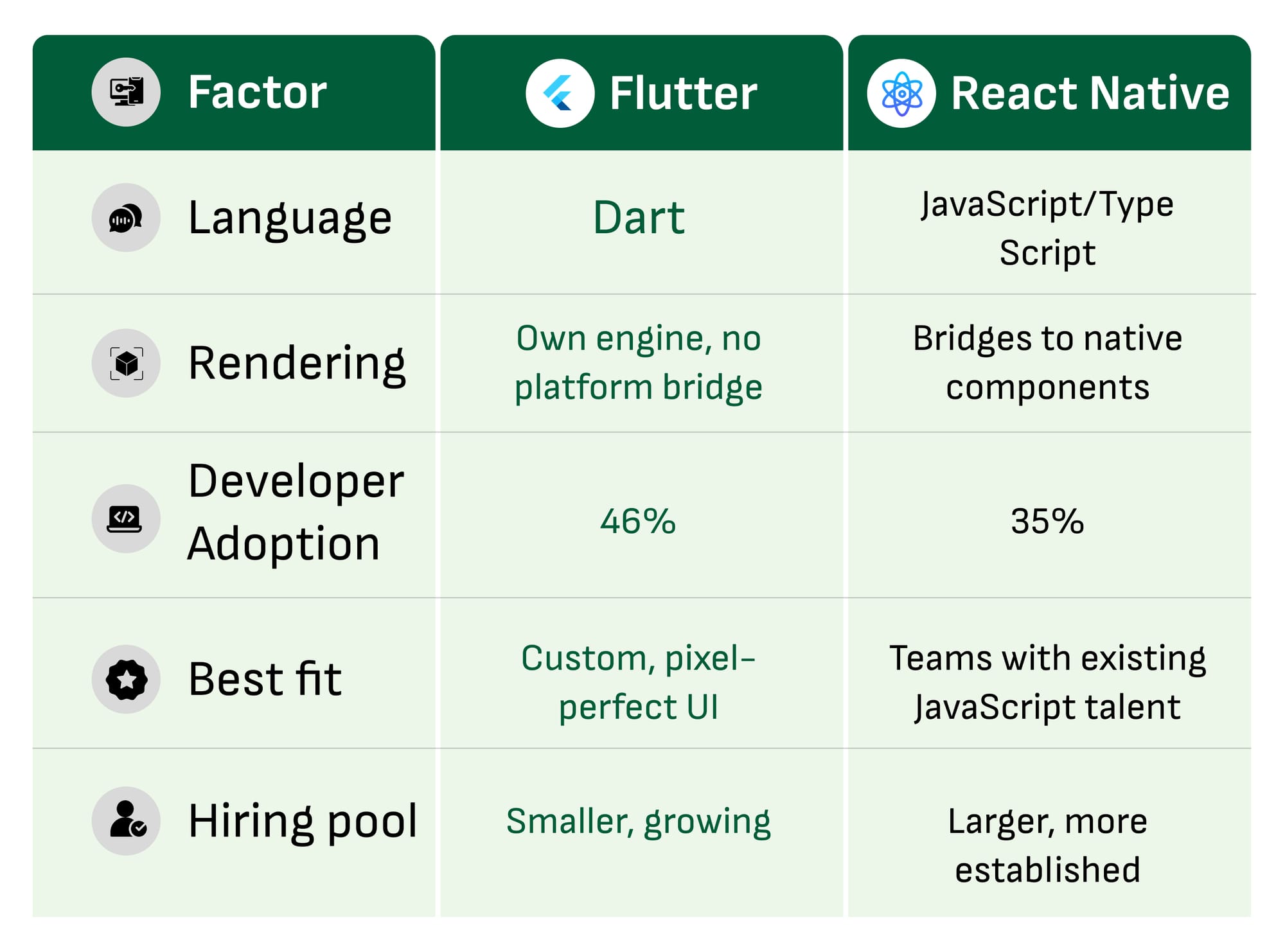
Neither framework wins universally. The right pick depends on your team's existing skills, how custom your UI needs to be, and how much long-term flexibility matters.

3. How Low-Code Is Reshaping Mobile App Development Services
This is the trend with the clearest data behind it. Gartner forecasts that by 2026, low-code tools will account for 75% of new application development, up from 40% in 2021, and that developers outside formal IT departments will make up at least 80% of the low-code user base, up from 60% in 2021.
That shift means faster MVP validation and smaller upfront budgets, without needing a large engineering team just to test whether a concept holds up. It doesn't replace custom development for complex, highly differentiated products.
The smartest teams use both: low-code to validate early, then full mobile app development services once the idea needs to scale past what a visual builder can support.
4. 5G Is Finally Mature Enough to Change What Apps Can Do
5G has been "arriving" for years. In 2026, it actually did. Ericsson's June 2026 Mobility Report confirms global 5G subscriptions passed three billion in Q1 2026, adding 162 million new subscriptions in three months, a figure forecast to more than double, to 6.4 billion, by 2031.
For developers, mature 5G coverage changes what's realistic to ship. Real-time video, cloud-rendered AR, and low-latency multiplayer now depend on network conditions that are common rather than exceptional, so features that felt experimental in 2022 are reasonable defaults now.
5. iOS App Development and Privacy: What's Actually Required Now
Privacy regulation reshaped mobile development gradually, then all at once, and US developers feel it from two directions this year. Apple's App Tracking Transparency framework, introduced in 2021, requires apps to ask explicit permission before tracking users across other apps, and that shift shows up clearly in iOS app development.
Adjust's data shows global opt-in rates starting around 16% in May 2021 and climbing to roughly 25% by mid-2022. AppsFlyer's more recent benchmark put the global figure at 50% by 2024, though other platforms report closer to 35% as of Q2 2025, reflecting different measurement methods. The methodologies vary, but the direction doesn't: opt-in rates have risen since launch as developers get better at explaining why tracking is worth it.
Layered on top is a distinctly American compliance problem: there's no single federal privacy law, so US-facing apps navigate a patchwork of state rules instead. California's CCPA, as amended by the CPRA, received a significant update effective January 1, 2026, adding mandatory cybersecurity audits, risk assessments, and new disclosure rules for automated decision-making. Virginia and Colorado run their own, differently structured versions of the same idea, meaning any app serving a national US audience has to design for the strictest applicable state law, not just the one where the company happens to be headquartered.
An app that simply asks "allow tracking?" gets a reflexive no. One that explains, in a plain sentence, why tracking helps remembering a cart, personalising a feed tends to see better results. Privacy engineering can't be retrofitted at launch anymore; it has to be scoped into the brief on day one, alongside a clear answer to which state's rules govern the strictest part of your user base.
6. Super Apps: One of 2026's Fastest-Growing Mobile App Trends
Super apps, single platforms bundling messaging, payments, commerce, and services into one ecosystem, built their reputation in Asia through WeChat and Grab, where a single login handles chat, ride-hailing, food delivery, and payments without ever leaving the app. That model is now showing up in Western markets too, as enterprise platforms and fintech products add service layers instead of staying single-purpose. Payment apps expanding into budgeting, investing, and peer-to-peer lending are an early US example of the same pattern, even if no Western platform has gone as far as its Asian counterparts yet.
The logic is retention: an app opened once a week for one task is easy to abandon; one opened daily for five reasons is not. Businesses building loyalty-driven products increasingly treat their roadmap as a question of adjacent value, not just core functionality, asking what else a user might reasonably do inside an app they already trust.
That doesn't mean every app should become a super app, and forcing unrelated features into a focused product usually backfires. It does mean 2026 roadmaps are built with room to expand, rather than treating expansion as a problem to solve in year three once the core product has already calcified around a single use case.
7. AR and Spatial Computing Enter Mainstream App Design
Augmented reality spent its first decade mostly in gaming and novelty filters. It's now showing up where it solves a real problem: furniture placement in retail apps, virtual try-on in beauty and fashion, spatial navigation in logistics, and remote assistance tools that let a technician see what a field worker sees in real time.
Cloud-based XR rendering is a big part of why this is finally practical at scale. Instead of demanding a headset like Apple's Vision Pro or high-end on-device processing, platforms like Google's ARCore and Apple's ARKit let developers build spatial features that run acceptably on an ordinary phone, with the heaviest computation streamed back from the cloud.
The lesson isn't "add AR because it's trendy." It's finding the one moment in a user journey where seeing something in physical space, before buying it, assembling it, or navigating to it, actually removes friction instead of adding a gimmick nobody asked for.
8. Foldables and New Form Factors Force Adaptive Design
Foldable phones moved from novelty to a real, if still niche, hardware category. Devices like Samsung's Galaxy Z Fold and Google's Pixel Fold have pushed both Android and iOS-adjacent design systems to account for screens that change shape mid-session, and that matters more for design systems than most people expect.
An interface built for a single fixed screen size breaks awkwardly on a device that switches between a phone-sized cover screen and a tablet-sized unfolded display. Text reflows badly, tap targets shift, and layouts built with hardcoded pixel dimensions simply look broken on the larger surface.
Teams that build with flexible grids and constraint-based layouts from the start handle foldables, tablets, and split-screen multitasking without a separate redesign project. Teams that hardcode fixed dimensions end up rebuilding the same screens repeatedly as each new form factor reaches the market.
9. Wearables Extend the App Experience Beyond the Phone
Smartwatches, fitness trackers, and increasingly smart glasses are no longer accessories tracked separately from the core app. Platforms like Apple's WatchOS and Google's Wear OS are becoming an extension of the phone experience itself, syncing data through frameworks like Apple's HealthKit and surfacing quick actions in moments where pulling out a phone isn't practical.
That has real architectural consequences. Data needs to sync reliably across devices with very different processing power, screen real estate, and battery limits, and a feature that works fine on a phone can drain a smartwatch battery in hours if it wasn't designed with that constraint in mind.
Health, fitness, and productivity apps are furthest along here, since step counts, heart rate, and workout tracking map naturally onto wearable hardware. But the pattern is spreading into categories that never used to think about wearables at all, from banking apps adding quick-glance balance checks to retail apps sending fitting-room notifications.

10. Sustainable, Efficient Engineering Gets Real Attention
The last trend is quieter than AI or AR, but it shows up in how teams actually write code. Battery efficiency, reduced background processing, and smaller app sizes are getting real engineering attention, partly from user expectations and partly because app store visibility increasingly factors in performance signals that platforms like Android's Battery Historian tooling make easy to measure.
This isn't a sustainability badge slapped on for marketing. It's writing apps that don't drain a battery in an hour, that don't quietly burn cellular data in the background, and that respect the fact that most phones aren't replaced every year anymore the way they once were.
Efficient code is good for the planet and good for retention, since a battery-draining or storage-hungry app is one of the fastest paths to an uninstall, especially on older or budget devices where every megabyte and every percentage of battery matters more than it does on this year's flagship.
What This Means for Your Next Build
These mobile app development trends connect to each other rather than existing in isolation. A 2026 app is increasingly likely to combine several at once: an AI-native feature set, built cross-platform in Flutter or React Native, with privacy and US state compliance scoped in from the brief, and validated early through a low-code prototype before full development begins.
The businesses that get ahead this year aren't chasing every trend at once. They're picking the two or three that genuinely serve their users and building those well. Before your next build, it's worth asking yourself a few honest questions:
- Could I clearly explain to a user what data my app collects and why, and do I know which state privacy laws actually apply to them?
- Am I still maintaining two separate codebases for iOS and Android instead of one shared foundation?
- Would a low-code prototype answer my open product questions faster than committing straight to a full build?
- Does my current app architecture bolt AI on as an afterthought, or is it built around it as a foundation?
If two or more of those questions gave you pause, that's usually where to start.

Frequently Asked Questions
- Is Flutter or React Native better for a 2026 app?
Neither is universally better. Flutter leads in developer adoption (46% versus React Native's 35%, per Statista) and offers more UI consistency across platforms, while React Native benefits from a larger, more established JavaScript talent pool that's often easier and faster to hire for. For most iOS and Android app development projects, the right call comes down to your team's existing skills more than either framework's raw popularity.
- Do I need AI features to compete in 2026?
Not every app needs AI, but the apps winning attention increasingly build intelligence into the core experience rather than adding it as a bolted-on feature. The better question is whether on-device prediction, personalisation, or automation would genuinely improve your specific user journey.
- Is low-code development a replacement for custom app development?
No. Low-code works best for early validation, internal tools, and MVPs where speed matters more than deep customisation. Complex, performance-critical, or highly differentiated products still benefit from full mobile app development services.
- How does 5G actually change what my app can do?
Mature 5G coverage makes real-time video, cloud-rendered AR, and low-latency features realistic for mainstream users instead of a small early-adopter segment, since the network conditions behind them are now widely available rather than exceptional.
- Do US apps need to worry about anything beyond Apple's App Tracking Transparency?
Yes. US privacy compliance means navigating separate state rules, with California's CCPA/CPRA the strictest and most closely watched. Its January 2026 update added new audit and disclosure requirements that apply regardless of where a company is headquartered, as long as it serves California users.