Mobile App Development Trends
Top 10 Mobile App Development Trends to Watch in 2026
Quick Summary * This blog explores the latest mobile app development trends re


Quick Summary
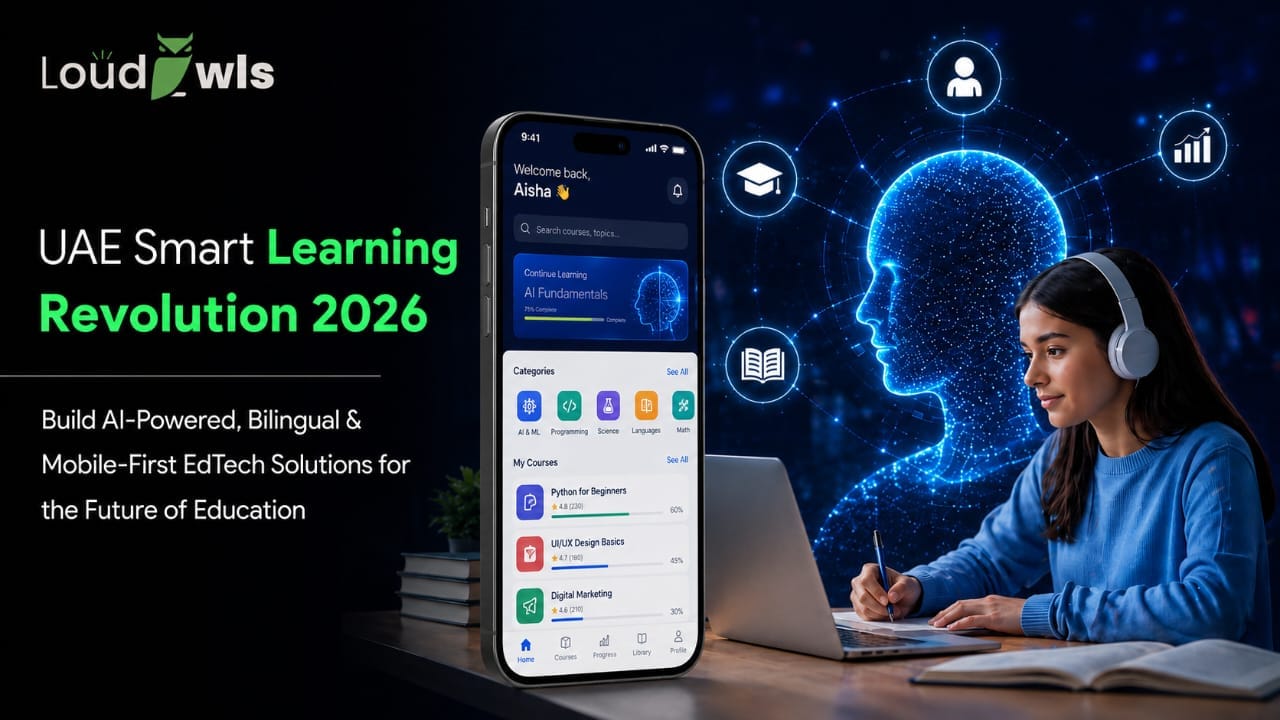
The UAE is getting ready to make the education system digital with the UAE Smart Learning Initiative, a national initiative to use digital education in line with UAE Vision 2031 and the UAE's future based on Artificial Intelligence. AI-powered learning systems, bilingual education platforms, school management software, and mobile-first classroom technologies are the main areas of heavy investment by schools, universities, training institutes, and government education bodies in the realm of AI education.
This is one of the largest opportunities available for EdTech startups and software companies in the global education technology market in 2026.
There is an increasing need for:
But, getting into the UAE market isn't just about making apps! Compliance, localisation in Arabic, cloud scalability, student data privacy, and the integration of modern AI are all key factors in achieving success.
LOUDOWLS — AI educational app development Company assists startups, institutions and enterprises with developing intelligent, scalable, UAE-ready education software. Whether it's an AI-driven learning app or a multi-language school management system, Loudowls creates future-proof EdTech solutions tailored for the UAE market.
The UAE is one of the most ambitious countries in terms of digital transformation over the last decade. The country has continued to be a global leader in all the areas of innovation including smart cities, AI governance, Global use of blockchain technology and autonomous infrastructure.
Education is now one of the most vital aspects of that change.
UAE's education landscape is shifting from classrooms to a networked, AI-powered, digital learning environment in 2026. Schools are increasingly implementing smart classroom systems, universities are beginning to digitize the teaching and learning processes of courses, and parents are increasingly demanding a mobile-first approach to education for their children.
The smart learning UAE Initiative, a government-backed initiative aimed at modernizing education and integrating advanced technology and AI into classrooms, is driving this transformation.
The UAE Smart Learning Initiative is a federal initiative focused on digital education, aimed at transforming the country's learning landscape by introducing educational technology and AI-driven educational solutions.
Its objective isn't just to digitize classrooms, but to fundamentally change the way education is taught, experienced and customized.
The project aims to be closely connected to:
The programme is dedicated to building an education ecology that will enable students to learn any time, any place, with networked digital devices and smart learning systems.
Adopting a digital approach to teaching and learning is the UAE government's quick way to reform traditional curriculum frameworks. This includes:
This gives rise to a high demand for modern LMS platforms and curriculum delivery systems from digital education software UAE suppliers.
In the UAE, AI is increasingly emerging as a key component of the future of education.
Schools increasingly want:
For developers, it is no longer an option, but a competitive necessity, to adopt AI app development Dubai services.
While the pandemic has driven a fast pace of remote learning, the UAE government has been investing significantly in hybrid education facilities.
Schools now want platforms that enable them to:
The government has actively promoted private investment in EdTech with the following measures:
This makes the UAE market a very favorable market for EdTech companies.
The UAE education sector offers several unique benefits that make it attractive to software firms and investors.

The UAE is a country where digital education is progressing at a relatively fast pace, quite different to other countries where the implementation of the policy is slow. Adoption of innovation is rapid, budgets are large and government initiatives are quick.
This enables schools and institutions to use newer technologies in a more aggressive manner than many Western education systems.
The UAE is one of the world's most technologically advanced countries regarding smart phone and internet usage.
Compared to less digitised markets, students, parents and teachers are already digitally connected and adoption of learning apps will be significantly easier.
The UAE education system consists of learners of dozens of nationalities and education backgrounds.
This diversity brings a need for:
Schools in the United Arab Emirates (UAE) can typically allocate more funds to technology than many other developing countries.
Private schools invest particularly in:
This makes the UAE a promising B2B EdTech market.
In the UAE, AI is fast emerging as the backbone of the next generation of educational software.
The government sees AI not just as a productivity tool but as an important, strategic capability in the future that will drive economic growth.
Consequently, schools are becoming more and more aspirational of AI- native learning experiences.
In 2026, UAE EdTech Market Trends will shape the future of the sector.UAE EdTech trends 2026 will be defining the future of the sector for developers.
The UAE education sector is rapidly changing and when developers join the market, they must be aware of the trends that shape their purchases.
The most obvious lesson for app developers is that generic LMS platforms are not sufficient anymore.
Schools are now calling for a deeper level of digital ecosystems tailored to UAE learning environments.
One of the most important aspects of entering the UAE education market is regulatory compliance.
The Knowledge and Human Development Authority (KHDA) is responsible for the regulation of private education in Dubai, and is a significant player in the assessment of digital education systems.
There are many international startups that fail to realise the importance of compliance whilst developing products.
This sometimes results in:
Any educational site that processes students' data should adhere to UAE data protection laws.
This includes:

Content of learning must align with UAE Ministry of Education curriculum frameworks.
Accessibility Standards
Today, the educational platform has to be accessible to all devices and learning levels.
Bilingual (English/Arabic) support is frequently necessary for government related contracts.
Many education systems will need UAE or regionally-compliant hosting infrastructure.
Initially, LOUDOWLS builds compliance ready architecture, ensuring that the EdTech startup can scale faster in the UAE market without needing to re-architect core systems later on.
There are numerous companies that are not aware of the technical complexity of constructing a genuine bilingual education platform.
Arabic localisation is not just a translation of UI text. It affects the entire product architecture, user experience, navigation logic, typography system and even AI functionality.
The biggest technical challenge is to create fully responsive port-RTL interfaces.
Arabic screens need a whole application structure that changes dynamically.There is a need for the whole application structure to change dynamically in Arabic screens as opposed to English based layouts. This affects:
If the RTL implementation is not done well, it becomes immediately unnatural for the users who speak Arabic. This hurts the trust, usability, and adoption rates, particularly in education where clarity and accessibility are crucial.
Today's schools in the UAE demand native Arabic interfaces rather than those that are 'transliterated' from English.
Many developers don't realize how vital the role of typography is in Arabic EdTech.
Arabic scripts have connected characters, variable letter shapes and space behaviours which directly influence the readability of the script across devices and screen sizes.
Poorly optimised typography can have a negative effect on:
The key to successfully optimising educational platforms is to carefully consider:
This is especially critical when used on tablets, Chromebooks, smartphones and interactive classroom displays.
The UAE classrooms are predominantly bilingual classrooms in which Arabic and English are heard at all times.
People frequently use English to read lessons and are taught, assessed or given explanations in Arabic. The teacher could also change the language dynamically in the course of teaching.
Consequently, today's EdTech platforms need to accommodate:
These experiences need much more engineering work compared to normal localisation systems.
With the proliferation of AI-driven educational tools, Arabic text processing adds an additional layer of complexity.Arabic language processing adds a new dimension of complexity as AI-driven education tools become increasingly prevalent.
Arabic AI systems need to be able to manage:
This is particularly important for:
There remains a significant opportunity for regionally-specialised EdTech companies to spur higher performance of many global AI systems in Arabic.
LOUDOWLS — AI App & Software Development Company's bilingual education apps start from Arabic-first design to support seamless RTL experiences, scalable support for multiple languages, and AI-ready infrastructure for UAE schools and EdTech startups.
The UAE education system is fast moving towards a mobile-centric environment.
Today's students demand a learning experience that happens fluently across devices — phones, tablets, laptops and classroom devices. Meanwhile, schools are becoming more common and are implementing BYOD (Bring Your Own Device) policies to cut costs and increase access to devices.
That implies that the educational site used cannot simply be built for desktop customers.
On the contrary, today's EdTech products need to be seamless in working with:
This for developers alters the whole strategy of product architecture and user experience.
The UAE Schools expectations of what Modern Learning Apps can do.
Now, UAE educational institutions consider platforms not just in terms of features, but also in terms of performance, accessibility, scalability, and user experience quality.
Schools desire all students and teachers to have the same experience across all devices.
A student should be able to get on a Chromebook, carry on their progress on a phone, and come back to review later on a tablet without any interruptions.
That's why cross-platform solutions like Flutter and React Native are gaining significance in developing school apps for the UAE.
The Internet connection in a classroom, in a home, in a transportation system, or in a remote learning environment might differ.
Modern learning apps need to be able to provide offline first capabilities such as:
The ability to work offline is particularly vital for continuous learning for students.
Educational Apps should work as soon as you use it.
Engagement and classroom usability can be drastically affected by slow-loading dashboards, sluggish assessment time, or burdensome mobile apps.
Optimisation should be done to make the modern EdTech platform both functional and accessible:
In UAE Edtech, the focus has shifted to performance optimisation as a key differentiator in the market.
There is a new urgency to being accessible and it is not an option anymore.
These are all new features that schools are increasingly expecting platforms to support:
Use of learning platforms that are accessible makes them easier to use for all learners and meets the needs of the government and institutional procurement.
LOUDOWLS builds performance and mobile-first education platforms built on scalable cloud stacks, Flutter, React Native and modern PWA designs that are tailored to the UAE school and digital learning landscape.
The UAE education sector remains a key opportunity for startups to address local challenges.
There is a growing desire from schools to have adaptive solutions that customize learning experiences to students' behaviors, performance, and engagement.
The lack of a truly Arabic-native LMS and learning platform for educational environments in the GCC is a huge gap in the market.
Tools of mobile communication that connect schools, teachers and parents continue to grow rapidly.
The UAE's efforts to build a workforce are resulting in robust investment in enterprise learning platforms and training systems.
Schools desire more insight into classroom performance, engagement data and academic results.
There is growing emphasis in K-12 settings for employing gamification and behavioural design for engagement-based learning experiences.
However, the UAE EdTech market is very competitive, and technically challenging.
UAE institutions are looking for top-tier digital experiences, similar to the world's leading tech platforms.
Large-scale government and enterprise education contracts may be subject of a lengthy approval and procurement process.
Platforms should be able to support very high concurrency during school hours, examinations and peak learning times.
Educational Software must adhere to stringent security protocols regarding student data and school information.
Successful products must be adapted to the UAE educational process, language, and culture and not just localised.
The future of educational technology in the UAE will focus on AI-driven, personalized, and immersive learning experiences. Schools and universities are rapidly adopting artificial intelligence to customize lessons, track student progress, and improve learning outcomes. Smart classrooms equipped with interactive boards, virtual reality (VR), and augmented reality (AR) will become more common, making education more engaging and practical.
Hybrid learning models will continue to grow, allowing students to learn both online and offline with greater flexibility. The UAE is also emphasizing future-ready skills such as coding, robotics, cybersecurity, and digital literacy to prepare students for an AI-powered economy.
Another major trend is the rise of data-driven education, where analytics help teachers identify learning gaps and support students more effectively. EdTech startups in the UAE are also expanding quickly, introducing innovative platforms for remote learning and skill development. With strong government support and digital infrastructure, the UAE is set to become a leading global hub for educational innovation and smart learning solutions.
The UAE Smart Learning Initiative is more than just converting classrooms into smart spaces; it's transforming the future of learning for the region. The UAE is rapidly moving towards an AI-led, knowledge-based economy, and both schools and universities and training institutions are making significant investments in smarter, faster, and more personalised ecosystems for learning.
The shift is opening up huge possibilities for EdTech startups and app developers in 2026.

From AI-powered tutoring systems and adaptive learning platforms to bilingual school management software and mobile-first education apps, the demand for innovative digital learning solutions is growing at an unprecedented pace. However, achieving success in the UAE market is not just about technical development.
That's where AI App & Software Development Company LOUDOWLS comes in handy.
Loudowls supports EdTech startups, schools, universities and businesses to create education technology for the future specifically for the UAE and GCC market. From creating AI-driven learning apps and bilingual LMS platforms to school ERP systems and scalable mobile learning solutions, our team has the expertise to deliver cutting-edge tech solutions with a regional perspective.
The UAE Smart Learning Initiative is a government-driven program focused on integrating advanced digital technologies into schools and universities. It promotes smart classrooms, AI-based learning tools, digital content, and interactive teaching methods to improve education quality across the country.
Artificial intelligence is helping schools personalize learning experiences for students. Ai in education can track performance, identify learning gaps, automate assessments, and provide customized study recommendations, making education more efficient and student-focused.
UAE smart classrooms commonly use interactive smart boards, cloud-based learning platforms, virtual reality (VR), augmented reality (AR), AI-powered learning systems, and digital collaboration tools to create engaging and modern learning environments.
Smart learning improves student engagement, flexibility, and accessibility. It allows students to learn at their own pace, access digital resources anytime, and develop future-ready skills such as coding, problem-solving, and digital literacy.
Yes. Many schools and universities in the UAE continue to use hybrid learning models that combine physical classroom teaching with online education. This approach offers flexibility and ensures uninterrupted learning experiences.
The future of EdTech in the UAE will focus on AI-driven personalized education, immersive VR learning, smart campuses, data-driven teaching, and skill-based digital education. The UAE is expected to become one of the leading innovation hubs for smart education globally.
Quick Summary * This blog explores the latest mobile app development trends re
LoudOwls
Key Takeaways ● A food delivery app like DoorDash typically costs $150,000
LoudOwls

QUICK SUMMARY- * A great mobile app development company in Canada combines pro
LoudOwls