AI app development cost
How Much Does It Cost to Build an AI App in 2026? A Complete Guide
Quick Summary * Building an AI app can cost anywhere from $15,000 to over $500

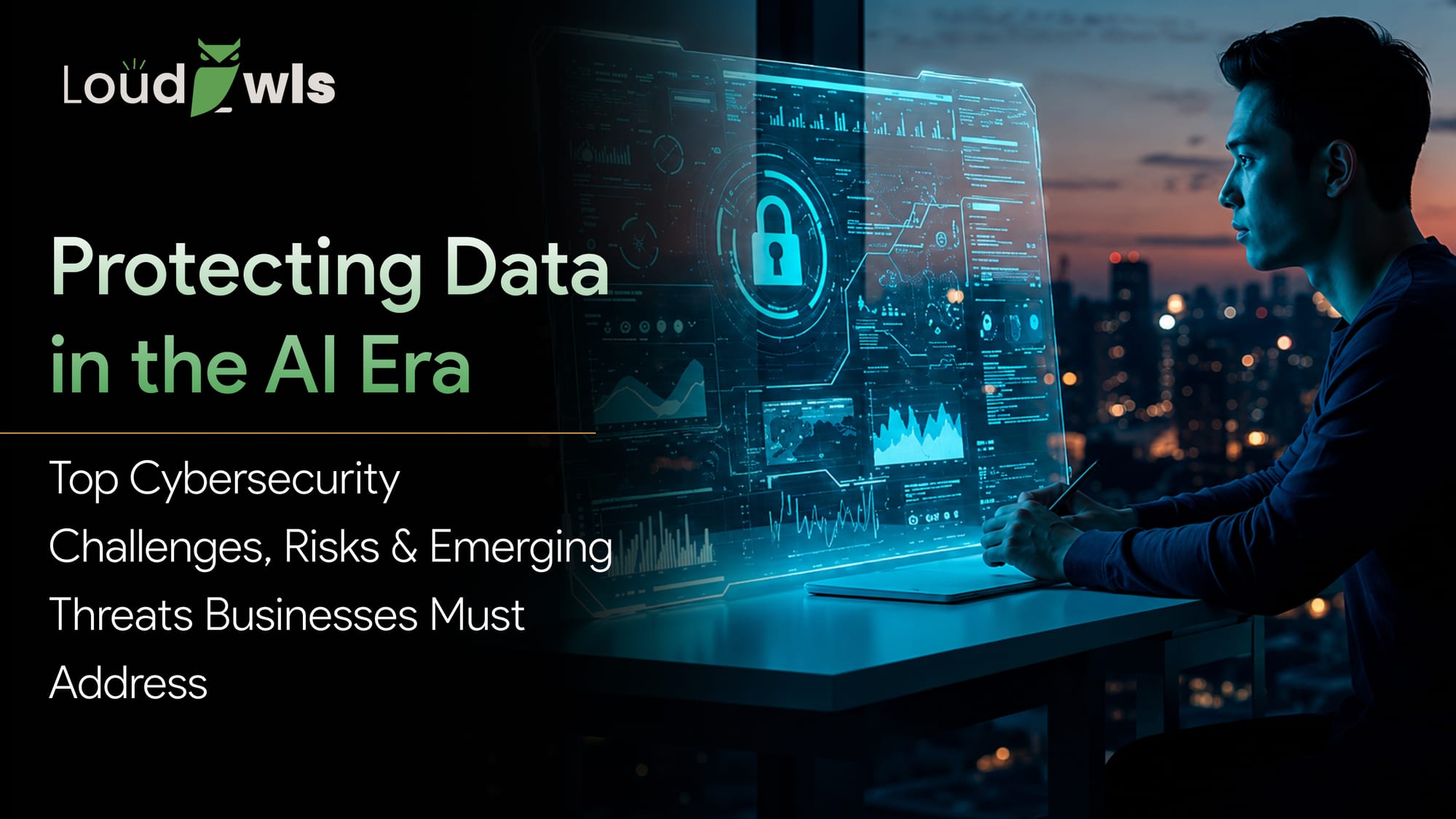

Artificial Intelligence (AI) is transforming industries at an unprecedented pace. From automating repetitive tasks to improving decision-making and customer experiences, AI is helping businesses achieve higher efficiency and innovation. However, as organizations increasingly adopt AI-powered technologies, new concerns around data security, data privacy, and data protection in AI environments are emerging.
Cybercriminals are now leveraging AI to launch more sophisticated attacks, while organizations struggle to secure sensitive data across increasingly complex digital ecosystems. As AI adoption accelerates, businesses must rethink their security strategies and invest in advanced cybersecurity solutions and AI security solutions to stay protected. According to the World Economic Forum, 71% of cyber leaders believe smaller organizations can no longer adequately defend themselves against increasingly complex cyber threats.
In this article, we'll explore the biggest cybersecurity challenges in the AI era, emerging threats, and practical strategies organizations can implement to safeguard their data.
Traditional cybersecurity frameworks were intended for static threats. Unfortunately, threat actors today are leveraging AI to dramatically scale the delivery of hyper-personalized, automated attacks. AI-driven cyber threats have become more capable, faster, and even more flexible, making threat detection and defense that much more difficult.
71% of cyber leaders at the Annual Meeting on Cybersecurity believe that small organizations have already reached a critical tipping point where they can no longer adequately secure themselves against the growing complexity of cyber risks.
This widening cyber inequity is becoming a top concern as sophisticated attacks become increasingly targeted and complex.
Malicious threat actors now leverage generative AI to generate hyper-realistic phishing messages and impersonate leaders via voice cloning. By the time security teams remediate vulnerabilities, threat actors have exploited those vulnerabilities multiple times. In addition, deepfake cybersecurity threats add another dangerous layer, potentially rendering traditional verification methods ineffective by replacing video footage or voices, further advancing malicious impersonation schemes.
The implications of this change from broadly "automated" indiscriminate attacks to targeted attacking intrusions driven by AI is a seismic shift in organizations’ approach to cybersecurity.
AI systems depend on training data—frequently sourced from real world assets. This generates a new risk class, particularly in the light of machine learning data leaks. If sensitive data is mishandled when training a model, it may unintentionally create training data leaks in either the internal or external context.
Two especially vulnerable attack vectors include:
These AI vulnerabilities can trigger an AI data protection breach that violates personal or sensitive privacy, in addition to opening legal and reputational issues for businesses.

With increasing accessibility of AI tools, employees are using AI tools without the supervision of the IT department. These tools fall into the category of shadow AI, unauthorized use of these tools may process customer data for example, financial records, or other confidential documents excluding any sanctioned infrastructure. Shadow AI implementations may result in failures in AI risk management due to improved use of AI tools.
Without any governance in place, the implementation of AI tools lacks the necessary safeguards and are more susceptible to a breach directly targeting shadow AI. Limited visibility and accountability through the organization by the absence of a formal AI governance framework yet challenges organizations.
Organizations must move from a reactive response to establishing tangible internal policies defining the use of, access to, and compliance around any and all AI implementations.
Legacy security tools such as firewalls and antivirus programs are no match against modern smart and dynamic cyber threats. These tools rely on static rules, and modern attackers utilize AI to adapt and evolve in real-time.
2025 data shows that organizations using AI and automation in their cyber defenses save on average $2.2 million per breach versus those who do not. To keep up, organizations must transition to AI-augmented security—think of the following:
These tools facilitate real-time threat visibility and faster response—important elements in an unstable security environment. Organizations that rely on legacy security systems are placed at a greater disadvantage than their modern counterparts.
Today’s enterprise relies upon a wide variety of cloud providers, APIs, and external platforms. Though these technologies can be high-leverage productivity tools for workers, they have also broadened the attack surface. Exposed APIs, misconfigured cloud services, and vendors that can’t be vetted can expose an organisation to significant data breaches.
Neal Jetton, Director, Cybercrime Directorate, INTERPOL, highlights the need for unified action:
"The complexity of today’s cyber threats and evolving criminal methodologies requires a unified response. This response requires coordination not only from the global law enforcement community, but with cybersecurity experts who provide their own talents, experiences and expertise. In 2024, INTERPOL’s Cybercrime Directorate supported several regional and global cybercrime operations that were very successful in large part due to these collaborations. As we move into 2025, our team will continue to pursue new partnerships and strengthen existing ones to have an even greater impact disrupting cybercriminal activity."
Data governance for artificial intelligence systems is imperative. It enables safe integration of the technology, allows access control to be defined, and ensures compliance is achieved within the organization. Routine assessments of third-party risks and security audits should be part of every organization’s artificial intelligence adoption strategy.
To ensure AI data protection in this evolving environment, organizations must take a proactive and layered approach. Key strategies include:
Security is no longer a one-time investment—it’s a continuous commitment. Cybersecurity Ventures predicts global cybercrime costs will exceed $10.5 trillion annually.
“AI is accelerating the speed of cyberattacks, with breakout times now often under an hour. The ability of hackers to use AI—from creating convincing phishing emails, fake websites, and even deepfake videos—allows cybercriminals
Artificial intelligence is enhancing the future of business, but it also presents us with more sophisticated and untraceable types of risk if not monitored. Companies must elevate their focus on data privacy, safe model development, and proactive risk management with AI just like they are leveraging AI for new innovative capabilities.
By demonstrating meaningful and respectful security practices, companies can not only protect against today’s cyber risk—but build trust and confidence from their customers, their regulators and their stakeholders, in an AI enabled world.
Need help safeguarding your data in the AI era? Connect with LoudOwls to build smarter, more secure digital solutions.
Artificial intelligence is revolutionizing how businesses operate, but it is also creating new challenges for protecting sensitive information.
From AI-powered phishing and deepfakes to Shadow AI and machine learning data leaks, organizations face increasingly sophisticated threats that demand proactive security strategies.
Strong data security, comprehensive governance frameworks, and advanced AI security solutions are no longer optional—they are essential for business resilience.
By investing in robust data protection in AI environments today, organizations can confidently embrace innovation while safeguarding their most valuable digital assets.
As AI adoption accelerates, protecting sensitive information has never been more important. LoudOwls helps businesses implement secure, scalable, and future-ready digital solutions designed to address evolving cybersecurity challenges.
Connect with LoudOwls today to strengthen your security posture and build confidence in an AI-powered future.
AI systems often process large volumes of sensitive information. Strong data security measures help prevent unauthorized access, data breaches, and compliance violations.
Key challenges include AI-powered phishing attacks, deepfakes, data leakage from AI models, Shadow AI, and third-party security risks.
Shadow AI refers to the unauthorized use of AI tools by employees without approval or oversight from IT and security teams.
Organizations should conduct risk assessments, implement Zero Trust Architecture, establish AI governance policies, and deploy advanced AI security solutions.
These include phishing attacks, deepfake scams, automated vulnerability exploitation, and AI-generated malware designed to bypass traditional defenses.
AI security solutions help organizations detect threats faster, automate responses, and identify suspicious behavior patterns that traditional tools may miss.
Professional data protection services help businesses secure sensitive information, ensure compliance, reduce breach risks, and strengthen overall cybersecurity posture.

Quick Summary * Building an AI app can cost anywhere from $15,000 to over $500
LoudOwls
Quick Summary * This blog explores the latest mobile app development trends re
LoudOwls

Key Takeaways ● A food delivery app like DoorDash typically costs $150,000
LoudOwls