How Much Does It Cost to Build an App in the UK? (2026 Price Guide)
The cost of building an app in the UK ranges from a few thousand pounds to well over a quarter of a million, depending on scope. Mobile app development means designing, building, testing, and launching a software application for phones and tablets.

Pardip Bhatti
·10 min read
Bg Green: Quick Summary
- App development cost UK ranges from £8,000 for a basic MVP to £300,000+ for a complex, regulated build.
- Mobile app development cost depends more on features, integrations, and compliance than on which platform you pick.
- A standard SME app usually costs £30,000 to £80,000, with a three- to six-month build.
- London day rates run 15–30% above the UK average outside the capital.
- Maintenance adds 15–20% of your build cost every year, so budget for it before launch.
[CTA Green: Talk to LoudOwls](https://www.loudowls.com/contact-us)
How Much Does App Development Cost in the UK Right Now?
The cost of building an app in the UK ranges from a few thousand pounds to well over a quarter of a million, depending on scope. Mobile app development means designing, building, testing, and launching a software application for phones and tablets.
Ask three agencies for a quote, and you'll get three different numbers. That's not padding. It reflects how much "an app" can vary from one business to the next.
A loyalty app for a coffee chain and a two-sided delivery marketplace can look similar on a one-page brief. The engineering work underneath is nowhere close to the same.
This guide breaks down 2026 UK app development pricing by app type, platform, team structure, and timeline. You'll see what pushes a quote higher, what you can trim safely, and where hidden costs tend to surface after launch.
The figures below reflect UK market data gathered from industry sources rather than one agency's rate card. Treat them as a benchmark, then get a scoped quote once your feature list is settled.
Average app development cost UK figures sit around £90,780 across all project sizes, according to Clutch's directory data, though that number is skewed upward by a handful of large enterprise builds.
How Much Does It Cost to Build a Simple App in the UK?
A simple app with one core workflow and a handful of screens typically costs £8,000 to £30,000. This tier covers MVPs, single-purpose utility apps, and internal tools built to test an idea.
Expect an eight- to twelve-week build, handled by a small team: one developer, a part-time designer, and light project management.
Simple doesn't mean careless. A rushed MVP with no user testing often needs a costly rebuild within a year. Spending a bit more on early UX research often saves money down the line.
Think of this tier as a way to answer one question cheaply: does anyone actually want what you're building? Everything else can wait.
How Much Does a Mid-Complexity App Cost?
A standard SME production app costs £30,000 to £80,000. This band covers user accounts, a few third-party integrations such as payments or mapping, push notifications, and a polished, brand-matched interface.
Build timelines run twelve to twenty-four weeks, depending on scope and how many review rounds you build into the process. Most SME projects land well below the £90,780 average cited above, since that figure gets pulled upward by a small number of very large enterprise builds.
Most growing UK businesses land somewhere in this range. If you're comparing quotes and one comes in far outside it, ask what's driving the gap before you assume it's the best or worst deal on the table.
Testing rounds are the part people underbudget most. Two rounds of real user feedback, with time built in to act on it, often makes more difference to the final product than any single feature you add.
What Drives Up Mobile App Development Cost in the UK?
Five factors have the biggest impact on any app development quote: platform choice, design complexity, backend and integrations, compliance requirements, and team location. A fintech app with open banking integration will always cost more than a static content app with a similar screen count.
- Backend complexity is easy to underestimate. An app that just displays content needs far less server-side work than one syncing data across users in real time, like a booking or logistics tool.
- Third-party integrations are a common budget surprise. Payment processing, live chat, mapping, and analytics tools each add development and testing time, and some carry ongoing licence fees on top of the build cost.
- Compliance is a quieter cost driver. Apps handling health data, financial transactions, or children's information need extra security review, accessibility testing, and sometimes legal sign-off before launch.
- Design complexity matters more than most founders expect. A custom UI with bespoke animations costs £6,000 to £18,000 on its own, against £2,000 to £6,000 for a well-executed template-based design.
- Team location shifts the number too. A London-based agency typically charges 15–30% above the UK average, driven by higher overheads and stronger competition for experienced developers.
What Do Different App Types Cost to Build?
Different categories of app carry very different price tags because complexity varies so widely. The table below gives realistic UK cost ranges by app type for 2026.
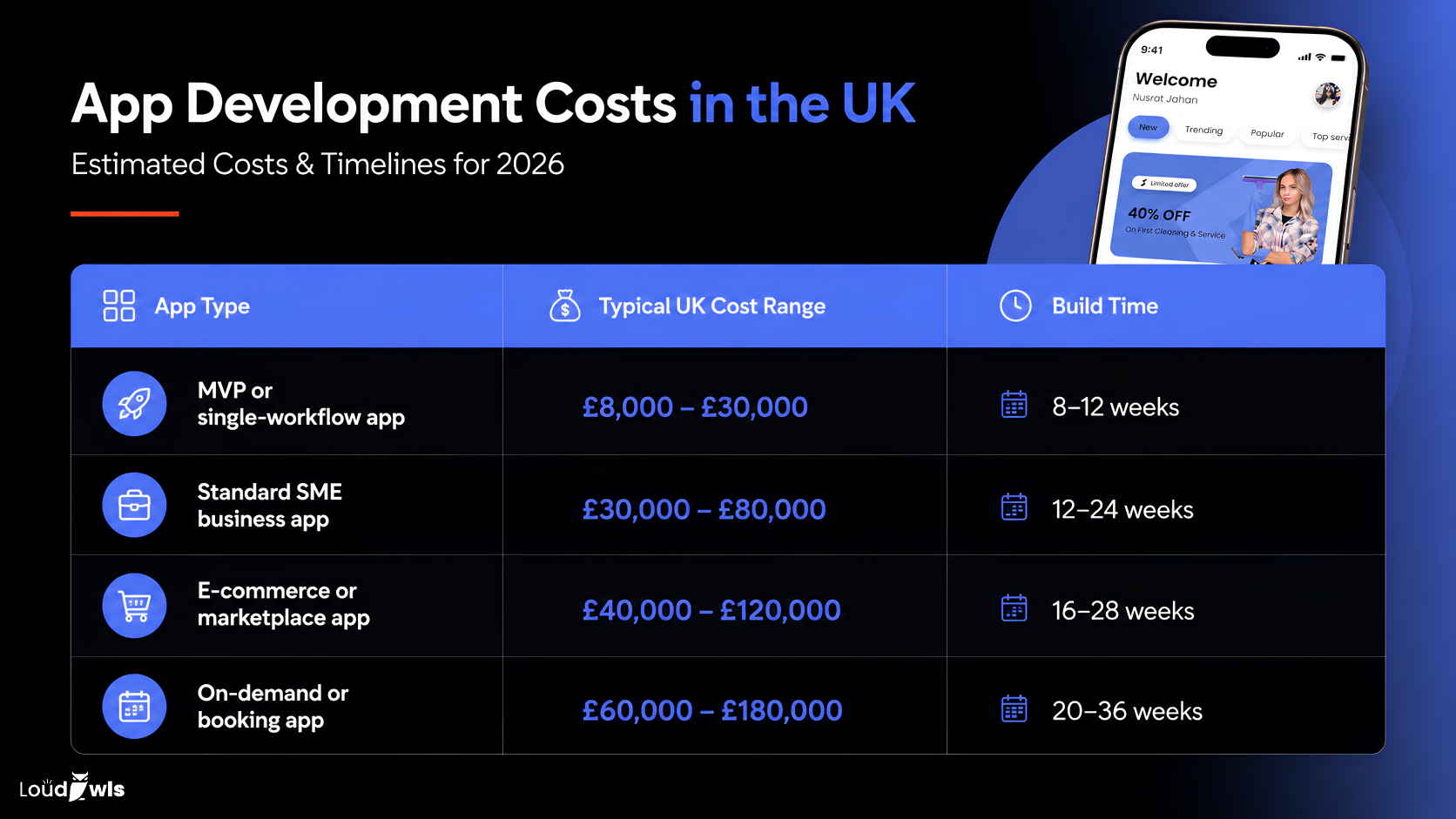
These figures assume a single mobile platform or a cross-platform framework such as Flutter or React Native. Building separate native iOS and Android apps typically adds 50–70% to the total cost.

iOS vs Android: Which Platform Costs Less?
Neither platform is reliably cheaper once you look past the headline number. iOS development tends to move faster because Apple's device range is narrow, which cuts testing time.
Android needs broader testing across screen sizes, chipsets, and OS versions, which adds hours even when the feature set matches an iOS build exactly.
The real question isn't which platform costs less. It's which platform your users are actually on.
A consumer app aimed at a younger, urban UK audience may skew iOS-heavy. A utility or B2B tool used across a wider demographic may see stronger Android numbers instead.
Most teams solve this by building cross-platform from day one, then going fully native only once real usage data justifies the extra spend. Rebuilding natively later is normal, not a sign of a failed first build.
In-House Team vs Agency vs Freelancer: What's the Real Cost Difference?
In-house hiring gives you full control but carries the highest fixed cost. A UK software developer's average salary reached roughly £65,000 in 2026, before recruitment time and employer overheads.
A typical mid-complexity project needs at least a developer, a designer, and a QA tester working together, not one generalist covering all three.
Freelancers look cheaper per hour, but they bring more project risk. You're relying on one person's availability and skill range across design, development, and testing at once.
Agencies sit in the middle. You pay for a coordinated team and shared accountability. UK agency day rates averaged around £500 in 2026, roughly £530 in London and £510 outside it.
When comparing agencies, ask to see a past project close to your scope, not just a polished portfolio. It tells you far more about how they'll handle your build. For most SME projects, an agency offers the strongest balance of cost predictability and delivery risk.
Is It Cheaper to Outsource App Development Outside the UK?
Offshore rates can look attractive on paper, with some regions quoting 40–60% below UK prices, but the real comparison rarely stops at the hourly rate.
Time zone gaps slow feedback loops and can stretch a straightforward project by weeks. Communication gaps around UK-specific compliance, payment rails, or user expectations add risk that never shows up in the initial quote.
A hybrid model is usually the practical middle ground. A UK-based project lead manages requirements and quality, while part of the build happens in a compatible time zone.
For UK businesses in regulated sectors, keeping the full project onshore is usually worth the premium. It means someone is directly accountable if something breaks after launch, rather than a support ticket sitting in a queue overseas.
How Long Does It Take to Build an App in the UK?
Timelines track closely with the cost tiers above. A simple MVP typically ships in eight to twelve weeks, while a standard SME app takes twelve to twenty-four weeks.
A complex, regulated build can run from six months to well over a year, once compliance review and multiple testing rounds are factored in. Rushing a timeline rarely saves money. Compressed schedules usually mean more parallel work streams, which pushes up hourly costs even as the calendar shortens.
Build in buffer time for App Store and Google Play review, too. Rejections over minor policy issues are common and can add a week right when you expected to launch.
What Costs Show Up After Launch?
Launch isn't the finish line, and this is where first-time app owners often get caught out. Annual maintenance typically runs 15–20% of your original build cost every year.
That figure covers bug fixes, OS compatibility updates, and minor feature work. Hosting, API usage fees, app store fees, and customer support tools sit on top of it.
Budget for these costs during scoping, not after your app is live. An agency that raises maintenance costs early in the conversation, rather than after the contract is signed, is usually one worth trusting.
How Can You Reduce App Development Costs Without Cutting Quality?
Scope discipline saves more money than a cheaper hourly rate ever will. Start with an MVP that tests your core assumption, not every feature on your wish list. Every extra screen is one more thing to design, build, test, and maintain for years to come.
Cross-platform frameworks like Flutter or React Native can cut costs by 30–40% compared with building separate native apps, with little real-world performance trade-off for most business apps.
A hybrid delivery model can help too. Pairing a UK-based project lead with a development team in a nearby time zone brings real savings while keeping communication straightforward.
Phasing your release also spreads the cost out. Launch the core workflow first, gather real feedback, then fund the next round of features from actual usage data instead of guesswork.
UK founders should look at government support before assuming the full cost falls on them. R&D Tax Credits and Innovate UK grants can offset development spend for qualifying projects, though most eligible businesses never apply.
What Mistakes Push UK App Costs Higher Than They Need to Be?
A handful of avoidable mistakes account for most budget overruns on UK app projects, and spotting them early costs nothing.
- Skipping the discovery phase. Jumping into design without documenting user flows, edge cases, and technical constraints almost always leads to costly rework mid-build.
- Adding features before validating the core idea. Every extra feature multiplies design, development, QA, and maintenance work, and most of that effort is wasted if the core concept hasn't been tested.
- Choosing a provider on price alone. The cheapest quote can exclude testing, post-launch support, or compliance work that a more transparent quote includes from the start. You pay for it later anyway, usually at a worse rate.
- Ignoring data protection early. Any UK app collecting personal data needs to meet UK GDPR requirements from the design stage, not bolted on before launch. Retrofitting it into a finished app costs far more.
How Do You Get an Accurate App Development Quote?
A useful quote depends on what you bring to the conversation, and a thin brief almost always comes back with a thin, unreliable number.
Before approaching a developer or agency, write down your core user journey in plain language: what does someone do in the app, step by step, from opening it to completing their goal?
List any integrations you already know you need, such as payments, mapping, or login through an existing system. Flag any regulatory requirements, particularly in healthcare, finance, or any sector handling sensitive personal data.
A good UK development partner will turn that brief into a phased quote covering discovery, design, build, testing, and launch as separate line items. That structure makes it easier to see where your money is going, and where there's room to trim scope if the total comes in higher than expected.
Why Work With LoudOwls on Your App Build?
LoudOwls scopes every project through a discovery phase before quoting a fixed price, so the number you sign off on already accounts for integrations, compliance needs, and testing rounds rather than expanding once the build is underway.
Quotes come broken down by phase: discovery, design, build, testing, and launch, so you can see exactly where the budget goes and where there's room to adjust scope if needed.
The team works across the UK, UAE, and Canadian markets, which means experience with the compliance and payment quirks specific to UK app projects, not just general mobile development.
Maintenance and post-launch costs get discussed at the scoping stage, not after a contract is signed, so there are no surprises once your app is live.
Frequently Asked Questions
- How much does it cost to build an app in the UK for a startup?
Most UK startups building a first MVP should budget £8,000 to £30,000 for a single-workflow app with a lean feature set. This covers core functionality, basic design, and a small development team, without the extras a scaling business adds later.
- What is the average app development cost in the UK in 2026?
The average sits around £90,780, according to Clutch's directory data, though that figure is skewed upward by large enterprise projects. Most SME apps actually cost between £30,000 and £80,000, a more realistic benchmark for a typical business build.
- Is mobile app development cost higher in London than the rest of the UK?
Yes. London day rates and salaries typically run 15–30% above the UK average outside the capital, largely due to higher overheads and stronger competition for experienced developers. A team based outside London can lower costs without sacrificing quality.
- How much does app development cost per hour in the UK?
UK agency day rates averaged around £500 in 2026, which works out to roughly £60 to £70 per hour depending on team seniority. Freelance rates vary more widely, typically £30 to £120 per hour based on experience and specialism.
- Does app development cost include ongoing maintenance?
No. Most initial quotes cover build and launch only. Ongoing maintenance typically adds 15–20% of the original build cost each year, covering bug fixes, security patches, and OS compatibility updates. Budget for it separately from day one.
Getting Your App Development Cost Right From the Start
Mobile app development costs in the UK cover a wide range for good reason. A basic MVP and a regulated fintech platform aren't the same project, and pretending otherwise is how budgets fall apart mid-build.
Use the ranges above as your starting benchmark, then get a scoped quote based on your actual feature list, platform choice, and compliance needs.
Businesses that stay on budget plan for maintenance, integrations, and testing before signing a contract, not after.