How to Build an App Like Zillow: Cost, Features & Tech Stack
Building an app like Zillow requires smart search, maps, listings, and personalised recommendations. Real estate app development can include saved searches, alerts, virtual tours, and agent communication.

Niti Aggawal
·7 min read
BG green: Quick Summary
- Building an app like Zillow requires smart search, maps, listings, and personalised recommendations.
- Real estate app development can include saved searches, alerts, virtual tours, and agent communication.
- A powerful property search app helps users find properties by location, price, type, and amenities.
- Zillow clone app development can start with an MVP and scale with custom features for your market.
- A real estate MVP can cost around $35K–$60K CAD, depending on features and complexity.
- Development typically takes around 4–6 months for a focused MVP.
- The right technology stack can support scalability, security, and future AI-powered features.
How a Real Estate App Like Zillow Works
If you're considering real estate app development, understanding why Zillow works is more valuable than simply copying its features. The strongest real estate platforms are built around how people actually search, compare, and make property decisions.
1. Instant Price Estimates
Showing estimated property values alongside asking prices helps users compare listings faster, reduce uncertainty, and make more informed decisions.
2. Map-First Search
A property search app should make location central to the experience. Interactive maps, nearby listings, and location-based filters help users explore properties in the areas that matter to them.
3. Saved Searches & Alerts
Saved searches and instant notifications keep users coming back. When a matching property becomes available, users can discover it without having to search again.
4. In-App Communication
Built-in chat, agent contact, and appointment scheduling remove unnecessary steps between property discovery and enquiry—helping turn searches into real leads.
5. Trust & Transparency
Verified listings, agent profiles, property history, and pricing information can make a property listing app feel more credible and give users greater confidence before contacting a seller or agent.
The Key Takeaway
Successful Zillow clone app development isn't about copying Zillow's interface. It's about understanding the behaviours that make the platform useful—discover, compare, save, connect, and trust—and adapt those experiences to your target market.
The result? A real estate product that is easier to use, more valuable to agents and buyers, and built for long-term growth.
Must-Have Features for a Real Estate App Like Zillow
Before adding advanced capabilities, your real estate app development project needs a strong foundation for both property seekers and professionals.
For Buyers & Renters
- Smart Search & Filters — Find properties by price, location, type, size, and amenities.
- Interactive Map View — Explore available properties directly by location.
- Saved Listings & Alerts — Save favourites and get notified when matching properties appear.
- Mortgage Calculator — Estimate monthly payments without leaving the app.
- Agent Chat — Let users ask questions and schedule viewings instantly.
For Agents & Sellers
- Listing Management — Add, update, and manage property listings with ease.
- Lead Dashboard — Track inquiries and manage potential buyers in one place.
- Listing Analytics — Monitor views, saves, inquiries, and overall performance.
- Profile & Listing Verification — Build credibility and increase trust across the platform.
Advanced Features to Scale Your Real Estate App Like Zillow
Once your MVP proves demand, advanced features can help your real estate app development project improve engagement, differentiate from competitors, and support long-term growth.
- AI-Powered Price Estimation — Use market and listing data to provide smarter property valuations and help users make informed decisions.
- Virtual Tours & 3D Walkthroughs — Let buyers explore properties remotely before scheduling an in-person visit.
- AR Room Visualisation — Help users visualise furniture, layouts, and potential renovations directly within the app.
- CRM Integration for Agents — Connect leads and inquiries with existing agent workflows to make follow-ups faster and more effective.
- Personalised Recommendations — Use search behaviour and preferences to surface properties that are more relevant to each user.
- Multi-Language & Multi-Currency Support — Expand into new markets by adapting the experience to local languages, currencies, and property preferences.
How to Get Property Data for a Zillow-Like App
Property data is one of the most important parts of a Zillow-style platform. Depending on the market, you can use MLS integrations, regional property APIs, data partners, or direct agent and owner submissions.
For an MVP, direct listings can be a practical starting point. As the platform grows, MLS or regional data integrations can help expand inventory and keep listings more current. Data access, licensing, freshness, and local rules should be considered before development begins.
Tech Stack for an App Like Zillow
When planning real estate app development, the technology should deliver what users notice most: speed, reliability, accurate search, and room to scale.
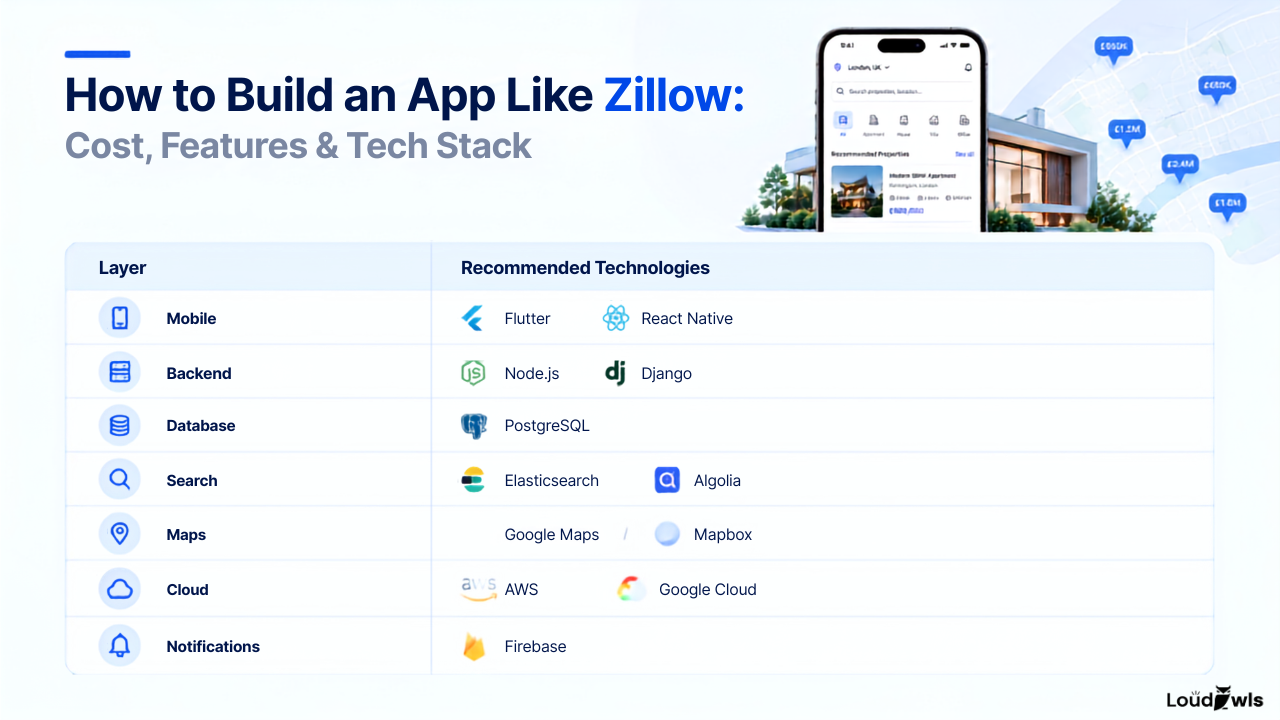
- Cross-Platform Development — Build for iOS and Android together to launch faster and control development costs.
- Fast Property Search — A strong backend should handle location-based search, filters, and thousands of listings without delays.
- Reliable Maps & Location — Smooth maps and accurate location features are essential for any property search app.
- Scalable Backend — Your property listing app should handle growing users, listings, and traffic without requiring a complete rebuild.
- Real-Time Notifications — Instant alerts for new listings, price changes, and saved searches keep users engaged.
For an app like Zillow, you don't need technology that sounds impressive—you need technology that keeps the experience fast, reliable, secure, and scalable as your real estate business grows.
Build an App Like Zillow: Cost & Timeline
The cost of real estate app development depends on how much you want to build in the first release. A focused MVP can launch relatively lean, while a Zillow-style platform requires significantly more development.
MVP Real Estate App
- Cost: $35,000–$60,000 CAD
- Timeline: 4–6 months
- Includes: Property listings, search and filters, map view, saved properties, alerts, user accounts, and basic agent communication.
Advanced Real Estate App
- Cost: $80,000–$150,000+ CAD
- Timeline: 7–10 months
- Includes: AI-powered valuation, virtual tours, advanced search, agent dashboards, analytics, CRM integrations, and more.
What Affects the Cost?
- Number of platforms and user roles
- Search, maps, and geolocation requirements
- AI and third-party integrations
- Agent and admin dashboards
- Custom design and advanced features
You don't need to build everything at launch. Start with a focused MVP, validate demand, and add advanced features as your property listing app grows.
How to Build a Real Estate App Like Zillow: Step-by-Step
A successful real estate app development project starts with a focused MVP and grows based on real user demand.
1. Research & Validate
Study your target market, competitors, users, and business opportunity before development begins.
2. Define the MVP
Prioritise essential features such as listings, search, maps, filters, alerts, and user accounts.
3. Choose a Development Partner
Work with a real estate app development company experienced in location-based and data-driven platforms.
4. Design the Experience
Create and test simple, intuitive experiences for buyers, renters, agents, and sellers.
5. Build the MVP
Develop the frontend, backend, database, APIs, and map integrations in focused phases.
6. Test & Refine
Test search, maps, listings, performance, security, and usability before launch.
7. Launch & Learn
Release the MVP, monitor user behaviour, collect feedback, and identify what needs improvement.
8. Scale Strategically
Add advanced features such as AI valuation, virtual tours, personalisation, and CRM integrations as demand grows.
Launch a useful product quickly, validate the market, and invest in features that users actually need.
How Real Estate Apps Like Zillow Make Money
Understanding how real estate apps make money can help build a sustainable business from the start.
- Featured Listings — Let agents and sellers pay to promote properties in search results.
- Agent Subscriptions — Offer premium plans with analytics, lead management, and advanced listing tools.
- Lead Generation — Charge agents for qualified buyer or renter inquiries through the property search app.
- Transaction Commissions — Earn a percentage from successful property transactions.
- Advertising — Partner with mortgage, insurance, moving, and home-service providers.
A successful real estate mobile app can combine 2–3 revenue models to create multiple income streams while keeping the property listing app experience useful and user-friendly.
FAQs About Building a Real Estate App Like Zillow
- How do I get property listing data for my app?
You can source listings through MLS integrations, regional property APIs, data partners, or direct agent and owner submissions. For an MVP, starting with direct listings can be more practical.
- Can I use Zillow’s data in my app?
Not directly. A Zillow-like app typically needs its own MLS connection, property data provider, or listings submitted by agents and owners.
- Do I need MLS integration for a real estate app?
Not necessarily for an MVP. You can start with direct agent or owner listings, then add MLS or regional data integrations as inventory and market coverage grow.
- How much does it cost to build an app like Zillow?
A basic MVP can cost around $35,000–$60,000 CAD, while an advanced platform with AI, MLS integration, and custom tools can reach $80,000–$150,000+ CAD.
- How long does it take to build a real estate app?
A focused MVP can take around 4–6 months. A more advanced real estate mobile app may take 7–10 months, depending on features and integrations.
- What features should a property listing app have?
Core features include map-based search, property filters, listing details, saved properties, alerts, user profiles, and agent communication.
- How do real estate apps make money?
Common revenue models include featured listings, agent subscriptions, lead generation, advertising, and transaction commissions.
- Can I build a real estate app for a specific country or city?
Yes. A Zillow-like platform can be adapted to a specific market with local listings, currencies, languages, regulations, search behaviour, and property data sources.
- Can I build a real estate app without coding?
No-code tools can work for a simple MVP, but a large property search app may eventually need custom development for MLS integrations, advanced search, maps, and scalability.
- What tech stack is best for a Zillow-like app?
Popular choices include React Native or Flutter for mobile, Node.js or Django for the backend, PostgreSQL for property and location data, and Elasticsearch or Algolia for fast search.