How to Choose the Right Mobile App Development Company in Canada
QUICK SUMMARY-
A great mobile app development company in Canada combines proven technical depth, transparent processes, and a portfolio that matches your industry, not just a long client list.
Before signing any contract, ask direct questions about team structure, post-launch support, pricing models, and who actually owns your code and IP.
Watch for red flags such as vague quotes, no discovery phase, and reluctance to share references. These usually predict problems later in the project.
The app development company you choose in Canada does not just build software. It shapes your timeline, your budget, and whether your product actually reaches the market on schedule.
Picking a development partner isn't as simple as comparing price quotes. Ask any founder who has been through it twice: the difference between a company that delivers and one that drags a project into missed deadlines and rising costs usually comes down to a handful of decisions made before the contract is even signed.
So, how do you separate a capable mobile app development company in Canada from one that only sounds capable in a sales call? This guide covers what to look for, what to ask, what to watch out for, and why this decision matters more than most founders think going in.
What Makes a Great Mobile App Development Company in Canada?
There's no certification, no badge, no stamp of approval for a good app development company in Canada. It usually comes down to how they operate once the contract is signed, and not what their homepage promises.
A few things separate the companies that deliver from the ones that just talk well:
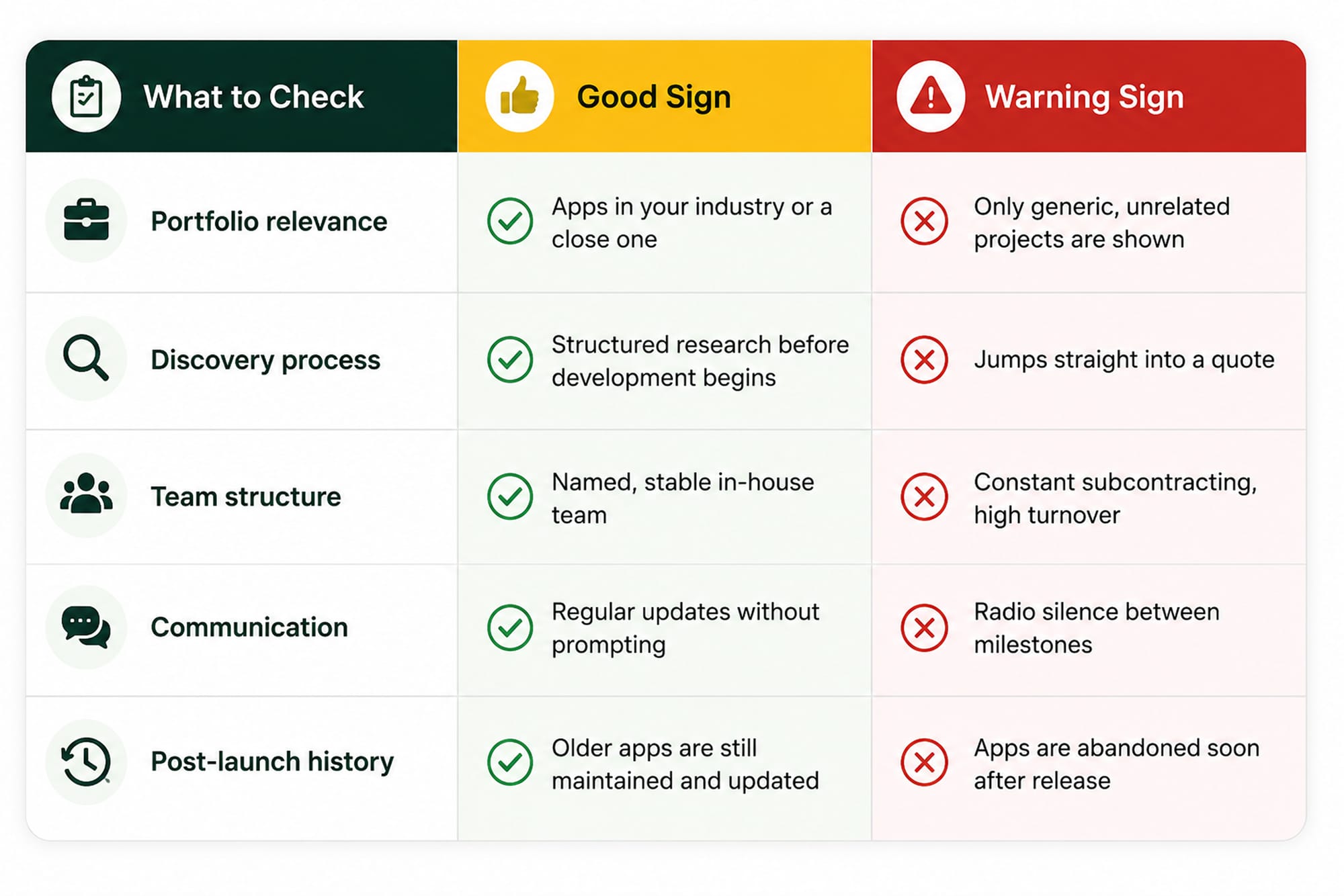
Their portfolio matches what you need. A company that has built five fitness apps and three e-commerce platforms is not automatically the right fit for a fintech product. Look at the categories they have shipped in, not just the total number of apps.
They ask before they build. A discovery phase, where the team studies your users, your competitors, and your business goals before writing a single line of code, is a sign they are thinking about your product, not just executing a spec sheet.
Their team is in-house or close to it. Fully outsourced benches change constantly. When your developer this month is not your developer next month, context gets lost and so does momentum.
They communicate without being chased. You should not have to send three follow-up emails to find out where things stand.
Their older apps are still alive. Check the App Store or Play Store for what they've shipped before, and see if anything's been touched in the last two years.
Here is a quick way to compare shortlisted companies against each other.
Questions to Ask Before Hiring Mobile App Developers in Canada
A portfolio shows what a company has built. The interview reveals how they work. Ask direct questions and pay close attention to how they answer, not just what they say.
1. Who exactly will be working on my project?
Ask this early. Find out who your lead developer and project manager will be, and how much experience they have with your platform. Some agencies pitch senior experts but assign junior developers after the contract is signed. If they can't identify your team upfront, consider it a warning sign.
2. What does your development process look like, start to finish?
Don't accept "we follow agile" as the full answer. Ask for a clear walkthrough—from discovery and wireframing to prototyping, testing, and launch. An experienced team will explain its process with specific milestones, sprint cycles, and review stages.
3. How do you handle changes to the project scope?
Project requirements often evolve. Ask how scope changes are managed, including approvals, costs, and timeline updates. A reliable development partner has a documented change process, not informal agreements that can lead to misunderstandings later.
4. Who owns the source code and intellectual property once the app is finished?
Make sure the contract clearly states that you own the full source code and intellectual property. Never rely on verbal promises get ownership terms in writing.
5. What does post-launch support include, and for how long?
Launching your app is only the beginning. Ask what post-launch support covers, how long it lasts, and whether it's included or billed separately. Operating systems change, bugs appear, and security updates are inevitable, so clear maintenance terms help you avoid unexpected costs later.
6. How do you calculate your cost and timeline estimates? Ask for a detailed breakdown by feature, sprint, or team hours. Transparent estimates help you understand costs and avoid unexpected budget overruns.
7. What kind of testing happens before anything reaches the App Store?
“We test everything thoroughly” isn't an answer. It's a dodge. Push harder: load testing under real traffic, security audits, and real devices instead of just simulators. How deep they go tells you how seriously they take it.
Red Flags to Avoid When Choosing an App Development Company
Some red flags show up on the first call. Others don't surface until you're already three months in. That's exactly why it's worth knowing them now.
Vague, verbal only quotes. A serious app development company puts scope, cost, and timeline in writing before any work begins. A number thrown out over the phone with nothing in writing? Be cautious.
No real discovery phase. If a team is ready to start coding on day one, without asking who your users are, what your competitors are doing, or what success looks like for your business, that is a shortcut being taken at your expense.
Timelines that sound too good to be true. A complex app rarely ships in three or four weeks. Anyone agreeing to an unrealistic deadline without pushback is either inexperienced or planning to cut corners.
Reluctance to share references. Genuine past clients are usually willing to answer a few quick questions about their experience.
Ownership terms left undefined. If code and intellectual property rights are not addressed clearly, do not assume they default in your favor. Ask directly.
High turnover mid-project. Constant handoffs between developers slow everything down and increase the odds of miscommunication and rework.
The sales team is the only point of contact. You should have at least some access to the people actually building your product, not just the person who closed the deal.
One red flag alone isn't a dealbreaker. Two or three together usually means trouble ahead.
Why the Right App Development Company in Canada Can Make or Break Your App
The company you pick affects a lot more than clean code. It shapes your go-to-market timeline, your ability to show investors a working product when you need to, and how fast you can respond once users start asking for changes.
Startups rarely get a second shot at a failed development cycle. Budgets are tight, and timelines are tighter. A mobile app development company in Canada that understands local market behavior, App Store and Play Store review requirements, and regional data privacy expectations gives your product a genuine head start over teams working purely from generic templates with no local context.
The right partner also plans past the launch date. Apps need updates when new operating system versions roll out. They need security patches. They need feature changes based on how real users actually behave once the app is live, which is almost never exactly how it was imagined during planning. A development company that treats launch day as the finish line, rather than the starting point, is quietly setting your product up for a short shelf life.
Why LoudOwls is a Trusted Mobile App Development Company in Canada
LoudOwls isn't the biggest name among app development companies, but that's by design. As a mobile app development company in Canada, the team stays lean and in-house, so the people who scope your project are the same mobile app developers who build it, and that shows up in how projects actually run.
Local, in-house team: As an app development company in Canada, LoudOwls skips offshore handoffs and rotating subcontractors. Your developers stay the same from kickoff to launch.
Discovery before code: Every project with our mobile app developers starts with research into your users and competitors, not a jump straight to a quote.
Transparent, itemized pricing: You get a cost breakdown by feature and sprint from an app development company that shows its math, not a single number with no explanation.
Full IP ownership, in writing: Source code and design assets transfer to you at project close, spelled out in the contract.
Post-launch support built in: Maintenance and bug-fix packages are scoped before launch, not pitched after something breaks.
Active portfolio: Unlike many mobile app developers in Canada, our past apps are still live and updated, not abandoned once the invoice has cleared.
Our Proven App Development Process
Working with LoudOwls, a mobile app development company in Canada, follows a straightforward path from the first conversation to a live app, with a clear checkpoint at each stage.
Discovery call: A short conversation with our team to understand your idea, audience, and business goals.
Scoping and proposal: You get a written breakdown of features, timeline, and cost, no verbal-only quotes, the standard that any serious app development company should meet.
Team introduction: You meet the actual mobile app developers and project manager assigned to your build.
Design and prototyping: Wireframes and a clickable prototype come before any development starts.
Development sprints: Work happens in tracked sprints with regular check-ins, not radio silence until "done."
Testing and QA: Real-device testing, load testing, and security checks before anything reaches the App Store or Play Store.
Launch: The app goes live, with a maintenance plan already agreed on, a step many app development companies in Canada skip.
Post-launch support: Bug fixes, OS updates, and feature changes are handled under the agreed support package.
LoudOwls has helped Canadian startups and businesses build high-quality apps across industries, backed by experienced developers, transparent communication, and long-term support. If you're evaluating app development companies in Canada, see what a team focused on your product's long-term success can deliver. Book a discovery call with LoudOwls today.
Simple apps typically cost CAD 15,000–40,000, mid-complexity apps CAD 40,000–100,000, and enterprise apps CAD 150,000+. Costs vary based on features, complexity, and the development team's experience.
2. Roughly how long does it take to go from idea to launch?
Most mobile apps take 3–9 months to develop, depending on the project's complexity, required features, and how quickly feedback and approvals are provided.
3. What should be included in an app development contract?
A contract should clearly define the project scope, timeline, payment schedule, intellectual property ownership, confidentiality terms, and post-launch maintenance and support.
4. Should startups choose Flutter or native app development?
For most startups, Flutter offers faster development, lower costs, and a single codebase for iOS and Android. Native development is better suited for apps requiring maximum performance or advanced device-specific features.
5. What should I expect after my app goes live?
After launch, expect ongoing maintenance such as bug fixes, operating system updates, performance improvements, security patches, and occasional feature enhancements to keep the app running smoothly.
6. How do I choose the right mobile app development company in Canada?
Look for a company with relevant experience, a transparent development process, clear communication, verified client reviews, defined post-launch support, and contracts that transfer full source code and intellectual property ownership.