How to Build an App Like Uber: Cost, Features & Development Guide (2026)
On-demand taxi app development means building a rider app, a driver app, and an admin panel as one connected system. Business owners enter this space to launch a general ride-hailing service in an underserved city

Pardip Bhatti
·10 min read
BG green: Quick Summary
- A custom app like Uber typically costs $10,000 to $500,000 or more, depending on scope.
- Development timelines depend heavily on that same scope, from a lean MVP to a full-featured platform.
- A typical platform includes three core components: a rider app, a driver app, and an admin panel that manages bookings in real time.
- Insurance is more specific than most founders expect, with real legal weight before launch.
- Where your development team is based affects cost almost as much as what you're building.
CTA green: Book a Free Consultation
On-demand taxi app development means building a rider app, a driver app, and an admin panel as one connected system. Business owners enter this space to launch a general ride-hailing service in an underserved city, or to adapt the Uber model for a niche like corporate transport, medical transit, senior transportation, or intercity travel. These niches typically compete less directly with Uber, which can make them a more approachable starting point than a general city-wide launch.
Ride hailing is one branch of a broader category. The same rider-provider-admin structure powers on-demand platforms across food delivery, home services, and logistics.
This guide covers what it takes to build an app like Uber in 2026, including real cost ranges, the features worth building first, honest timelines, the regulatory requirements most cost guides skip, and the build-versus-buy decision most business owners get wrong on their first attempt.
How to Develop an App Like Uber?
Building a ride-hailing platform follows a fairly consistent sequence, even though the specifics vary by business. Here's the order most successful launches follow, with full detail on each step further down the page.
- Define your niche. Decide whether you're building a general ride-hailing service or targeting something specific, like corporate transport or senior transportation.
- Choose your build path. Weigh custom development against a white-label platform or clone script, based on what you need to prove first.
- Scope your core features. Map out the rider app, driver app, and admin panel requirements before writing a single line of code.
- Handle insurance and registration. Confirm state-level TNC insurance and permit requirements early, since retrofitting compliance later gets expensive.
- Pick your tech stack. Settle on a frontend framework, backend, database, and mapping and payment integrations.
- Build and test the MVP. Start with the smallest feature set that gets a rider matched with a driver, then expand from there.
- Launch in one city, then scale. Prove the model in a single market before taking on multi-city complexity.
How Much Does It Cost to Build an App Like Uber?
Building an app like Uber costs $10,000 to $500,000 or more, depending on scope. Feature complexity and your development team's location drive most of that range.
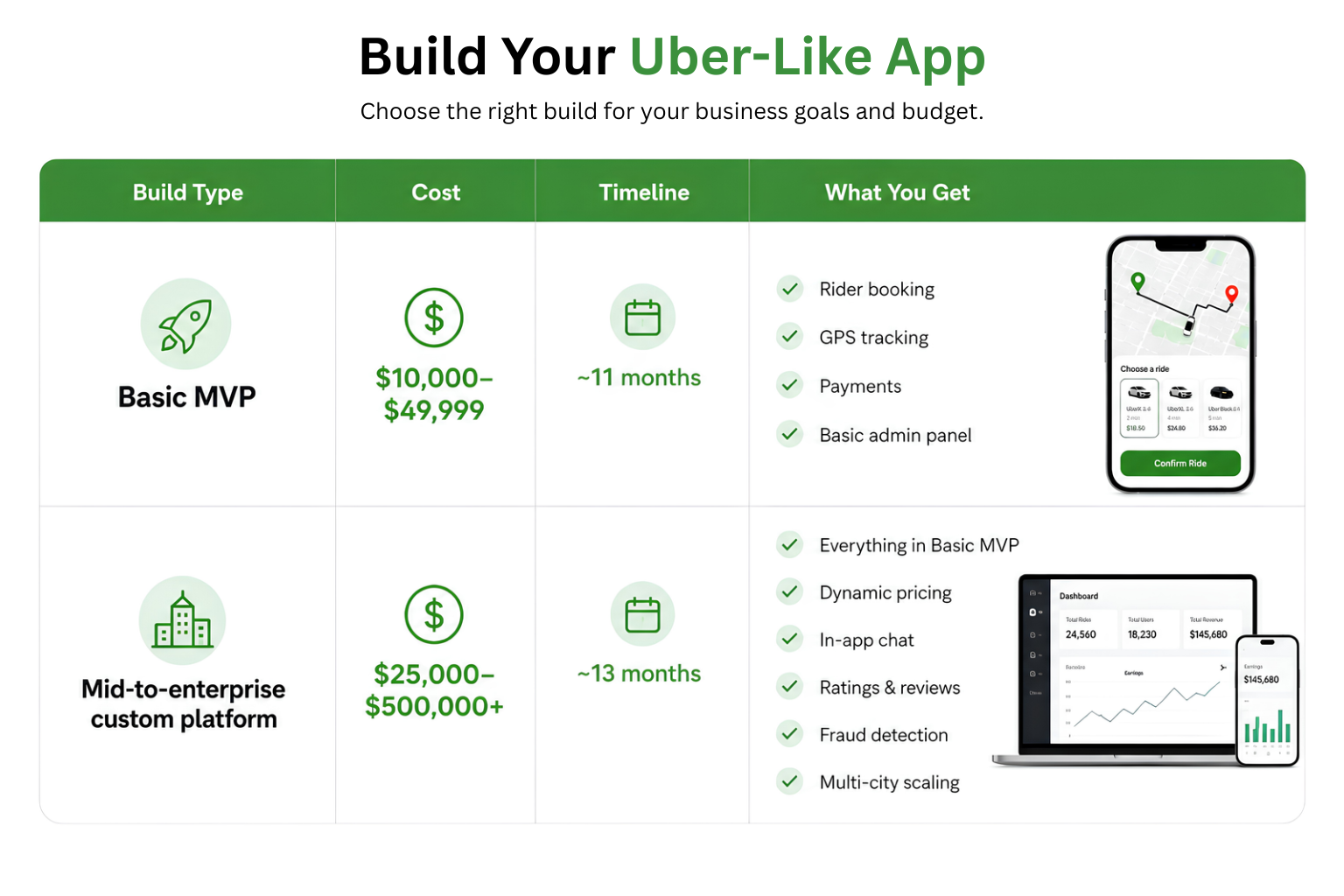
Mobile app-specific projects average $90,780, at $25 to $49 an hour, over about 11 months. Clutch's broader software data covers heavier custom builds: $132,480 average, up to $150 an hour, closer to 13 months.
A basic MVP tracks toward the first number. A feature-heavy, multi-city platform tracks toward the second, since it isn't one market price, it's two different products.
Feature count and compliance work move a project between tiers. Design quality matters too: a templated interface costs less than a custom one, though skimping here tends to cost more later in lost retention.
Budget past the build itself. Maintenance, API fees, and hosting continue after launch, and they scale with ride volume once real users show up. LoudOwls' pricing guide breaks this down further, and the cost of a comparable food delivery build is a useful reference point.
What Features Do You Need to Build an App Like Uber?
Anyone looking to build an app like Uber needs three connected products working together: a rider app, a driver app, and an admin panel. Skip any of the three, and you don't have a smaller product. You have a broken one.
Rider App Features
Trust gets won or lost in the first thirty seconds. New users expect one-tap booking, an upfront fare estimate, live driver tracking, and cashless payment before they'll choose an unfamiliar platform over Uber.
Core rider features:
- Real-time GPS tracking and live arrival estimates
- Upfront fare estimation before booking
- Multiple payment methods, including card, digital wallet, and cash
- Driver ratings and trip history
- In-app chat and an SOS safety button
Driver App Features
Driver retention depends on features that respect their time and income. Hiding earnings data or forcing drivers to accept trips blindly loses them to competing platforms within weeks.
Core driver features:
- Trip details, including pickup, drop-off, and estimated earnings, shown before a driver accepts
- Turn-by-turn navigation with live traffic data
- Daily, weekly, and monthly earnings dashboards
- Offline mode for areas with weak internet coverage
- Driver identity verification and document checks during onboarding
Admin Panel Features
Invisible to end users, the admin panel carries the most operational weight. Fare rules, driver approvals, dispute resolution, and payout schedules all live here.
Core admin features:
- Live fleet and ride monitoring
- Dynamic pricing and surge rule configuration
- Driver onboarding and document verification
- Payment reconciliation and payout management
- Analytics dashboards for demand and revenue trends
A common mistake is treating the admin panel as an afterthought during planning. Operations teams end up managing disputes and payouts through spreadsheets, and that doesn't scale past a few hundred rides a week.
Build it alongside the rider and driver apps, not after them. That avoids a scramble to retrofit operational tools once ride volume actually picks up.
What Insurance and Regulatory Requirements Apply?
Ride hailing platforms in the US operate under transportation network company (TNC) rules, and insurance is where founders most often underestimate the work involved.
According to NAIC's guidance on commercial ride-sharing, a driver's personal auto policy usually doesn't cover them once they're transporting paying passengers. That's why TNCs must carry their own commercial coverage.
That coverage splits into three periods: app on with no ride accepted, a ride accepted but no passenger yet, and a passenger in the vehicle.
NAIC notes that TNCs generally carry $1 million in primary liability coverage during the second and third periods, with lighter requirements while a driver is just waiting for a request.
Coverage rules are set at the state level, so the specifics depend on where you're launching. Background checks and an operating permit are common conditions in most jurisdictions before a platform can legally carry passengers.
Build the verification and permit-tracking logic into your admin panel from the start. It's cheaper than retrofitting it once you're already processing rides.
Skipping this step doesn't just risk fines. It can also void coverage entirely if an incident occurs and the required policy was never in place.
How Long Does It Take to Build an App Like Uber?
Timelines for on-demand taxi app development vary enormously, and scope is what decides where a project lands. Clutch's data puts app-specific projects at around 11 months on average and broader custom builds at around 13, with lean MVPs landing on the shorter end because they skip most of the added complexity.
A tightly scoped MVP, rider app, driver app, admin panel, and payment integration- moves faster than a platform that also adds AI-based dispatch (software that matches riders to nearby drivers automatically), fraud detection, or multi-city fleet management.
Unclear requirements and mid-project scope changes are the most common reasons launches slip past their target date.
Design and planning take longer than most first-time founders expect. Wireframing, user testing, and revising the interface before development even starts can account for several weeks on its own, and skipping that stage tends to cost more time later in rework.
Launching in a single city before expanding is the more common sequence, and for good reason. It lets a team validate driver supply, fix booking issues, and tune pricing before multi-city dispatch and region-specific compliance enter the picture.
Should You Build Custom, Go White-Label, or Use a Clone Script?
Choose custom if your business model does something Uber can't easily copy. Choose white-label if you're testing demand before committing serious capital. The decision comes down to what you need to prove first: differentiation or demand.
Custom builds fit corporate transport networks, medical transit services with compliance requirements, or any model Uber has no reason to copy. Full ownership and flexibility justify the higher cost and longer timeline.
White-label or clone scripts fit founders validating demand in a new city or niche, trading some brand differentiation and customisation for a faster path to launch.
A middle path exists as well. Some founders start white-label to prove demand, then migrate to a custom build once real usage data justifies it.
That reduces risk but adds a second development cost down the line. It works best when the white-label phase is treated as a deliberate test, not a permanent home for the product.
If you can name a specific feature Uber's app can't reasonably support, lean custom. If your real question is whether local demand exists at all, a white-label test answers that more cheaply.
Consumer ride hailing markets in major US cities tend to be crowded already. Founders who build an app like Uber and gain traction usually target an underserved area, a niche like airport transfers or senior transport, or a B2B market Uber has little interest in.
An underserved area usually means a mid-sized city or a district within a larger one, where wait times run long and driver supply hasn't caught up. It doesn't have to mean zero competition.
How Do Apps Like Uber Make Money?
Ride hailing app development projects are usually built around a commission model: a percentage of each fare, taken before the driver is paid. It's the same structure Uber and Lyft use, and it remains the default for new entrants.
Some platforms layer on secondary revenue once ride volume is established: subscription tiers for frequent riders, surge pricing during high demand, or advertising placements within the app.
Setting the commission rate is a balancing act. Too high, and drivers leave for competing platforms. Too low, and the business can't cover operating costs like insurance, mapping fees, payment processing, and support.
Pricing closer to the lower end early on is a common approach, since driver supply is usually the harder problem to solve first. A market with plenty of riders and too few drivers still fails, because wait times climb and riders leave before drivers ever become the bottleneck.
Local taxi and rideshare pricing in that market sets a rough ceiling on what riders will tolerate, and the starting rate should reflect it. As ride volume stabilizes, commission rates can move up in small increments rather than one jump, giving drivers time to adjust.
What Technology Is Used to Build an App Like Uber?
A standard ride-hailing app development setup pairs a cross-platform app framework with a real-time backend and a mapping service. Major platforms already build ride-hailing support directly into their infrastructure, which shortens development time.
Typical components:
- Frontend: Flutter or React Native for iPhone and Android from one codebase
- Backend: Node.js or Python for the core business logic
- Database: Firebase or MongoDB for real-time data like driver locations
- Mapping: Google Maps Platform, which lists ridesharing as a supported integration for reducing navigation friction and improving wait times
- Payments: Stripe Connect, which names ride-hailing services like Lyft directly as a typical use case for its Express account type
Flutter and React Native let you maintain one codebase for both platforms. That lowers your overall cost to build an app like Uber compared to building two separate native apps.
Native code keeps its edge specifically for continuous background tasks like live location tracking, since it has more direct access to a phone's operating system than a cross-platform layer does. This gap matters more for safety-relevant, high-frequency tracking than for less time-sensitive parts of the app. Some teams build most of the product in Flutter or React Native and drop into native code just for that one piece.
What Mistakes Should You Avoid When Building an App Like Uber?
A flawed core idea is rarely what sinks a ride-hailing launch. Business owners planning to build an app like Uber tend to repeat a handful of operational mistakes instead.
Launching the rider app before recruiting enough drivers causes the most damage early. New users open the app, see no drivers nearby, and don't come back. Building a solid driver base in the launch area first reduces this risk substantially.
Underestimating infrastructure costs, mapping fees especially, is another frequent surprise once ride volume grows.
Treating surge pricing purely as a revenue lever, instead of a tool for balancing driver supply, tends to backfire with driver trust.
Skipping a written operations plan causes damage that lasts. Without documented processes for disputes, refunds, and safety incidents, the app can't enforce consistency as the team grows.
Frequently Asked Questions
How much does it cost to build an app like Uber?
The cost to build an app like Uber ranges from $10,000 to $49,999 for a basic MVP, based on Clutch's mobile app pricing data, up to $500,000 or more for a full-featured custom platform. Feature scope and developer location drive most of the difference.
How long does ride hailing app development take?
Timelines depend heavily on scope. Clutch's data puts app-specific projects at around 11 months on average and broader custom software builds at around 13, with lean MVPs finishing faster.
What features does a basic on-demand taxi app need?
A basic on-demand taxi app needs real-time GPS tracking, upfront fare estimation, in-app payments, driver-rider matching, and a functional admin panel. Advanced features like AI-powered dispatch can come later.
Do ride hailing apps need special insurance?
Yes. According to NAIC, a driver's personal auto policy generally doesn't cover them while transporting paying passengers, so platforms are required to carry their own commercial liability coverage that applies once a ride is accepted.
Is it cheaper to build a custom app or use a white-label solution?
White-label solutions generally cost less upfront and launch faster. Custom development costs more and takes longer, but gives you full ownership and no long-term licensing fees.
Can a new ride-hailing app compete with Uber in the US?
Yes, by avoiding saturated markets and targeting underserved cities, specific niches like medical or corporate transport, or business-to-business markets Uber has little interest in serving.