On-Demand Home Services App Development in Saudi Arabia
Booking a plumber, electrician, cleaner, or car wash service shouldn't require multiple phone calls, unclear prices, or endless follow-ups. Customers want to find a professional, check availability, book an appointment, and pay directly from their smartphones.

Niti Aggarwal
·9 min read
Booking a plumber, electrician, cleaner, or car wash service shouldn't require multiple phone calls, unclear prices, or endless follow-ups. Customers want to find a professional, check availability, book an appointment, and pay directly from their smartphones.
This creates an opportunity for businesses planning to build an on-demand home services app in Saudi Arabia.
A dedicated mobile application connects customers with service professionals through one platform. Customers can browse services, schedule appointments, track bookings, and make payments, while providers manage their jobs, availability, and earnings.
Whether you are planning a plumbing app, an electrician booking app, a house cleaning service app, or a complete home maintenance marketplace, the development approach depends on your business model and target customers.
How much does it cost? A focused MVP may require an estimated USD 15,000–30,000 (approximately SAR 56,000–113,000) and 3–4 months of development. More advanced platforms with multiple services, tracking, and automated provider management require a larger budget.
This guide explains how to develop your application, which features to prioritise, what technology to use, and how to plan your investment.
Why Build a Home Services App in Saudi Arabia?
Saudi Arabia has a strong digital foundation for businesses offering mobile-based services.
According to the General Authority for Statistics (GASTAT), internet usage reached 99.6% among individuals aged 15–74 in 2026. The same survey found that 74.5% of internet users purchased goods or services online.
Digital payments are growing as well. The Saudi Central Bank (SAMA) reported that electronic payments accounted for 85% of total retail payments in 2025, compared with 79% in 2024.
These figures demonstrate that customers are familiar with digital platforms and online transactions. However, businesses still need to validate demand for their particular service categories.
Where Is the Business Opportunity?
Traditional service businesses often manage customer requests through phone calls, WhatsApp messages, and manual scheduling. This can create problems with availability, pricing, appointment confirmations, and service quality.
A home services app can bring these activities into one system.
Potential opportunities include:
- Verified professionals: Help customers find qualified plumbers, electricians, and cleaning professionals.
- Transparent pricing: Display service packages or estimated costs before booking.
- Convenient scheduling: Allow customers to choose appointments based on provider availability.
- Recurring bookings: Support regular cleaning, maintenance, and vehicle-washing services.
- Local service coverage: Focus on specific neighbourhoods before expanding into additional Saudi cities.
The opportunity is not simply to put an existing service online. It is to make booking and managing that service easier for both customers and providers.
Types of On-Demand Home Services Apps You Can Develop
Your app's functionality depends on the services you plan to offer. Here are five common business models.
1. Plumbing App
A plumbing app connects customers with professionals for water leaks, pipe installations, drainage problems, and emergency repairs, with features such as service requests, photo uploads, price estimates, and appointment scheduling.
2. Electrician Booking App
An electrician booking app allows customers to find professionals for wiring, appliance installations, electrical faults, and general maintenance, with verified profiles, qualifications, ratings, and available time slots.
3. House Cleaning Service App
A house cleaning service app supports apartment cleaning, villa cleaning, deep cleaning, and recurring appointments, with hourly packages, preferred cleaners, booking reminders, and subscriptions.
4. On-Demand Car Wash App
An on-demand car wash app brings cleaning professionals to customers' homes or workplaces, with vehicle selection, washing packages, location-based bookings, provider tracking, and recurring plans.
5. Home Repair App
A home repair app combines services such as AC maintenance, carpentry, painting, electrical repairs, plumbing, and appliance servicing within one platform.
Which model should you choose?
Start with a service where you can build a reliable provider network and deliver consistent quality. Introduce additional categories after validating demand.
Essential Features of a Home Services App
A complete on-demand services platform usually has three components: a customer application, a service provider application, and an admin dashboard.
1. Customer App Features
The customer application should make finding and booking services straightforward.
- User registration: Sign up using a phone number, email, or supported social login.
- Service categories: Browse available plumbing, cleaning, electrical, and maintenance services.
- Search and filters: Find professionals by location, service type, price, and ratings.
- Service details: View descriptions, packages, estimated prices, and provider information.
- Booking and scheduling: Select an appointment date and available time slot.
- Location sharing: Enter an address or select a location on the map.
- Online payments: Pay using supported payment methods.
- Booking tracking: View provider arrival details and appointment progress.
- Notifications: Receive booking confirmations and service updates.
- Ratings and reviews: Share feedback after service completion.
- Booking history: Access previous appointments and invoices.
2. Service Provider App Features
The provider application helps professionals manage their jobs and earnings.
- Registration and verification: Submit identification documents and professional qualifications.
- Job management: Accept, reject, and update service requests.
- Availability calendar: Manage working hours and appointment slots.
- Location and navigation: Find customer locations and plan visits.
- Earnings dashboard: Monitor completed jobs, payments, and payouts.
- Customer feedback: View ratings and reviews.
3. Admin Dashboard Features
The admin panel gives business owners control over the entire platform.
- User management: Manage customer and provider accounts.
- Provider verification: Review documents and approve professionals.
- Service management: Add categories, packages, and pricing.
- Booking management: Monitor appointments, cancellations, and disputes.
- Commission management: Configure service charges and provider commissions.
- Payment management: Track transactions, refunds, and payouts.
- Reports and analytics: Monitor bookings, revenue, and platform performance.
- Promotional tools: Manage discounts, offers, and notifications.
Saudi Arabia-Specific Features You Should Plan For
Building an application for Saudi Arabia requires more than translating the interface. The platform should account for local customer preferences, payment methods, and applicable regulations.
- Arabic and English Support
Provide Arabic and English interfaces with proper right-to-left (RTL) layouts for Arabic navigation, forms, buttons, and notifications.
- Local Payment Integration
Evaluate payment providers that support your merchant requirements and preferred methods, including Mada, Apple Pay, Visa, Mastercard, and other eligible digital payment options.
Providers worth evaluating include Moyasar, HyperPay, and PayTabs.
Compare transaction fees, supported payment methods, onboarding requirements, and integration options before making a decision.
- SAR Pricing and Location Support
Display service prices in Saudi Riyals (SAR), support local addresses and map locations, and configure service coverage areas for providers.
- ZATCA E-Invoicing
If your business falls within the applicable Saudi e-invoicing requirements, your invoicing system should support the relevant Fatoora specifications, VAT information, and required integration processes.
Refer to the official ZATCA e-invoicing guidelines and confirm your obligations with a qualified tax adviser.
- Personal Data Protection (PDPL)
Plan appropriate privacy, security, access-control, and data-retention measures for customer information. Assess the PDPL's territorial scope and its requirements for international data transfers where applicable.
Official reference: Saudi Data and AI Authority – PDPL.
Technology Stack for Home Services App Development
The technology stack affects application performance, development cost, maintenance, and scalability.
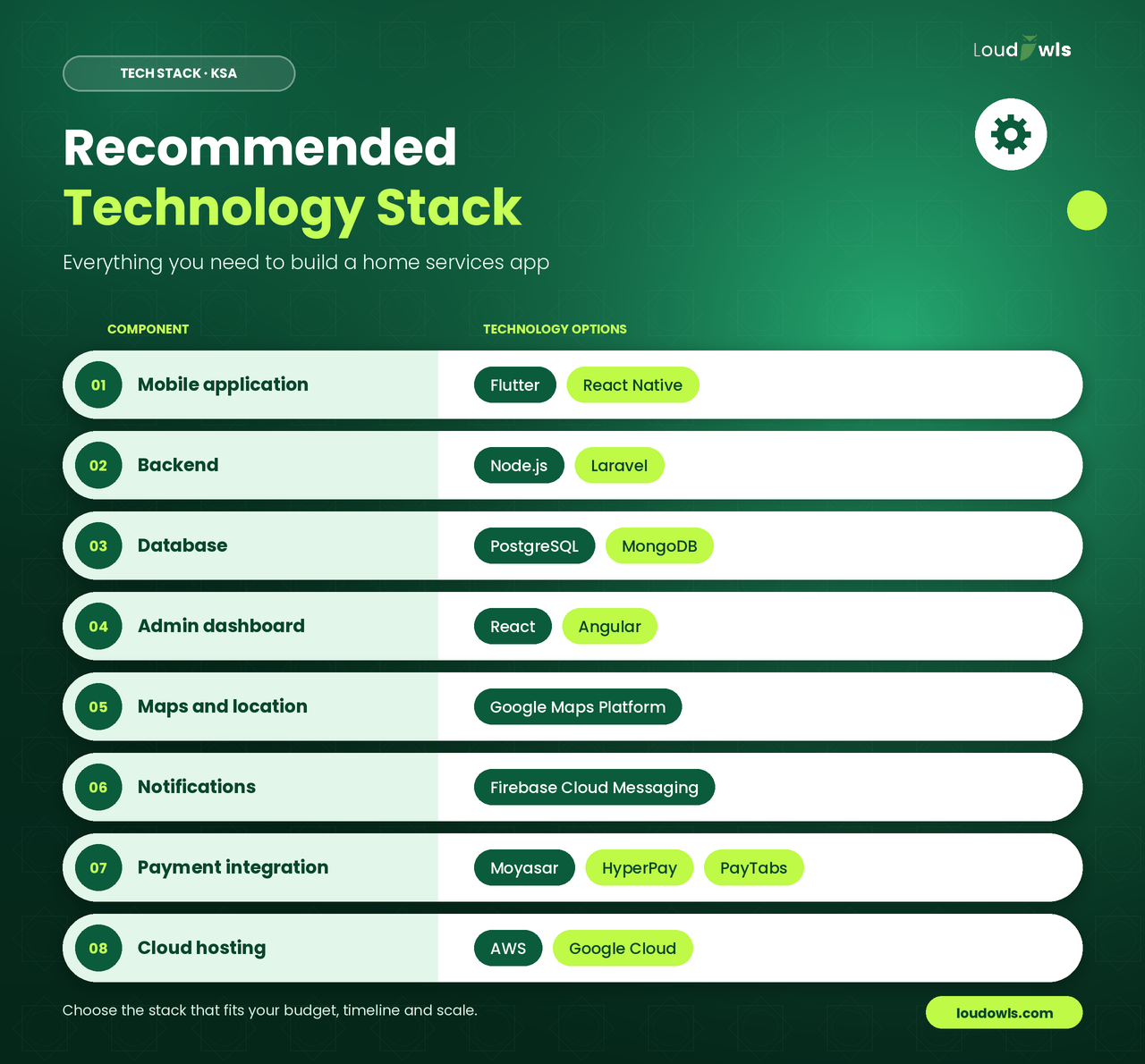
Flutter and React Native are suitable cross-platform options for developing iOS and Android applications using a shared codebase.
Explore LoudOwls' Flutter and React Native development services to understand the available approaches.
The final technology selection should depend on your features, integrations, expected usage, and maintenance requirements.
On-Demand Home Services App Development Cost in Saudi Arabia
Development cost depends on the number of features, supported platforms, third-party integrations, and the booking system's complexity.
Here are indicative planning estimates for different project scopes:
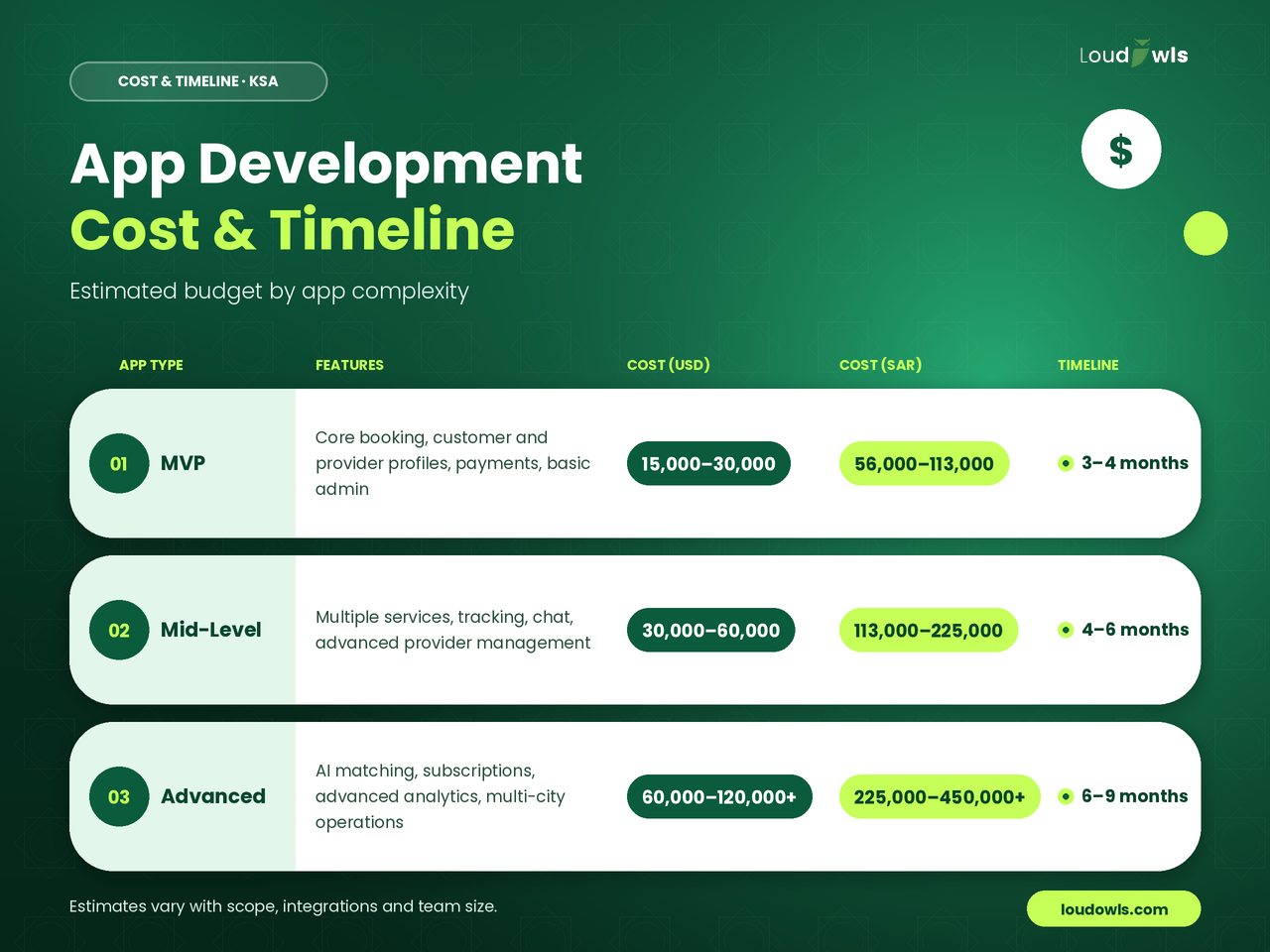
These are indicative LoudOwls project-planning estimates, not fixed quotations or verified Saudi market averages. The final price depends on your agreed scope, development requirements, and integrations.
What Affects the Development Cost?
- Features: Advanced tracking, subscriptions, and automated provider matching require additional development.
- Platforms: Supporting iOS, Android, and web affects the overall scope.
- UI/UX design: Custom interfaces and Arabic RTL layouts add design and testing work.
- Third-party integrations: Maps, payments, and SMS services can increase development and recurring costs.
- Admin management: Advanced reporting, commission controls, and payout workflows add complexity.
- Security and compliance: Privacy controls, secure integrations, and applicable invoicing requirements must be planned.
Ongoing Costs After Launch
Budget separately for hosting, payment charges, map and SMS usage, maintenance, application updates, customer support, and provider onboarding.
For a broader cost breakdown, read our Mobile App Development Cost Guide for 2026.
How to Develop an On-Demand Home Services App
Experienced on-demand app developers should follow a structured development process rather than jumping straight into coding.
- Business planning: Define the target customers, service categories, pricing, and business model.
- Market research: Select your initial city and understand local customer needs and provider availability.
- MVP planning: Finalise the essential customer, provider, and admin features.
- UI/UX design: Prepare wireframes and prototypes for Arabic and English interfaces.
- Development: Build the applications, backend, admin panel, and required integrations.
- Testing: Check booking workflows, payments, performance, security, and device compatibility.
- Launch and maintenance: Release the app, monitor feedback, and introduce improvements.
Starting with one service category and one city can make the initial launch easier to manage.
How Can a Home Services App Generate Revenue?
Choose a monetisation model that suits your customers and service providers.
- Commission per booking: Charge a fixed fee or percentage on completed bookings.
- Provider subscriptions: Offer monthly or annual plans to professionals.
- Featured listings: Charge providers for additional visibility.
- Customer subscriptions: Sell recurring cleaning or car wash packages.
- Convenience fees: Add clearly disclosed service charges to eligible bookings.
- Service packages: Offer bundled maintenance and cleaning services.
You can combine multiple revenue models, provided the pricing remains transparent.
Common Challenges and How to Solve Them
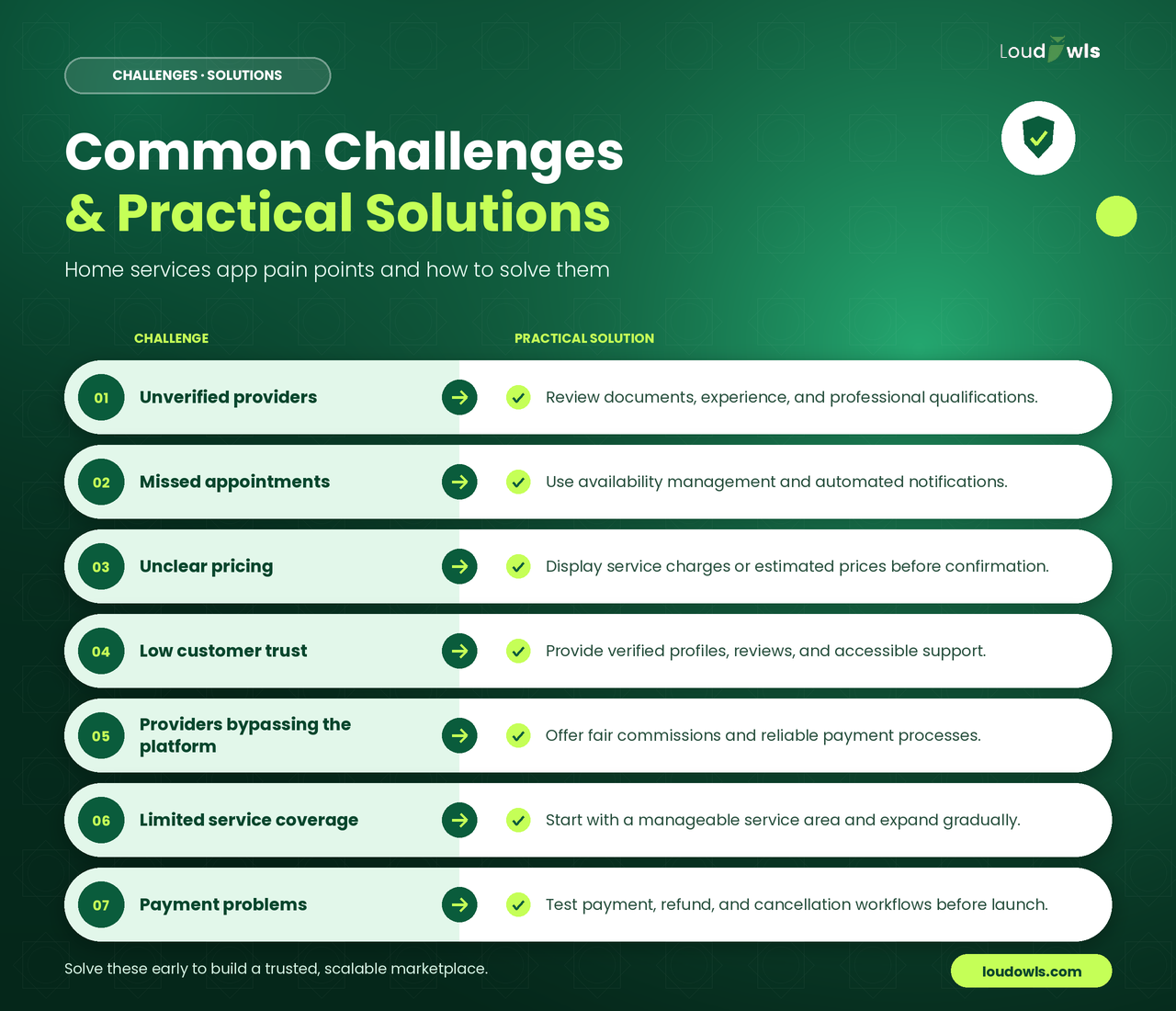
A successful platform needs dependable service operations alongside a good application. Build the provider network and customer support process before expanding into multiple cities.
Choosing the Right Home Services App Development Company
The development partner you choose influences your app's functionality, technical quality, scalability, and ongoing maintenance.
Before hiring a home services app development company, consider:
- Relevant experience: Review completed mobile applications and software projects.
- Technical capabilities: Check expertise in mobile, backend, integrations, and admin dashboards.
- Project transparency: Request a feature breakdown, cost estimate, and development timeline.
- Testing standards: Understand how the team checks security, usability, and performance.
- Post-launch support: Discuss maintenance, updates, and future improvements.
Why Choose LoudOwls?
LoudOwls is a founder-led mobile app and software development company established in 2018, with offices in Mohali, India, Dubai, UAE, and Ottawa, Canada.
Our published company profile highlights:
- 150+ projects launched across mobile and web products.
- 98% client satisfaction as reported on our company profile.
- 20+ specialists and collaborators across product and engineering.
- 365-day support availability for ongoing product needs.
Our capabilities include iOS, Android, Flutter, React Native, backend engineering, UI/UX design, and custom software development.
Our Product Development Experience
Our portfolio includes products across fintech, fitness, healthcare, education, and other industries.
Motus – Fitness Tracking Application
An iOS product featuring camera-based body tracking, automatic repetition counting, workout sessions, and social features.
Klink – Financial Planning Application
A mobile product combining open banking, spending insights, financial goals, and a rewards system.
These are examples of our broader mobile product engineering experience, not home-services projects. You can review more work through our LoudOwls portfolio and explore our company and team.
Independent client feedback is also available on Clutch.
Frequently Asked Questions
1. How much does it cost to build a home services app in Saudi Arabia?
A focused MVP may cost around USD 15,000–30,000 (approximately SAR 56,000–113,000). The final estimate depends on the features, platforms, and integrations.
2. How long does on-demand home services app development take?
A basic MVP may take 3–4 months, while mid-level and advanced platforms may require 4–9 months or longer.
3. Can I start with a single-service application?
Yes. You can launch a plumbing app, electrician app, cleaning application, or car wash platform and introduce additional services after validating demand.
4. What features should a home services app include?
Essential features include registration, service listings, booking, scheduling, provider management, payments, notifications, reviews, and an admin dashboard.
5. Which technology is suitable for home services app development?
Flutter and React Native are suitable cross-platform options. Node.js or Laravel can be used for backend development, depending on the project requirements.
6. Should my app support Arabic and English?
Yes. Businesses targeting Saudi Arabia should provide both languages with properly implemented Arabic right-to-left layouts.
7. Which payment gateways can I integrate in Saudi Arabia?
Evaluate Moyasar, HyperPay, and PayTabs based on supported payment methods, merchant eligibility, integration options, and transaction fees.
8. How can a home services app generate revenue?
Popular revenue models include booking commissions, provider subscriptions, featured listings, customer packages, and convenience fees.
9. Can I add more services after launching the app?
Yes. A scalable platform can introduce additional categories such as plumbing, cleaning, electrical repairs, AC servicing, and car washing as the business grows.
10. What compliance requirements should I consider?
Review the applicable Saudi PDPL requirements for personal data, ZATCA e-invoicing obligations, and payment-provider requirements before launching.