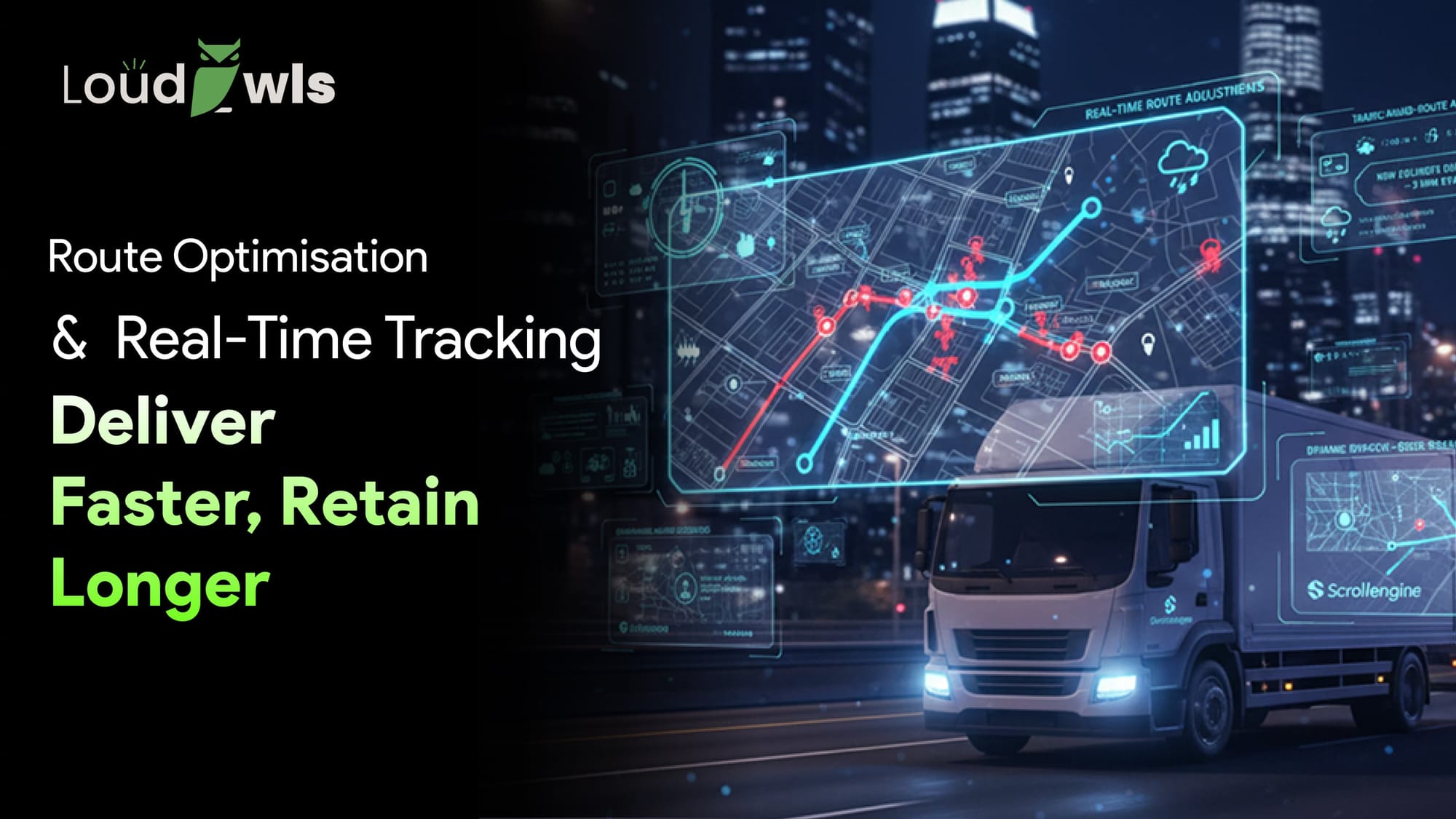
Route Optimization Software and Real-Time Tracking for Food Delivery Apps
Quick Summary
Food delivery apps thrive on two key factors: speed of order delivery and how well customers are updated on the journey.
This article covers what route optimization software development entails, how real-time delivery-tracking app development directly affects customer retention, which AI features are worth building in 2026, and what realistic development costs look like.
Food and grocery delivery is expected to grow to $2.3 trillion worldwide by 2027. With that kind of scale, the platforms that build smarter logistics infrastructure now will hold a significant advantage over those still running manual dispatch in two years.
Based in Dubai, LoudOwls is a mobile and web app development firm creating AI-powered route optimisation and real-time tracking solutions for food delivery apps in the UAE, Canada and North America. Need smarter delivery logistics built into your food platform? Talk to LoudOwls and get a quality consultation at an affordable price today!
Introduction to Route Optimization Software
A customer places a food order at 7:14 PM and expects it by 7:44 PM. Everything that happens between those two points in time can help them decide to reorder next week or go to a competitor. The delivery window is not just a logistics problem but a retention problem.
Most food delivery platforms underestimate how directly route efficiency connects to repeat orders. According to data from UpperInc, drivers using optimised route planning complete 3 to 4 deliveries per hour compared to 2 per hour on manual routing. Reducing fuel cost is not the only benefit of that 50 percent efficiency gain. It reduces delivery times, increases on-time deliveries and provides customers with the customer experience that keeps them coming back.
This article breaks down the specific software features behind that improvement, what they cost to build, and why the technical decisions made at the logistics layer have a direct commercial impact on your platform's retention numbers.
Why Delivery Logistics Is Now a Product Decision, Not Just an Operations One
Three years ago, it was possible to have a food delivery driver with only basic GPS tracking and manual driver assignment. There was no better way to get customers to wait 45 minutes for a vague estimate than to make them wait 45 minutes.
That tolerance is gone. Statista conducted a survey in 2024 and discovered that 90 percent of those who place orders use the internet to track them afterwards. Without live tracking, or if it's wrong, support ticket volumes grow and ratings decline and customers stop using the app and move to competitors . The logistics part is no longer behind the scenes for customers, but a product feature that they can see.
This is why investment in route optimization software development and real-time delivery tracking app development has moved from optional to essential for any platform serious about growth in 2026.
What Route Optimisation Software Actually Does on a Live Delivery Platform
Route optimisation is not the same as navigation. Google Maps can give instructions to a driver to travel from A to B. A well-designed route optimization software engine is able to determine the order of a number of stops, factor in real-time traffic conditions, adjust in the event of an incoming order, and plan delivery sequences to minimize overall time on road for all drivers in the fleet.
Here are some of the things a well-constructed route optimisation system can manage at one time:
Multi-stop sequencing: sequences drop-offs for each driver to reduce overall distance and time
Dynamic re-routing: shortens the route for the individual to follow during mid delivery
Predictive traffic analysis: Forecasts traffic delays based on historical and current traffic information
Demand zone forecasting: positions drivers in areas where orders are likely to spike based on time and day patterns
Fleet load balancing: distributes new orders across available drivers to avoid overloading one zone
ETA calculation: generates accurate delivery time estimates that update in real time as conditions change
The difference between platforms that have this and those that do not shows up clearly in average delivery times and driver utilisation rates. A driver completing 2 deliveries per hour instead of 3.5 is not a staffing problem. It is a routing problem.
Manual Dispatch vs AI Route Optimisation: What Changes
Metric
Manual Dispatch
AI Route Optimisation
Deliveries per driver/hour
1.5 to 2
3 to 4
ETA accuracy
Estimated, often wrong
Live, updates in real time
Route adjustment on traffic
Manual, slow
Automatic, instant
Fuel cost per delivery
Higher (unoptimised paths)
15 to 30% lower
Driver idle time
High in slow zones
Minimised via zone forecasting
Late delivery rate
12 to 18% on average
Under 5% with full AI routing
Real-Time Delivery Tracking App Development: What Customers Actually See
The tracking screen is the most-used feature in any food delivery app during an active order. Most users open it multiple times between placing an order and receiving it. What they see there directly shapes their perception of the platform.
Live Driver Map View
A pin on a map that moves as the driver moves, updated every 10-15 seconds. This is the minimum level of service in 2026. Platforms without it are already behind. The technical requirement is a WebSocket connection between the driver app and the customer app, with position data pushed from the driver's device at regular intervals.
Dynamic ETA Updates
Having a static ETA at order placement is not sufficient. If the driver becomes stuck in the traffic, or completes a previous drop-off sooner than anticipated, the ETA is updated. This would need the backend to constantly update arrival time according to the current route progress and push it to the customer screen.
Order Status Notifications
Push notifications at each stage: order confirmed, driver assigned, driver picked up, driver nearby, delivered. Each notification reduces the number of customers who open a support chat to ask where their order is. This directly lowers support costs and improves satisfaction scores without changing anything about the actual delivery.
Proof of Delivery
Photo confirmation and digital signature capture are sent to the customer on delivery. This minimises conflict, avoids the platform taking the hit on late deliveries, and documents what has been received by the customer.
AI Dispatch Management: The Feature that Separates good platforms from great platforms
At scale, an AI dispatch management system can handle every incoming order, every driver position, every traffic signal, every zone demand pattern, and every order quickly, and pairs them with the correct driver in seconds, something a human dispatcher cannot achieve.
With manual dispatch, assigning a user to an order takes 2 to 4 minutes per order, delaying orders by the same amount for a platform with 300 orders per evening in a city.
Key capabilities to build into an AI dispatch module:
Proximity-based assignment that accounts for current driver workload, not just physical distance
Restaurant prep time integration so the driver arrives at pickup when the food is ready, not five minutes before
Weather and event-based demand adjustments that shift driver positioning before a spike hits
Automatic escalation when no driver accepts an order within a set threshold
The most successful delivery businesses increasingly combine dispatch automation with route optimization software to improve efficiency across the entire logistics process.
Food Delivery Driver App Development: What the Driver Side Needs
The customer-facing tracking experience is only as good as the driver-facing app feeding it. A food delivery driver app development project needs to handle several things that generic navigation apps do not.
Offline mode: save route and order information locally for offline use to overcome connectivity gaps
One-Tap status updates: driver confirms pickup and delivery with a single tap, eliminating delays in the driver's workflow while maintaining customer tracking.
In-app chat: It enables the driver to reach the customer without revealing personal phone numbers
Earnings dashboard: The drivers get real-time views of completed deliveries, pay per drop, and daily earnings.
Battery optimisation: Continuous GPS tracking is battery-intensive, the app must keep a balance between the frequency of GPS updates and the battery usage to prevent drivers losing navigation during the trip.
Route Optimisation and Tracking: Development Cost Breakdown
For businesses considering route optimization software, integrating a proven routing API and building the tracking layer around it is often the most practical starting point. Custom AI routing becomes worth the investment once daily order volume crosses 500 to 1,000 orders consistently. Starting with APIs keeps costs low and lets you validate the product before committing to a full custom build.
Feature / Module
Build Approach
Estimated Cost
AI route optimisation engine
Custom ML model
$40,000 to $80,000
Route optimisation via third-party API
Google Maps / HERE / RouteXL integration
$8,000 to $20,000
Real-time tracking (customer app)
WebSocket + live map
$12,000 to $25,000
AI dispatch management system
Custom dispatch logic
$20,000 to $45,000
Driver app (iOS + Android)
React Native cross-platform
$18,000 to $35,000
Admin dashboard + analytics
Web panel with reporting
$10,000 to $20,000
Full logistics platform built
End-to-end custom
$80,000 to $180,000
Key Trends in Route Optimization Software for 2026
EV route planning: Today, routing engines consider charging station locations and battery range for electric delivery fleets, which are rapidly proliferating in the UAE and Canadian markets.
Contactless proof of delivery: The expectation of having a photo taken as proof of delivery and QR based confirmation, which has become a standard feature after 2023.
Sustainability reporting: platforms combining CO2 per delivery data into dashboards for routing in client and regulatory pressure markets such as EU and Canada
Micro-fulfilment integration: systems that are directly integrated with the dark kitchen or micro-warehouse inventories thereby cutting down pick-up time before the driver even leaves the zone.
Voice assistant driver apps: hands-free order confirmation and navigation data for safety compliance being adopted across in the UAE and North American markets
Frequently Asked Questions
Q1. How much would it cost to implement a route optimisation system for food delivery?
The Third party routing API integration (Google maps, HERE or RouteXL) is available for $8,000 to $20,000 and it's the quickest starting point. A custom built AI route optimisation module from the ground up will cost between $40k and $80k and can be cost effective from 500 to 1000 orders a day.
Q2. What are the benefits of real-time tracking for customer retention in food delivery apps?
The 90% of delivery customers follow up on their orders after purchase. Live ETAs and map tracking lower the number of support tickets, increase satisfaction, and boost repeat orders.
Q3. Can you integrate a logistics module into an existing food delivery platform?
Yes. Route optimisation and tracking can be built as standalone microservices with REST APIs that connect into any existing codebase. No full platform rebuild is required. Most integrations of this type take 8 to 14 weeks, depending on the complexity of the existing system.
Q4. How does route optimization software improve delivery speed?
Route optimization software identifies faster routes and reduces delays, helping drivers complete more deliveries in less time.
Q5. Is route optimization software suitable for grocery delivery platforms?
Yes. Route optimization software improves grocery deliveries through efficient route planning, tracking, and driver allocation.
Q6. Can small businesses use route optimization software?
Small businesses can use route optimization software to improve delivery performance without having to manage large driver fleets.
Conclusion
Theroute optimization software and real-time tracking are not back-end infrastructure decisions. They are product decisions that show up in delivery times, driver efficiency, customer satisfaction scores, and repeat order rates. The platforms getting this right in 2026 are not necessarily the ones with the largest driver fleets. They are the ones with the smarter logistics layer underneath.
Building that layer does not require rebuilding everything at once. A routing API integration and a real-time tracking module can be added to an existing platform without a full rebuild, and the commercial impact shows up within the first month of operation. The question is not whether your platform needs this. It is how quickly you move on it before your competitors do.
LoudOwls builds AI-powered route optimisation and real-time delivery tracking apps that integrate with existing platforms or launch as part of a full new build. Whether you need a routing API integration in 8 weeks or a complete logistics platform in 5 months, the starting point is a 30-minute call. Talk to LoudOwls today and get an affordable consultation on your delivery logistics project.