Top 10 Dating Apps in the USA: The Complete 2026 Guide
This blog covers the ten leading dating apps operating in the U.S. market in 2026, along with pricing, safety considerations, emerging trends, and what the category means for businesses evaluating their own platform.

Niti Aggarwal
·9 min read
Short answer: The most widely used dating apps in the USA are Tinder, Bumble, Hinge, OkCupid and Match, with The League, eHarmony, Coffee Meets Bagel, Grindr and Zoosk completing the top ten. Tinder suits casual dating, Hinge and eharmony lean toward serious relationships, and Grindr serves LGBTQ+ users. Paid plans range from about $10 to $60 a month depending on app and tier.
People choose a dating app by intent, price, and safety. Founders looking at the same list ask a different question: what makes these products keep paying users? This guide answers both. Each app gets the same short template, followed by a builder takeaway you can use if you are planning a dating product.
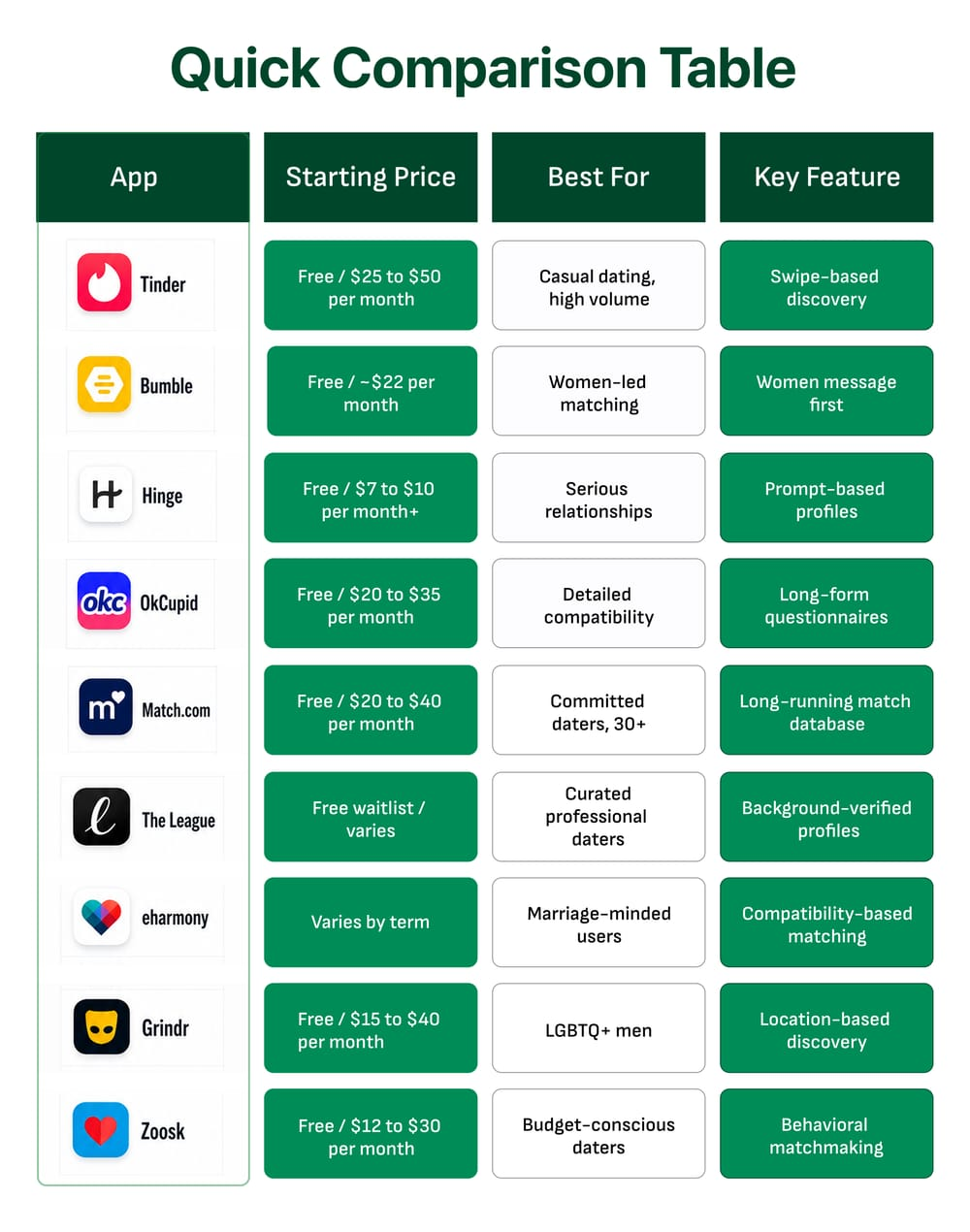
Top 10 dating apps in the USA at a glance
1. Tinder
Tinder is where the swipe-first era of dating began, and it's still the largest platform by raw user count in the country. It leans casual, though plenty of long-term couples met right here, and its free tier remains generous compared to most competitors.
- Largest user base among the top dating apps in the USA
- Casual-first, but not exclusively casual
- Paid boosts available for extra visibility
- Free to join, with Plus, Gold, and Platinum tiers running $25 to $50 a month depending on age and location. It's also one of the most downloaded lifestyle apps on either app store, so scale isn't really in question here.
2. Bumble
Women message first here, full stop, and that single rule shapes almost everything else about how Bumble operates. It's built a loyal following among professionals in their late 20s and 30s, and the platform doesn't stop at romance either: Bumble BFF and Bizz extend the same model to friendships and professional networking, giving it a broader footprint than a typical dating app in the USA.
- Women message first
- Strong appeal among career-focused users
- Extra modes for friendship and networking
- Free tier available, with Premium running around $22 a month on average. Worth noting: Bumble reportedly holds onto a higher share of paying subscribers than most of its competitors, which says something about how attached its users get.
3. Hinge
Hinge markets itself as "designed to be deleted," built for people who actually want to stop using it. Prompt-based profiles replace the endless photo-swiping of other apps, and it consistently ranks among the best dating apps in the USA for people chasing something serious.
- Prompt-based profiles instead of just photos
- Built for serious daters
- High match-to-conversation quality
- Free to use, and Hinge+ starts as low as $7 to $10 a month on longer plans, one of the cheaper premium tiers on this list. User satisfaction scores here also tend to run above average, likely thanks to the prompt-based format doing some of the work upfront.
4. OkCupid
OkCupid runs on long-form questionnaires that power a genuinely detailed matching algorithm, appealing to users who want more than a bio and a few pictures. It's also one of the more reliable free dating apps in USA, with most core features unlocked at no cost.
- Detailed compatibility questionnaires
- Most features are free to use
- Popular with users seeking depth over speed
- Mostly free, with Premium landing around $20 to $35 a month. The user base is genuinely massive, historically cited at north of 70 million registered accounts, which is part of why the questionnaires tend to return matches worth the effort.
5. Match.com
Match.com is one of the longest-running platforms in the space and still a fixture whenever anyone lists popular dating apps in USA. It skews toward users in their 30s and beyond who are looking for something committed rather than casual.
- One of the original dating platforms
- Skews toward serious, committed users
- Long track record and brand trust
- Free to browse, but a real subscription runs $20 to $40 a month. It's been around long enough that the brand still carries genuine weight with daters 30 and up, even if it isn't the flashiest name on this list.
6. The League
Founded in San Francisco, The League positions itself around curated, background-verified matches for people who want quality over quantity. As one of the popular top dating apps in the USA, its user base is smaller than the giants on this list, but it's notably engaged.
- Background-verified profiles
- Curated match suggestions
- Smaller but highly engaged community
- Free to join the waitlist, though paid membership tiers shift by city and demand. The user base is small compared to the giants here, but engagement per member tends to run noticeably higher.
7. eharmony
eharmony's compatibility-based matching is rooted in psychological research, and it's built a strong reputation among people looking for marriage rather than just dates. It moves at a slower pace by design, which plenty of users actually prefer.
- Compatibility-based, research-driven matching
- Popular with marriage-minded users
- Slower, more intentional pacing
- Pricing varies a fair amount by term length and tends to sit toward the higher end of this list for longer commitments. What you're paying for, in theory, is one of the highest self-reported success rates in the industry.
8. Coffee Meets Bagel
No endless swiping here. Coffee Meets Bagel hands users a small batch of curated matches once a day instead, a deliberate antidote to the infinite-scroll fatigue that's crept into other platforms, and it's earned a quieter but consistent presence among the best dating apps in USA as a result.
- One curated match set per day
- Less time spent swiping
- Loyal, steady user base
- Free with a limited daily match count, and Premium runs $35 to $50 a month. It has a smaller user base than Tinder or Bumble, but the quality of engagement per match is generally rated higher.
9. Grindr
Grindr is the leading platform for gay, bi, trans, and queer men, with location-based discovery and a large, active community. It's frequently cited as the best dating app for LGBTQ+ users specifically, and its focus shows in every part of the product.
- Built specifically for the LGBTQ+ community
- Location-based discovery
- Large, active user base
- Free to use, with Xtra and Unlimited tiers landing between $15 and $40 a month. It's one of the most established names in its category, and the daily active user base reflects that.
10. Zoosk
Zoosk uses behavioral matchmaking that learns from how you interact with the app rather than relying on a static questionnaire. It's also one of the more budget-friendly free dating apps in USA, with quick social-media-based profile setup.
- Behavioral matchmaking algorithm
- Budget-friendly free tier
- Fast profile setup via social accounts
- Free to join, with subscription plans generally falling between $12 and $30 a month. It's built up a large registered user base over more than a decade, even if it doesn't get the same press as the bigger names on this list
Dating app scams and how to stay safe
Romance scams and fake profiles remain the main risk on every platform. Five habits reduce it:
- Verify before you trust. Use in-app photo or video verification, and be wary of profiles that avoid a video call.
- Keep money out of it. Never send money, gift cards or crypto to someone you have not met in person.
- Move slowly off-platform. Scammers often push to switch to private messaging quickly.
- Meet in public first. Tell a friend where you are going and share your location.
- Report and block. Reporting helps apps remove bad accounts faster.
What builders should ship: photo or ID verification, automated detection of spam and scam messaging, easy reporting, and block tools. Safety features are now a product requirement, not an add-on.
Where dating apps are headed: AI matching and video profiles
- AI-assisted matching: better recommendations from behaviour and stated preferences, with transparency about how it works.
- Video profiles and video-first dating: more authentic first impressions and fewer fake profiles.
- Safety and verification by default: ID checks and liveness tests becoming standard.
- Intent-based experiences: products built around specific goals such as marriage, friendship, or community.
Building your own dating app: what the leaders show
A new dating app rarely wins by copying Tinder. The apps above show three working patterns: scale with a free tier (Tinder), a distinctive product rule (Bumble), or a clear niche or intent (Hinge, eHarmony, Grindr, The League). Whichever you pick, plan for:
- Matching and discovery that suits your audience
- Verification and fraud detection from day one
- A monetisation model tied to real value, such as tiered subscriptions or consumables
- Privacy and compliance for each market, including Canada (PIPEDA), the UAE (PDPL), and US state laws
- Scalability so the app keeps working as the user base grows
LoudOwls builds mobile apps for clients in the USA, Canada and the UAE. Read our guides on dating app revenue models and how to build a dating app, or talk to our team.
How to build a dating app: 8 steps
Building a dating app is a product and trust problem as much as an engineering one. This is the order we recommend.
- Pick your audience and intent. Decide who the app is for (a city, a community, an age group, a goal such as marriage or friendship). A clear niche is easier to launch than a general app competing with Tinder.
- Choose your core mechanic. Swipe, curated daily matches, prompt-based profiles, questionnaires or video-first. This is the rule that makes your app feel different.
- Define an MVP. Ship only what is needed to create a match and a first conversation: sign-up, profile, discovery, matching, chat, verification, and reporting.
- Design for trust and safety first. Plan photo or ID verification, moderation, and blocking before you design growth features.
- Pick your platform and stack. Native iOS and Android, or a cross-platform framework such as React Native or Flutter, plus a backend that can handle real-time chat and location.
- Build, test, and soft-launch. Launch in one city or community first. Dating apps need enough users in one place to feel alive.
- Add monetisation once value is proven. Introduce paid tiers after users are matching and chatting, not before.
- Maintain and iterate. Moderation, security patches, OS updates and feature tuning continue after launch, which is why a maintenance plan belongs in the budget from day one.

Core features: what to build first
Monetization options
The common models are tiered subscriptions, one-off purchases such as boosts, and limited ads on a free tier. Read our guide to dating app revenue models for how each works and when to introduce it.
Technology choices
- Mobile: native Swift (iOS) and Kotlin (Android) for the best performance, or React Native and Flutter to share code across both platforms.
- Backend: an API layer with real-time messaging, a geospatial database for location search, and cloud storage for photos.
- Safety services: identity or liveness verification, image moderation and spam detection.
- Compliance: privacy and data protection for each market, including PIPEDA in Canada, the PDPL in the UAE and state laws such as CCPA in the USA.
How long and how much?
Timeline and cost depend on your feature set, platforms, and safety and compliance needs. A focused MVP is much faster and cheaper than a full-featured app with video and AI matching, and a discovery call is the quickest way to get a reliable estimate.
Common mistakes to avoid
- Launching everywhere at once. Thin user density in every city makes the app feel empty.
- Treating safety as a later feature. Fake profiles and scams drive users away fast.
- Over-building the MVP. Video, AI and gamification can wait until matching and chat work well.
- Charging too early. Users pay when they see value, not before.
- Ignoring maintenance. Platform updates and moderation never stop. See our guide to mobile app maintenance.
Ready to scope yours? Talk to our team about your audience, market and budge
Frequently asked questions
- What are the most popular dating apps in the USA?
Tinder, Bumble, Hinge, OkCupid and Match are among the most widely used, followed by The League, eharmony, Coffee Meets Bagel, Grindr and Zoosk.
- Are there good free dating apps in the USA?
Yes. Tinder, Bumble, Hinge, OkCupid and Zoosk all offer free versions, with paid plans that add features such as more visibility or filters.
- Which dating app is best for serious relationships?
Hinge, eharmony and Match are commonly chosen for long-term dating, because their features focus on compatibility and conversation.
- How much do dating apps cost per month?
Paid plans range from about $10 to about $60 a month depending on the app and tier. For example, Tinder Plus starts at $9.99, Hinge+ at about $29.99 and Bumble Premium at $32.99, according to Kiplinger.
- What should I look for in a dating app development company?
Experience with matching logic, verification and fraud detection, scalable architecture, privacy compliance and a clear approach to monetisation, along with live examples of apps they have shipped.
- How much does it cost to build a dating app?
Cost depends on features, platforms and integrations. A scoped estimate after a discovery call is more reliable than a general number.