AI Trends 2026: How AI Is Transforming Businesses
Every AI trends 2026 roundup points to the same shift: AI is no longer a side project; it's part of how work gets done. This roundup of artificial intelligence trends pulls from named, dated sources, so every figure here can be verified directly.

Niti Aggawal
·10 min read
BG Green: Quick Summary
- Agentic AI is moving from pilot to production, with 40% of enterprise apps adopting agents by 2026.
- Generative AI is now a governed company tool, with enterprise spending tripling to $37 billion in 2025.
- AI project costs split into three tiers: off-the-shelf tools, custom pilots, and full agentic platforms.
- Predictive analytics now updates in near real time, helping retailers and manufacturers act on fresher data.
- Businesses that scope one high-value workflow and measure results consistently outperform those chasing every new AI trend headline.
Every AI trends 2026 roundup points to the same shift: AI is no longer a side project; it's part of how work gets done. This roundup of artificial intelligence trends pulls from named, dated sources, so every figure here can be verified directly.
The US Census Bureau's Business Trends and Outlook Survey put AI use at 19.8% of US businesses in May 2026, using a strict definition: AI applied to a core business function, not just a tool someone tried once. Looser surveys tell a different story.
The US Chamber of Commerce puts generative AI use among small businesses at 58%, up from 40% a year earlier. Both numbers are true; they just measure different things. One counts businesses running AI in production, and the other counts anyone who has tried a tool like ChatGPT or Copilot.
The gap between them is where competitive advantage now sits. Businesses that only "try" AI stay in the 58% bucket, while those that scope a real workflow and ship it move into the 19.8% that shows up in production. This piece breaks down the latest AI trends worth acting on in 2026, what each one costs, and where US businesses are seeing measurable results rather than headline buzz.
What Are the Biggest AI Trends in 2026?
Underneath the noise, these artificial intelligence trends share one throughline: less experimentation, more integration. Instead of a standalone chatbot bolted onto a website, AI is getting wired into the systems a business already runs. CRMs, support desks, and internal dashboards now ship with AI features by default.
Three forces are driving that shift. Model costs have dropped enough that mid-sized US companies can afford custom builds, integration now takes weeks instead of quarters, and leadership has largely stopped debating whether to use AI and started asking where it saves the most time.
1. Agentic AI Moves From Pilot to Production
Agentic AI is the clearest shift this year. Instead of answering one prompt, these systems plan a sequence of steps, call tools, and check their own output before escalating to a human.
Gartner projects that 40% of enterprise applications will ship with task-specific AI agents by the end of 2026, up from under 5% in 2025. That makes it one of the fastest technology shifts on record, faster than the early growth curves of cloud software or mobile apps.
The adoption data tells a more grounded story. McKinsey finds 88% of organisations now use AI in at least one business function, yet only 23% have scaled an agentic system into production, which is why most pilots stall before they ever ship.
Where Businesses Are Using AI Agents
Support teams use AI agents to triage tickets and pull order history without a rep touching routine cases. Sales teams use them to qualify inbound leads, while operations teams use them to reconcile invoices and flag exceptions before they reach a finance manager.
A human still signs off on anything with financial, legal, or safety consequences, while the agent handles everything routine underneath that line. Getting that boundary right decides whether a rollout succeeds more than the underlying model does.
2. Generative AI Becomes an Enterprise Tool
Generative AI has moved past drafting blog posts. It now sits inside document review, code generation, meeting summaries, and first-pass legal redlines.
Menlo Ventures reported enterprise generative AI spending of $37 billion in 2025, up from $11.5 billion in 2024. Spending more than tripled in a single year, and most of that growth came from mid-sized companies, not just large enterprises.
Newer models cite sources and flag uncertainty instead of guessing with full confidence, which makes them usable in regulated workflows like finance and healthcare documentation, where a confident wrong answer used to be a dealbreaker.
How Businesses Are Using Generative AI
Generative AI also changed hands. It started as a tool an employee used on their own initiative, but in 2026 it has become an organisational resource, deployed and governed centrally with usage policies applied the same way across departments.
Centralised rollouts are easier to secure and audit, though they also move slower than an employee experimenting alone on a laptop. Businesses that pair a managed tool with short, role-specific training tend to see faster adoption than ones that simply grant access and hope.
3. Smaller, Specialised AI Models
A fourth force gets less attention: model specialisation. Smaller models trained on industry-specific data are starting to outperform massive general-purpose ones on narrow tasks. A claims-processing model trained on insurance data, for example, beats a generalist that has never seen a claim form.
Multimodal AI follows a similar path. Systems that once handled text alone now read documents, interpret images, and process voice within a single workflow. That consolidation removes the need to stitch together a separate tool for every data type, cutting both cost and integration risk for a US business trying to keep vendor sprawl under control.
4. Predictive Analytics Becomes Real-Time
Predictive analytics is no longer confined to quarterly forecasting decks. Retailers now use it to adjust inventory in near real time, while manufacturers use it to flag equipment likely to fail before it breaks down.
The main shift is speed. Models that once took analysts days to retrain now update on a rolling basis, so the forecast reflects this week's data instead of last quarter's. That lets logistics teams reroute shipments around delays before a customer even notices. Energy providers apply the same rolling approach, adjusting grid load predictions hour by hour instead of day by day.
None of that speed helps without clean inputs, though, since a rolling model retrained on inconsistent data produces a confident forecast that is wrong faster than before. Data quality work remains the unglamorous prerequisite behind every headline about faster forecasting.
5. AI Transforms the Customer Experience
Several emerging AI trends are changing how customers interact with a business before a human ever gets involved. Voice assistants now handle multi-step requests rather than just simple FAQs, while personalisation engines adjust offers per visitor instead of per segment.
Whether AI or a person handled a request is often impossible for a customer to tell, and it no longer matters. Response quality is the bar, not the label on who answered.
Handoffs matter just as much as the AI itself, since a customer who repeats their whole issue after being passed from bot to human is more likely to abandon the interaction. Preserving conversation history across channels has a direct line to conversion. Trust is becoming part of the experience too: some businesses now show customers what data an AI system used and why it made a given recommendation, and customers tend to share more freely with a system they can see into than one that stays a black box.
AI Adoption and Spending: What the Data Shows
Here is how the major AI trends 2026 data points line up. Figures come from named, dated sources, so you can verify them directly.
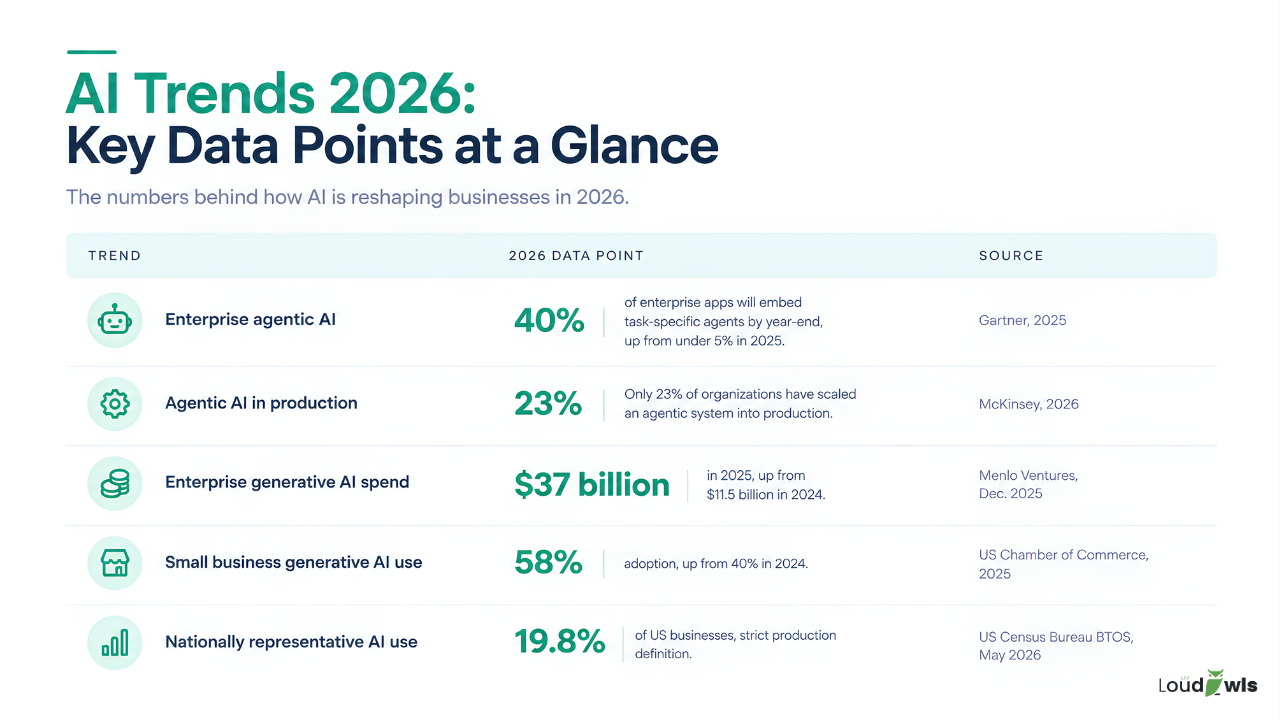
These AI trend numbers tell a consistent story: stated interest in AI is high, but verified, production-grade use is much lower. That gap is exactly where a scoped pilot with an experienced vendor outperforms an unmanaged internal experiment run by a small team without dedicated AI expertise.
How Much Does AI Development Cost in 2026?
Cost is usually the real question behind the trend talk. It splits into three tiers for a US business, and picking the wrong one is the most common way an AI budget gets wasted.
- Off-the-shelf tools. Monthly per-seat licenses for AI features bolted onto existing software. This is the cheapest entry point but the most limited option available, and it rarely fits a workflow the vendor did not already template for a generic use case.
- Custom-built AI features. A scoped agent or generative workflow built into your existing product or internal systems. Cost depends on data complexity and the number of integrations required. A well-scoped pilot is usually a fixed-cost engagement measured in weeks, not an open-ended monthly retainer with no clear end date.
- Full agentic platforms. End-to-end systems handling a whole function, like claims intake or lead qualification, from start to finish. These cost the most upfront but carry the highest ROI when the underlying workflow is high-volume and repetitive enough to justify it.
The strongest returns tend to go to businesses that match the tier to a workflow already costing real staff hours today, then prove out that one workflow before touching a second, rather than to whoever spends the most upfront.

AI Trends Across Different Industries
The AI technology trends above play out differently by sector:
- Retail and e-commerce: dynamic pricing and demand forecasting that adjusts in real time as inventory shifts.
- Healthcare: administrative automation and clinical documentation support, with careful compliance review before any deployment.
- Financial services: fraud detection and automated underwriting alongside conversational support for routine account questions.
- Real estate: lead qualification bots and document processing that speeds up closings.
- Manufacturing: predictive maintenance and quality inspection powered by computer vision.
- Logistics: dynamic route planning and rolling demand forecasts that adjust to weather and traffic conditions.
- Legal services: contract review and first-pass due diligence that used to consume junior associate hours.
- Education: adaptive learning platforms that pace content to an individual student's progress.
- Hospitality: dynamic pricing for rooms and AI concierge tools that handle booking changes without a call to the front desk.
The direction stays consistent across every sector: routine, data-heavy tasks move to AI first, while judgment-heavy decisions stay with people.
How to Implement AI in Your Business
A scoped AI project follows a predictable process, whether it is an agent, a generative workflow, or a predictive model.
- Workflow audit. Identify the single process costing the most staff hours today, not the one generating the most buzz internally.
- Data readiness check. Confirm the data behind that workflow is clean, structured, and accessible enough to train or connect a model to it.
- Scoped pilot build. Build a narrow version handling one task end to end, with a human checkpoint built in for anything high-stakes.
- Testing against real cases. Run the pilot against actual historical requests pulled from real records, not synthetic test data, before it touches a live customer.
- Staged rollout. Expand from one team or one workflow segment to the full department once the pilot has held up under real conditions.
- Monitoring and handoff. Set up an audit trail and a clear ownership plan, so the system stays accountable well after launch day.
Skipping the data readiness check is the single most common reason a pilot stalls before it reaches production, according to the adoption gap in the McKinsey figures above.
How Businesses Can Turn AI Trends Into Action
LoudOwls builds AI-powered mobile and software solutions for US startups and enterprise clients across real estate, healthcare, and e-commerce. The team scopes each engagement around one workflow first, not a general AI strategy, which keeps costs predictable and timelines short from the first conversation.
This approach lines up with what the 2026 data shows: verified production use is still low across the country, and the AI technology trends outlined above all point to the same gap between stated interest and production-grade delivery. The businesses pulling ahead are the ones executing one high-value workflow well before expanding into a second or third.
Working with a dedicated team also closes the gap between the 79% of businesses that say they have adopted AI agents and the far smaller share that run one in production, since a scoped pilot with clear success criteria is what gets a project across that line.
For a US business weighing an in-house build against a specialist team, the deciding factor is usually speed to a working pilot. An internal team without dedicated AI experience often spends its first few months on tooling and data clean-up alone, while a team that has already shipped similar projects can move straight into the build.
Where AI Trends Are Headed Next
Looking past this year, the emerging AI trends worth tracking are less about newer models and more about governance and infrastructure. Expect more businesses to publish AI usage policies as regulation around automated decision-making increases.
Executives are also growing more cautious about depending on a single cloud provider or region for AI workloads. An outage or policy change in one place can stall operations everywhere, so expect more businesses to diversify providers.
Workforce reskilling follows the same pattern as the human-in-the-loop teams described earlier: roles built entirely around manual lookups are shrinking, while roles built around reviewing and directing AI output are growing. Energy use is entering the cost conversation too, as running large models at scale carries a real power cost, and US businesses evaluating vendors are starting to ask about efficiency alongside accuracy as a genuine line item in total cost of ownership, not a footnote.
FAQs About AI Trends in 2026
- What are the top AI trends 2026 is bringing to US business?
Three shifts stand out among the latest AI trends: agentic AI running in production, generative AI managed as a shared company tool, and predictive analytics that updates in near real time.
- Is agentic AI different from a regular chatbot?
Yes. A chatbot answers a question, while an agent plans and executes a sequence of actions, checks its own results, and escalates only when something falls outside its scope.
- How much does a custom AI pilot typically cost?
It depends on data complexity and the number of integrations involved. A scoped pilot is usually fixed-cost and measured in weeks, not an open-ended retainer. Off-the-shelf tools cost less upfront but rarely fit an unusual workflow well.
- Do small and mid-sized US businesses need to keep up with all of this?
Selectively. The businesses gaining ground pick one or two high-volume, repetitive workflows and automate those well before expanding further, rather than adopting every new tool at once and spreading their team thin.
- Where should a US business start if it has not adopted AI yet?
Map the workflow that costs the most staff hours today. Scope a narrow pilot around that single process, then measure the result against a clear metric before expanding into a second workflow or department.
Key Takeaways: AI Trends 2026
The AI trends 2026 conversation keeps circling back to one point, and it's the same throughline running through every artificial intelligence trends report published this year: the businesses pulling ahead are not the ones with the most AI tools. They are the ones that picked the right workflow, scoped it well, and measured the result before scaling.